| New Reply |
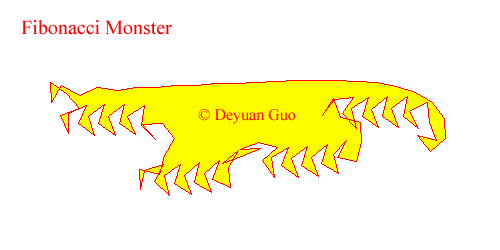
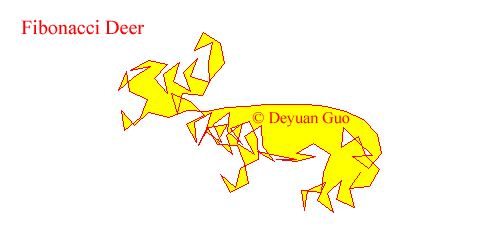
I captured an ancient Fibonacci Monster |
Share Thread |
| Jan31-13, 10:56 PM | #1 |
| Feb1-13, 12:22 AM | #2 |
|
Recognitions:
|
|
| Feb1-13, 12:50 AM | #3 |
|
|
|
| Feb1-13, 01:04 AM | #4 |
|
|
I captured an ancient Fibonacci Monster
This reminds me of singular value decomposition. It's a pretty common phenomena related to efficiency in the transmission of digital image pixels (satellite, fax, internet, etc.) and our ability to interpret them where blurry images become sharper and vice versa. By keeping all the "boring" parts out of the transmission close approximations can be found by reducing singular values and corresponding vector values, which, in turn, represents substantial savings in comprehensible data transmission! For example,
[tex]A = σ_1u^T_1+...+ σ_r u_r v^T_r[/tex] Let [itex]k≤r[/itex] and define [tex]A_k=σ_1u_1v^T_1+...+σ_ku_kv^T_k[/tex] [itex]A_k[/itex] is an approximation to [itex]A[/itex] that corresponds to keeping only the fist [itex]_k[/itex] singular values and the corresponding singular vectors in an [itex]nXn[/itex] pixelated image within some arbitrary [itex]\mathbb{R}^n[/itex]. |
| Feb1-13, 01:24 AM | #5 |
|
|
Andrew B. Watson may be of interest to anyone with the topic at hand:
http://humanfactors.arc.nasa.gov/org...ersonnel_id=62 http://vision.arc.nasa.gov/personnel/watson/watson.html Nasa journals concerning psychophysical research: http://naca.larc.nasa.gov/search.jsp...4089%26No%3D10 |
| Feb1-13, 01:46 AM | #6 |
|
|
In my opinion, I can describe this procedure like this: Start from the origin of Cartesian coordinate system: x(0) = 0 y(0) = 0 Then go to next point by forward L length and θ angle: x(n) = x(n-1) + L*cosθ y(n) = y(n-1) - L*sinθ here θ = F(n) / 180 * PI F(n) is the Nth number of Fibonacci sequence. I don't know why it becomes an closed curve and why it looks like this.. |
| Feb1-13, 02:11 AM | #7 |
|
|
|
| Feb1-13, 02:31 AM | #8 |
|
|
Perhaps the explanation is like this: Why: Ʃ(sin(F(i)/180*PI)) = 0 Ʃ(cos(F(i)/180*PI)) = 0 i = 0 to 119 F(i) is the ith number in Fibonacci sequence. I'm not able to prove these equations, I just happened to find these facts... |
| Feb1-13, 04:48 AM | #9 |
|
|
It amounts to saying that[tex]\sum_{i=1}^M \langle r, (s_i \mbox{ mod } 360) \rangle = {\bf 0}[/tex]for some integer M, where <r,a> is notation for a two dimensional vector in polar coordinates (a vector with magnitude "r", the 20 in the Python programs, and direction "a" degrees), and [itex]s_i[/itex] is some integer sequence, Fibonacci or otherwise. Notice that a (non-zero) constant sequence will satisfy the statement above, drawing regular polygons: for example, the constant sequence {90,90,90,90,...} will draw a square, and the sequence {1,1,1,1,...} will draw the 360-sided regular polygon. Similarly, consider a periodic sequence with period P; that is, a sequence where the numbers repeat every P numbers. Take, for example, the sequence {11,22,33,11,22,33,...} where the numbers 11,22,33 repeat indefinitely. Let the vector <R,A> (again in polar form: a vector with magnitude R and direction A, with A in degrees for our purposes) be the sum of the P vectors with angles taken from the period: the sum of <20,11>, <20,22>, <20,33> in this example. In the long run, the drawing with the periodic sequence will go to the same place as the drawing of the constant sequence {A,A,A,A,...}, using a vector magnitude of r=R (instead of 20) in the statement above. Thus, a closed curve (as long as the angle sum A is non-zero modulo 360). In summary, the figure will be closed if the Fibonacci sequence (or the other one) modulo 360 is periodic (as long as the period adds up to a non-zero number). The fact that these Fibonacci-like recurrence sequences are periodic modulo some number is not hard to prove; see the first few lines near the beginning of http://www.math.temple.edu/~renault/fibonacci/fib.html specifically, paragraph A.2. The part of the sum of the period being non-zero was just luck; for example, starting with 0,180 (instead of 1,1 or 1,5) would have not produced a closed curve. |
| Feb1-13, 05:44 AM | #10 |
|
|
P.S.:
There are a few loose ends in my argument above.
And by the way, DeyuanGuo... a very funny subject it is, congratulations. :) |
| Feb1-13, 06:35 AM | #11 |
|
|
I found these patterns are interesting. For example, if it starts from (j=1, k=7), then it will not be a closed curve. I think there are a lot of things I can learn from you. Could you please contact with me through my email: guodeyuan at gmail dot com? |
| Feb1-13, 07:35 AM | #12 |
|
|
I think the monsters are influenced by integer overflow, Try to see what happens if you use i = (j+k) % 360 to keep i and j small.
|
| Feb1-13, 08:02 AM | #13 |
|
|
The Python language supports the long integer type, and it can only overflow after the computer memory exhausted. |
| Feb1-13, 01:32 PM | #14 |
|
|
Interesting. I implemented it in Mathcad (using modulo arithmetic) and it seems as though initializing to (j k) results in a different patterns all of period of 120 except for the following (easily predicted) values, which move linearly ...
j - k ...... 1 - 2 7 12 17 2 - 4 9 14 19 3 - 6 11 16 21 4 - 8 13 18 23 5 - 10 15 20 25 (that is, start with j then choose a value from the various k values in that row, eg(j k) = (2 9) or (2 14)) |
| Feb1-13, 07:07 PM | #15 |
|
|
Another thing to look at is dividing the circle into n parts (rather than just 360 (degrees)) ... not all such n result in spatially cyclic sequences.
|
| Feb2-13, 12:02 AM | #16 |
|
|
These non-closed curves, or the linearly-moving pairs as you say, appear evenly and periodically in the 2-D plane: Code:
j\k 0 1 2 3 4 5 6 7 8 9 10 ... 0 N N N 1 N N 2 N N 3 N N 4 N N 5 N N 6 N N ... |
| New Reply |
| Tags |
| fibonacci |
Similar Threads for: I captured an ancient Fibonacci Monster
|
||||
| Thread | Forum | Replies | ||
| Captured US Soldier | Current Events | 44 | ||
| Solar eclipse captured!! | General Physics | 1 | ||
| When does the photon get captured? | General Physics | 1 | ||
| Saddam was captured by Kurds, not US | Current Events | 2 | ||
| Saddam Captured! | Current Events | 48 | ||