Can Circuit Component Order Affect Electrical Outcomes?

  • Context: High School 
  • Thread starter Thread starter ninjadrummer8
  • Start date Start date
  • Tags Tags
    Circuit
Click For Summary

Discussion Overview

The discussion revolves around the effects of circuit component order on electrical outcomes, specifically in series circuits involving resistors and capacitors. Participants explore theoretical implications and practical considerations of rearranging components and adding additional connections.

Discussion Character

  • Exploratory
  • Technical explanation
  • Debate/contested

Main Points Raised

  • One participant questions whether a series arrangement of resistors and capacitors can be treated as if the resistors and capacitors were grouped together, suggesting that the current through linear elements remains the same regardless of their order.
  • Another participant indicates that while linear components can be rearranged without affecting the overall current, adding an extra wire to the circuit could change its behavior, potentially creating a short circuit.
  • A later reply introduces the complexity of nonlinear devices, such as diodes, and questions whether their order in a series configuration affects the circuit's operation, noting that while a simple model may suggest equivalence, nuances in the IV curve could lead to different outcomes.
  • Some participants assert that all components in a series circuit see the same instantaneous current, implying that their position may not matter for linear components.

Areas of Agreement / Disagreement

Participants generally agree that linear components can be rearranged without affecting current, but there is disagreement regarding the implications of adding a wire and the behavior of nonlinear components, which remains unresolved.

Contextual Notes

Participants express uncertainty regarding the effects of adding components and the behavior of nonlinear devices, highlighting the need for further analysis of specific circuit configurations.

ninjadrummer8
Messages
24
Reaction score
0
Hey guys, I'm just trying to fully understand all these Circuit diagrams and stuff. If you can help me with these two questions I'd appreciate it, I thought about them while reading through my book. Sorry about the quality of pictures, I drew them in paint.

Question 1:
If I have a resistor, capacitor, resistor, capacitor in series like this picture below, even though they alternate, could I still look at them as if the 2 resistors were next to each other and the 2 capacitors were next to each other?
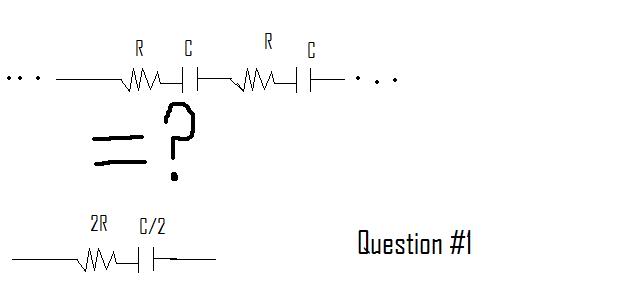
q1.jpg


Question 2:
If I added an extra wire to the first circuit, would it still yield the same results? I'm assuming it would but I just want to make sure.
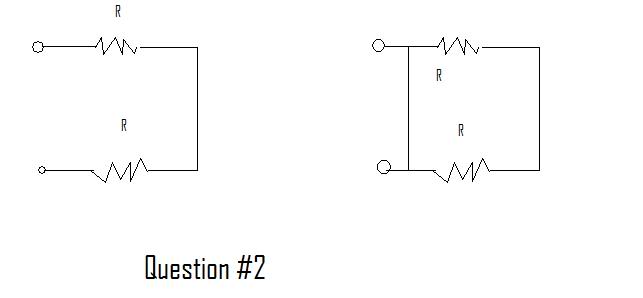
q2.jpg


Thank's for your help!
 
Physics news on Phys.org
Let me pull a 'clippit' and say "It looks like you are trying to do two-port models."

Q1: Technically the two devices are not the same, but if what you are trying to do is build a 2-port device that "acts" the same way as your R-C-R-C combination, then it seems that you are on the right track.

That is, the R-C-R-C combination with the two wires hanging off the sides acts the same way as your equivalent 2R-C/2 system when all you do is look at the circuit from the outside.

In general: You can move linear circuit elements on the same branch around when analyzing the circuit, since the current through them would be the same, so long as you don't care about the node voltages between the elements, and there are no connections that come in between the elements.

Q2: Here we have a problem. The circuit on the left acts like a resistor with series resistance 2R. The circuit on the right acts like a short circuit. To see why this is the case, try replacing that added wire with a resistor, say [tex]\tilde{R}[/tex], and let [tex]\tilde{R} \rightarrow 0[/tex].

-------------
Actually Q1 brings up an interesting dilemma. If you get two nonlinear devices, like diodes, and hook them up in series, would the circuit operate the same way (2-port wise) as if you interchange them, keeping the polarity constant? It seems that from a first analysis using a simple model it would, but putting in all the nuances in the IV curve, something fishy might happen.

That is, suppose two diodes are connected cathode-to-cathode like this -->|--|<--

How would the most honest physical 2-port model change when you reverse them to be like this --|<-->|--?
 
Q1: yes, because all the components see the same instantaneous current.

Q2; no, you've shorted it out! It wasn't a short before you added that wire.

zprog: Consider that any non-linear series components will still always see the same instantaneous current, so their position in the series circuit is moot.
 
I didnt even think about it being shorted out, but you're right. Thanks for your help both of you!
 

Similar threads

  • · Replies 4 ·
Replies
4
Views
3K
  • · Replies 38 ·
2
Replies
38
Views
7K
Replies
152
Views
8K
  • · Replies 3 ·
Replies
3
Views
2K
  • · Replies 36 ·
2
Replies
36
Views
7K
  • · Replies 6 ·
Replies
6
Views
804
  • · Replies 5 ·
Replies
5
Views
2K
  • · Replies 17 ·
Replies
17
Views
3K
  • · Replies 4 ·
Replies
4
Views
2K
  • · Replies 1 ·
Replies
1
Views
3K