| Thread Closed |
How can I ignite these three rocket igniters? |
Share Thread |
| Jul18-09, 01:45 PM | #1 |
|
|
How can I ignite these three rocket igniters?
First off, let me say that what I am working on has taken me a few days to get to work and I just cant figure it out. It is really frustrating so any help is really appreciated.
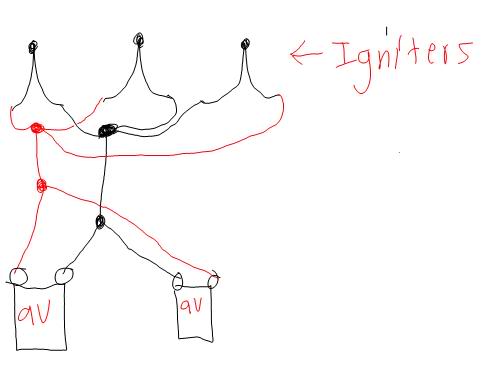
I have three igniters. They are connected to a circuit. Once a switch is turned to "on" the three igniters are supposed to ignite. This is the diagram ![]() I am using two nine volt batteries each charged at 9.50 volts. Now, if I remove the igniters from the diagram and test the voltage of each side of the wire, the voltage reads about 9.50 volts at all locations. Now, when I attach the igniters to these wires, and to a test ignition, only one of the igniters ignite. the batteries are connected in parallel, and the igniters are connected in parallel also. |
| Jul18-09, 01:46 PM | #2 |
|
Recognitions:
|
I thought your batteries were to be in series, for a nominal 18 V.
|
| Jul18-09, 01:52 PM | #3 |
|
|
They were in series but then I removed them in parallel. This is because when I tested the circuit with the batteries in parallel only one igniter ignited.
Also, as takled about in my previous post, the voltages near the igniters were rapidly jumping from one voltage to another. I found out this is because of the clips I was using. Apparantly, they cant be used in this sort of project. |
| Jul18-09, 01:58 PM | #4 |
|
Recognitions:
|
How can I ignite these three rocket igniters?
Try using something other than 9 V batteries. Those small rectangular batteries have a very high internal resistance and cannot supply a large current--typically less than an amp, because they are comprised of 6 smaller 1.5 V cells (usually AAAA-size) in series. I would suggest a small 12 V lead-acid gel cell, such as used for alarm systems, UPS units and emergency lighting since these have a much smaller internal resistance and can supply several tens of amps easily.
|
| Jul18-09, 02:20 PM | #5 |
|
|
Ok now where can I buy this item? It needs to be inside of my rocket which means that it neeeds to be light.
|
| Jul18-09, 02:22 PM | #6 |
|
|
Ok. Now I need to buy this item from radio shack because that is the only hardware store in my area. The problem is that I cannot find this item that they sell.
|
| Jul18-09, 02:28 PM | #7 |
|
Recognitions:
|
I thought the battery was 200 feet away?
|
| Jul18-09, 02:35 PM | #8 |
|
|
No. That is a different circuit. i already figured out how to launch the rocket frmo 200 feet away using one car battery. Once the rocket is in the sky, another circuit will be turned to on which will ignite a different part of the rocket in the sky.
That is what I am trying to figure out. I am trying to figure out how to launch these three igniters. Thanks |
| Jul18-09, 02:38 PM | #9 |
|
Recognitions:
|
Ahh. In that case, use lithium cells. They are very light and can source a lot of current.
|
| Jul18-09, 02:52 PM | #10 |
|
|
Ok. I looked into these batteries. It appears that their voltages are about 3 volts. I have found that the igniters need atleast 9 volts to ignite. I have found this through trial and error. Do you think we will definitly be able to know what batteries my circuit needs if we had detailed information about the voltage and amperage required to ignite the igniters?
It seems like getting those batteries will just lead to more trial and error. |
| Jul18-09, 03:15 PM | #11 |
|
|
Also, I would suggest putting the ignighters in series. This would ensure that they all light and at the same time.
Also, Unless I'm mistaken, I believe you can buy model rocket motors with an ejection charge that also lights the next stage. |
| Jul18-09, 03:18 PM | #12 |
|
|
I understand that the ejection charge can do that but the ejection charge in this design is beign used for other applications. Therefore, I need to use a battery to ignite tthe followign stage.
Why exactly does putting the batteries in series ensure that they all light at the same time? |
| Jul18-09, 03:21 PM | #13 |
|
|
Not only the batteries, but put the ingighters in series. Actually, I'm rethinking that now.
|
| Jul18-09, 03:28 PM | #14 |
|
Recognitions:
|
|
| Jul18-09, 03:35 PM | #15 |
|
|
You do want the batteries in series though. Double the voltage, double the curent. v=ir i = v/r |
| Jul18-09, 03:37 PM | #16 |
|
Recognitions:
|
|
| Jul18-09, 11:01 PM | #17 |
|
|
Ok. Now you are saying that I should put these two 9 volt batteries in series? Also, after looking through my notes, I found that if I have two batteries charged at 10 volts in parallel in the circuit, then all igniters ignite simultaneously.
Now, if I were to use these lithium cells, it appears that the voltage will be three volts which my understanding shows is just too low. The only problem is I cannot charge my batteries up to 10 volts and have them stay at that voltage. Any ideas? |
| Thread Closed |
Similar discussions for: How can I ignite these three rocket igniters?
|
||||
| Thread | Forum | Replies | ||
| If my rocket has two rocket engines going off each at an impulse at 20.00 N/S..... | General Physics | 3 | ||
| The Multiple Launch Rocket System and Rocket Noises | General Physics | 1 | ||
| Rocket car | General Discussion | 6 | ||
| bolt falls off rocket, find rocket acceleration | Introductory Physics Homework | 3 | ||
| rocket | Introductory Physics Homework | 1 | ||