| Thread Closed |
Simple Harmonic Motion - Find the velocity of a bullet entering a spring/block system |
Share Thread |
| Aug3-09, 03:51 PM | #1 |
|
|
Simple Harmonic Motion - Find the velocity of a bullet entering a spring/block system
Hi! Could someone please check if my following problems are correct? Any insight on why a problem is incorrect would be appreciated. Thanks!
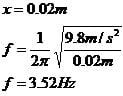
1) An object is hung from a light vertical helical spring that subsequently stretches 2.0 cm. The body is then displaced and set in SHM. Compute the frequency at which it oscillates. ![]() 2) A 5.0-g bullet is fired horizontally into a 0.5-kg block of wood resting on a frictionless table. The block, which is attached to a horizontal spring, retains the bullet and moves forward, compressing the spring. The block-spring system goes into SHM with a frequency of 9.0 Hz and an amplitude of 15 cm. Determine the initial speed of the bullet ![]()
|
| Aug3-09, 04:08 PM | #2 |
|
Mentor
|
Hello antiderivativ, welcome to PF.
For the second problem, shouldn't you be using the combined mass (block + bullet) in your calculation of k? After all, *that* is what is oscillating at 9.0 Hz (the combined object). In contrast, for your calculation of the initial speed, all of the kinetic energy that is converted into elastic potential energy is from the bullet. So why are you using the combined mass here? |
| Aug3-09, 04:16 PM | #3 |
|
|
1) The formula that you use is for a simple pendulum. Here you have a spring-mass system.
2) Start by assuming that the block does not start to move until the bullet is fully embedded in it, i.e. it has stopped moving relative to the block. Can you find the speed of the block? (Hint: What is conserved? It's not energy because a lot of friction is needed to stop the bullet.) That's the initial speed that you must use in your energy conservation equation. |
| Aug3-09, 04:46 PM | #4 |
|
|
Simple Harmonic Motion - Find the velocity of a bullet entering a spring/block system
I'm still working on number two. For that I'm guessing I can take the equation I have, but just consider that the block and the bullet each have their own velocities. I'll try it and post it again.
As for number one, here is all my work that I didn't include the first time to help you see I'm not trying to use the pendulum equation.
|
| Aug3-09, 04:51 PM | #5 |
|
|
This seems to be correct.
|
| Aug3-09, 04:55 PM | #6 |
|
|
Your work for number 1 is still incorrect. If you read through this thread, it might help illuminate some of your misunderstandings: http://www.physicsforums.com/showthread.php?t=321959
|
| Aug3-09, 05:19 PM | #7 |
|
|
Fs = k xeq where xeq is the amount by which the spring is stretched from its unstretched position. There is a downward force mg. Because the system is at rest, the two forces have equal magnitudes. Therefore, mg = k xeq from which we get k = mg/xeq. If we substitute this in the equation for the frequency of the system, we get [tex]f = \frac{1}{2\pi} \sqrt{g/x_{eq}}.[/tex] |
| Aug3-09, 05:22 PM | #8 |
|
|
Oops . . .
I guess I should probably read more thoroughly next time. Thanks for cathcing that.
|
| Aug3-09, 05:53 PM | #9 |
|
|
For Problem #1
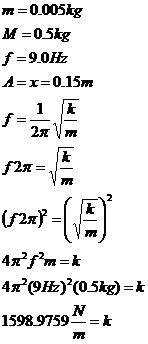
Hooray! Thanks kuruman for checking. I have 18 problems to work on and now I feel confident about at least 1! For Problem #2: Thanks for the tip cepheid. Here is my new k. ![]() I’m saying that v is the initial velocity of the bullet while V is the initial velocity of the block. If my second equation is correct I should be able to solve for the initial velocity of the bullet, for v. However, I got that the initial velocity of the bullet was 0.1031 m/s. I know that is incorrect. How can I find the correct equation???? Is my initial velocity for the block at least correct????
|
| Aug3-09, 07:29 PM | #10 |
|
|
I'm STILL on this problem. I didn't think I'd get stuck on the simple harmonic stuff. I have much more difficult problems to try after I get this one.
I know I'll need the conservation of momentum: mv=(m+M)v' where v' is after the impact. I think this because the block and bullet become one object. Am I thinking incorrectly? I tried making the assumption that v' is the answer I got in the last equation. However I'm told that the block's initial velocity is at rest so is V really 0? I want to believe the answer I obtained the my last post is useful somehow, so I don't want to believe V is 0. I want to believe v' = V so I can have this. Is it right? ![]() |
| Aug3-09, 07:38 PM | #11 |
|
|
Also, on another note, is anyone having problems seeing my pictures? I've had a picture in every post, so if you can't see it, let me know. If you don't see pictures in my posts please tell me, so I can stop doing that. I prefer doing it because I like using my equation editor, but if the physics masters can't see it, then it is not helping me at all!
|
| Aug3-09, 07:40 PM | #12 |
|
Mentor
|
See also kuruman's post #3. |
| Aug3-09, 08:00 PM | #13 |
|
|
My 10th post shows I know I need to apply the conservation of momentum formula and I tried to do so in that post. Since no comment was made on the work I showed, I have to consider that everything I did may not be right.
Looking at Kuruman's 3rd post, I think that maybe I should say that the intitial velocity of the block is 0. Is that true? (Y/N/Maybe or you're not going to tell me?? it must be a trade secret)If that's true, then according to the formula I have available that no one has told me is incorrect. mv=MV+mv' mv=mv' mv' -- = v m However I know this is wrong because the answer is too small. This leads me to finally conclude that the last two posts I made aren't right. Then kuruman asks if I can find the speed of the block. You know I've tried that and my response to that is shown in my 9th post, too. Did I say anything that needs clarification? I've been working on this one problem for over 5 hours and as a result I feel horrible for not knowing why or if I am misunderstanding the mv=MV+mv' equation. I know I've asked this once in the thread already, but it's still the same question that is bothering me. Is v and V the initial velocities of the bullet and the block respectively? Is v' the velocity after impact? Do I have to find v' first by using an equation with energy as you stated? This is only good for me if v' is the velocity after impact! As you can see my logic is completely convulted and I don't have any idea. Well, if v' is the velocity after impact and I need an energy equation then I'll find one somewhere I guess. I'll be right back in less than an hour and try some more until I get it, but I'm just so confused and I can tell that my arguements are becoming exceedingly circular. |
| Aug4-09, 08:34 AM | #14 |
|
|
mv = (m + M) v' This v' is the initial speed of the (block + bullet) system when it starts oscillating as a spring-mass sytem. I am sure this will fix quite a few issues. |
| Aug4-09, 01:55 PM | #15 |
|
|
First part
The bullet travels at a speed v. It has KE. E = .5K(A^2) E = .5(1614.8646)(0.15^2) KE = E = 18.1672 J Second Part The bullet hits the bock and moves the spring. The energy is no longer in the bullet as KE, but as spring energy. That's why KE = E. This is because of the law of conservation of energy. Energy initial = energy final. The energy of the bullet is transferred into the energy of the spring. KE = .5 m(v^2) v = sqrt((2*KE)/m) v = sqrt((2*18.1672J)/0.005) initial velocity of the bullet = 85.2460 m/s How's that??? I guess I didn't need the conservation of momentum formula after all???? Can someone let me know if this is right? It seems awfully slow for a bullet. |
| Aug4-09, 02:02 PM | #16 |
|
Mentor
|
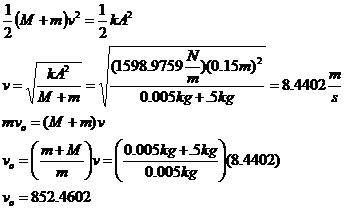
Energy is not conserved here, because this is an inelastic collision (the bullet becomes embedded in the block, and so some of its energy goes into deforming / heating / boring through the block). Here is what you have to do step by step: 1. Determine how much elastic potential energy is initially stored in the spring when it is compressed (which you have done). 2. Equate this elastic potential energy to the initial kinetic energy of the *combined block + bullet mass* just after the collision. 3. Use this result to determine the speed of the combined block + bullet mass just after the collision. 4. Use this speed, and the law of conservation of momentum to determine the initial speed of the bullet (before it struck the block). |
| Aug4-09, 02:13 PM | #17 |
|
|
When you say that the energy of the bullet before it hits the block is the same as the total energy of the harmonic oscillator after the bullet is embedded, namely
[tex]E = \frac{1}{2} kA^{2}[/tex] you are asserting that mechanical energy is conserved throughout the process. This is not true. While the bullet decelerates inside the block, some of its mechanical energy is converted into heat by the friction that stops it. However, once the bullet stops moving, mechanical energy is conserved from that point on because there is no more friction to dissipate mechanical energy as heat. After the bullet stops inside the block, the bullet+block system must move to conserve momentum. The equation to use is [tex]\frac{1}{2}(m + M)(v')^{2}=\frac{1}{2} kA^{2}[/tex] This says that the kinetic energy of the bullet+block system when the spring is initially unstretched right after the bullet has already stopped is the same as the potential energy stored in the spring at full compression. Because v' appears in this equation, you have to find it. |
| Thread Closed |
Similar discussions for: Simple Harmonic Motion - Find the velocity of a bullet entering a spring/block system
|
||||
| Thread | Forum | Replies | ||
| Simple Harmonic Motion - Spring-Pendulum-Mass System | Introductory Physics Homework | 0 | ||
| Bullet fired into wooden block. Trying to find kinetic energy of bullet and block. | Introductory Physics Homework | 1 | ||
| simple harmonic motion, spring, block on block, static friction help | Introductory Physics Homework | 4 | ||
| [SOLVED] Block- spring- bullet- harmonic motion... | Introductory Physics Homework | 13 | ||