Calc. Thermal Deflection for Alum. Sleeve & Steel Beam

  • Thread starter Thread starter Dell
  • Start date Start date
  • Tags Tags
    Thermal
Click For Summary

Discussion Overview

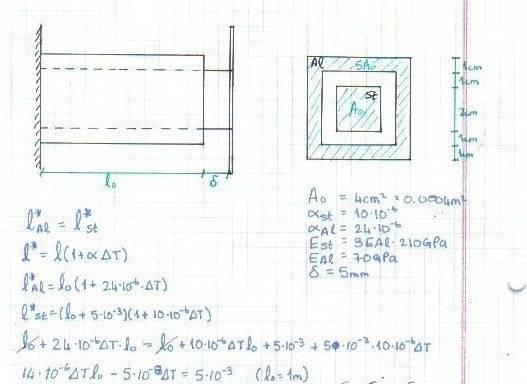
The discussion revolves around calculating the thermal deflection of an aluminum sleeve surrounding a steel beam, specifically focusing on the temperature change required to connect the sleeve to a rigid plate attached to the beam. The problem involves assumptions about material properties and the relationship between the lengths of the components.

Discussion Character

  • Technical explanation
  • Mathematical reasoning
  • Debate/contested

Main Points Raised

  • One participant presents a formula relating the lengths of the aluminum sleeve and steel beam to the change in temperature, noting that the original length of the sleeve (Lo) is not provided.
  • Another participant suggests dividing the equations to potentially simplify the problem.
  • A participant asserts that the dependence on Lo is logical, given the fixed additional length of the steel beam, and provides an example illustrating how varying Lo affects the required temperature change.
  • Another participant argues that Lo is not a given parameter and expresses the hope that it would cancel out in the calculations.
  • A further response questions the assumption that a given parameter must have a specific numeric value, suggesting that it could be treated as a variable instead.
  • One participant emphasizes that all other values in the problem were numerical, implying a preference for a numerical solution.

Areas of Agreement / Disagreement

Participants express differing views on the status of Lo as a parameter, with some asserting it is necessary for the calculations while others argue it can be treated as a variable. The discussion remains unresolved regarding the treatment of Lo and its implications for solving the problem.

Contextual Notes

The discussion highlights the uncertainty surrounding the initial length of the sleeve (Lo) and its role in the calculations, as well as the implications of treating parameters as variables versus fixed values.

Dell
Messages
555
Reaction score
0
given an aluminium sleeve with a steel beam inside as seeen in the diagram below
q1.jpg


knowing that the length of the steel beam is 5mm longer than the sleeve and that a rigid plate is connected to the end of the steel beam,

find the change in temperature needed to be able to connect the sleeve to the plate?

i base my answer on the assumption that when T=Tf

LAl=LSt

LAl=Lo(ΔT*αAl+1)
LSt=(Lo + 0.005)(ΔT*αSt+1)after comparing i find that my expression for ΔT is dependent on Lo, but Lo, the original length of the sleeve, was not given in the question

is there any way to solve this without knowing Lo?? is there a way i can find Lo?
 
Last edited:
Physics news on Phys.org
What happens if you divide the first equation with the second?
 
that is more or less what i did

but I am still going to have Lo in my equation
 
I would say it is not possible and I cannot see anything you've done wrong.

I'd say it's logical that it would depend on the initial length due to 5mm being a fixed value.

Imagine L0 being 1e-10m. An large deltaT would be required. With L0 being extremely large, the opposite would apply.

Agree?
 
Lo is a given parameter. You would, of course, solve for deltaT in terms of Lo.
 
no, Lo isn't a given parameter, i added it in the hope that it would cancel out
 
And what makes you think a given parameter must be a specific numeric value, instead of a variable? Why not solve for deltaT?
 
JUST because all the other values were numerical
 

Similar threads

  • · Replies 11 ·
Replies
11
Views
3K
Replies
5
Views
4K
  • · Replies 8 ·
Replies
8
Views
3K
Replies
9
Views
11K
  • · Replies 1 ·
Replies
1
Views
4K
  • · Replies 2 ·
Replies
2
Views
2K
  • · Replies 1 ·
Replies
1
Views
5K
Replies
5
Views
3K
Replies
4
Views
6K
Replies
20
Views
14K