Solve Friction Problem: Find Fx, Acceleration

  • Thread starter Thread starter AtlBraves
  • Start date Start date
  • Tags Tags
    Friction
Click For Summary

Homework Help Overview

The problem involves a block being pushed along a horizontal surface with a force at an angle, requiring the calculation of the frictional force and the block's acceleration. The subject area includes dynamics and friction in physics.

Discussion Character

  • Exploratory, Assumption checking, Conceptual clarification

Approaches and Questions Raised

  • Participants discuss the relationship between the applied force, frictional force, and normal force, questioning the calculations and assumptions regarding the normal force's magnitude due to the vertical component of the applied force.

Discussion Status

Some participants have provided guidance on the calculations involved, particularly regarding the normal force and its impact on the frictional force. There is an ongoing exploration of the correct values and reasoning behind the calculations, with no explicit consensus reached yet.

Contextual Notes

Participants are working under the constraints of a homework assignment, which may include specific rules about rounding and the presentation of answers. There is also a mention of discrepancies between the original poster's calculations and the expected answers from an online quiz.

AtlBraves
Messages
11
Reaction score
0
I am having trouble with this problem. I found the answer to a to be 14 N, but the online quiz says it is wrong. Fx-f=0. Fcos(theta)-f=0. f=18cos40=14 N. What am I doing wrong?

A 3.5 kg block is pushed along a horizontal floor by a force F of magnitude 18 N at an angle = 40° with the horizontal (Figure 6-20). The coefficient of kinetic friction between the block and floor is 0.25.
(a) Calculate the magnitude of the frictional force on the block from the floor.
(b) Calculate the magnitude of the block's acceleration acceleration.
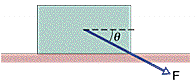
06_32.gif
 
Last edited:
Physics news on Phys.org
Welcome to PF!
In order to delete in the other forum, press the "Edit button". On top of that, there's a "Delete" option.
 
[tex]F_{x} - F_{f}[/tex] is not 0, It is moving on the x-axis.

Remember

[tex]F_{f} = \mu N[/tex]
 
For your problem:
Note that the NORMAL force acting on the block must be GREATER than the weight, due the vertical component of F.
Hence, the frictional force is also greater..
 
So if [tex]F_{f} = \mu N,[/tex] then [tex]F_{f} = \mu * (mg+18sin40) = .25 * ((3.5*9.8)+18sin40) = 12 N?[/tex]
 
That looks correct, yes.
(Do you understand, to your own satisfaction, why you need that addition to the weight?)
I haven't checked your numbers, though..
 
Oops. I mistyped. The correct answer is 11 N I'm hoping. Yes I do now see why the normal force is greater than the weight. Thanks for all of the help.
 
Perhaps you shouldn't round down to an integer answer.
 

Similar threads

  • · Replies 6 ·
Replies
6
Views
2K
Replies
13
Views
4K
  • · Replies 37 ·
2
Replies
37
Views
2K
Replies
6
Views
2K
  • · Replies 2 ·
Replies
2
Views
2K
  • · Replies 6 ·
Replies
6
Views
2K
Replies
2
Views
1K
  • · Replies 7 ·
Replies
7
Views
2K
Replies
61
Views
4K
  • · Replies 42 ·
2
Replies
42
Views
5K