| New Reply |
Economic and Fiscal Consequences of Financial Crises |
Share Thread |
| Aug10-11, 02:44 PM | #1 |
|
|
Economic and Fiscal Consequences of Financial Crises
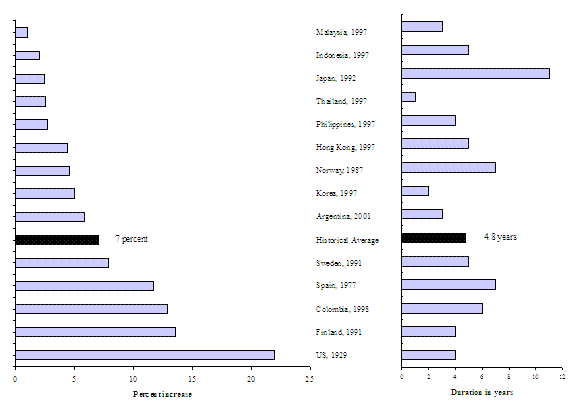
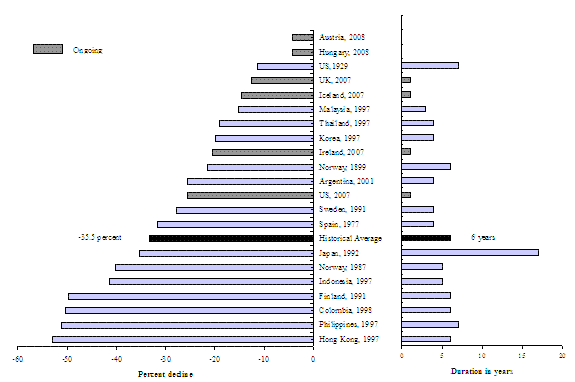
Carmen Reinhart and Ken Rogoff did a landmark empirical study in 2008 of past financial crises and found the following, which has proved to be prescient in regards to our current situation:
http://www.voxeu.org/index.php?q=node/2877 Figure 2. Past unemployment cycles and banking crises: Trough-to-peak percent increase in the unemployment rate (left panel) and years duration of downturn (right panel) |
| Aug10-11, 10:06 PM | #2 |
|
|
You've put a good bit of info on the table - what are your conclusions?
|
| Aug11-11, 03:11 AM | #3 |
|
|
|
| Aug11-11, 08:50 AM | #4 |
|
|
Economic and Fiscal Consequences of Financial CrisesNow what do these comparisons tell us about the current US housing market? |
| Aug11-11, 10:29 AM | #5 |
|
|
|
| Aug11-11, 11:43 AM | #6 |
|
|
I have a very specific example accordingly. In 1982 I priced a 1,500 sq ft ranch in Youngstown, OH - it was priced at $75,000 - in 2007 it sold for $82,000. During the same month in 1982, I toured a ranch house nearly identical to the OH property in Springfield VA. The VA house was priced at $100,000. I happened to drive by the VA property in late 2006/early 2007 and noticed a for sale sign - price $495,000 - it sold for about $460K. As a side note, a builder bought the VA house and demolished it to put up a "McMansion". To your point about Houston - it went boom to bust in a matter of a few short years. In 1989 we needed a physical office in Texas for our large ticket leasing company. One of our clients provided an entire floor of a downtown high rise to us. I used to fly to Houston every few weeks and sit by myself at a desk in the middle of the empty floor and make phone calls to satisfy the requirement. Our phone bill was proof of occupancy. |
| Aug14-11, 02:58 PM | #7 |
|
|
What's not clear is why the downturn from financial panics must be long. Could it be because governments inevitably interfere with markets clearing, as the US government has clearly done in our recent case (Home Affordable Modification Program, etc)?
|
| Aug14-11, 03:04 PM | #8 |
|
|
However, after thinking about it a while - my response is still - YES! |
| Aug14-11, 04:03 PM | #9 |
|
|
the basic rationale is that there is an overwhelming amount of debt that must be worked off. This differs from cyclical recessions which are more about inventory cycles
More depth in this paper by Reinhart & Ken Rogoff http://www.economics.harvard.edu/fil..._Aftermath.pdf and in their book http://www.amazon.com/This-Time-Diff...3355616&sr=1-1 |
| Aug14-11, 04:44 PM | #10 |
|
|
|
| Aug14-11, 05:38 PM | #11 |
|
|
|
| Aug15-11, 04:30 AM | #12 |
|
|
The overriding problem during periods of fiscal crisis is asset deflation. Given that prices are falling, there is no incentive for consumers to buy. Rightly, they respond to the expectation that an asset will be cheaper tomorrow by deferring purchases. On the other hand, producers (or asset holders) have an incentive to sell. Rightly, they respond to the expectation that their asset is depreciating by trying to get rid of it as quickly as possible. This makes the supply problem worse, and creates a repeating cyclical downturn. Absent any public intervention, there is every theoretical and empirical reason to expect the downturns to be long and dramatic (though it is not the case that given intervention the downturns necessarily won't be). Government can act, in an advertised short-run, to either encourage the purchase or delay the sale of the depreciating asset as a mechanism for stabilizing the price. The long-run price trend is unchanged, but instead of a dramatic fall today followed by a dramatic rise tomorrow, we get a relatively stable transitory period as planned future consumption is moved forward. There is some evidence that this worked with the automobile market, and some evidence that is has thus far failed in the housing market. The latter is more likely due to the problems scale being greater than the states effort, rather than a principled failure of the concept. This returns us to my previous point: the state has an interest in assisting the debt market with deleveraging by offering to buy up the "troubled assets". Granted, this must be balanced against the moral hazard such an occupation creates. |
| Aug15-11, 11:11 AM | #13 |
|
|
*Interestingly I don't see the S&L scandal mentioned by Reinhart and Rogoff. Maybe that's a flaw in their work in that they look only full blown financial crises at the national level, and not at financial crises that were contained before they became epidemic. |
| Aug15-11, 11:25 AM | #14 |
|
|
|
| Aug15-11, 12:57 PM | #15 |
|
|
If a company has a bad debt on the books they have 2 basic options. They can either dispose of the account- write off/liquidate, or keep the account - renegotiate/extend terms. If they write it off and/or sell the debt to another party, it will have an immediate impact on the financial statement. If they re-negotiate, it stays on the books - continues to be a risk - but MIGHT generate a higher return than selling at a loss. It might also be possible to renegotiate - then sell the account to achieve a better return. An involvement of the Government in this process would certainly complicate the decision making.
|
| Aug15-11, 01:25 PM | #16 |
|
|
I should add what is missing in the debt discussion is the banking system. What defines a systemic financial crisis is that losses on bad debts render the banking system insolvent. In the days before deposit insurance (like the 1870s or the Great Depression) that mean individual savings were wiped out in bank failures. In modern economies that means public funds are used to prop up the system. In either case, the volume of distressed assets dwarfs the potential market for them and the paradox of thrift comes into play - i.e. everyone cannot sell assets and deleverage at once without starting a deflationary spiral -Debt liquidations depress asset prices, the declining asset prices in turn render formerly solvent firm insolvent which then liquidate, etc. The other effect of this destruction of credit is that the money supply contracts.
The 1980s S&L crisis by this definition was not a systemic financial crises because it was regional and the banking system in aggregate remained solvent. Irving Fisher, the Yale economist (unjustly remembered by the public only for his remark about the stock market in 1929 being on a permanently high plateau) probably identified these dynamics first in his 1933 book: |
| Sep21-11, 04:09 AM | #17 |
|
|
Compared with 1929 US House price losses almost doubled while unemployment almost halved.
|
| New Reply |
Similar discussions for: Economic and Fiscal Consequences of Financial Crises
|
||||
| Thread | Forum | Replies | ||
| Low interest rates: the original fiscal stimulus | Social Sciences | 15 | ||
| Best economic indicators for the economic health of a country? | Social Sciences | 14 | ||
| Tax cuts to end fiscal stimulus: a fallacious opposition? | Social Sciences | 18 | ||
| Financial Math - For people who need help with Financial math related problems. | General Math | 7 | ||
| In the middle of two crises | Current Events | 29 | ||