New Reply

Complex Numbers - Forms and Parts

 
Share Thread Thread Tools
Feb11-12, 05:20 PM   #1
 

Complex Numbers - Forms and Parts


Hi, I have a complex number and understand that the rectangular form of the number is represented by

s = σ + jω, where σ is the real part and jω is imaginary.

I am having trouble locating them in the number below:
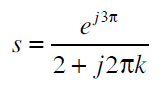
http://i44.tinypic.com/20koboi.png

I know that "2" is a real number, and the numerator is imaginary along with j*2*pi*k. Since the numerator is dividing both the elements at the bottom, does this number have a real and imaginary part? (This is where I am a little confused).

My guess would be that σ = 2 and the rest is imaginary.

If I could figure out what parts are real and imaginary, I can go on to find the rectangular form and the polar form.

Thanks
PhysOrg.com
PhysOrg
science news on PhysOrg.com

>> Bird's playlist could signal mental strengths and weaknesses
>> Minus environment, patterns still emerge: Computational study tracks E. coli cells' regulatory mechanisms
>> Bacterium uses natural 'thermometer' to trigger diarrheal disease, scientists find
Feb11-12, 07:08 PM   #2
 
Quote by dotNet View Post
Hi, I have a complex number and understand that the rectangular form of the number is represented by

s = σ + jω, where σ is the real part and jω is imaginary.

I am having trouble locating them in the number below:
http://i44.tinypic.com/20koboi.png

I know that "2" is a real number, and the numerator is imaginary along with j*2*pi*k. Since the numerator is dividing both the elements at the bottom, does this number have a real and imaginary part? (This is where I am a little confused).

My guess would be that σ = 2 and the rest is imaginary.

If I could figure out what parts are real and imaginary, I can go on to find the rectangular form and the polar form.

Thanks
Euler's relation e^ix = cos(x) + i*sin(x) vastly simplifies the exponential in the numerator. Cos and sin have period 2pi so the numerator is -1. Then multiply numerator and denominator by the conjugate of the denominator (assuming k is real). That leaves you with a real number in the denominator and a complex number in the numerator whose real and imaginary parts can be readily evaluated.

By the way, multiplying numerator and denominator by the conjugate of the denominator is the standard thing to do with this kind of problem.
Feb12-12, 07:58 AM   #3
 
Recognitions:
Gold Membership Gold Member
Science Advisor Science Advisor
Retired Staff Staff Emeritus
Quote by dotNet View Post
Hi, I have a complex number and understand that the rectangular form of the number is represented by

s = σ + jω, where σ is the real part and jω is imaginary.

I am having trouble locating them in the number below:
http://i44.tinypic.com/20koboi.png

I know that "2" is a real number, and the numerator is imaginary along with j*2*pi*k.
No, the numerator is NOT imaginary. In fact it is real- it is [itex]e^{j3\pi}= cos(3\pi)+ jsin(3\pi)= -1[/itex].
Since the numerator is dividing both the elements at the bottom, does this number have a real and imaginary part? (This is where I am a little confused).

My guess would be that σ = 2 and the rest is imaginary.

If I could figure out what parts are real and imaginary, I can go on to find the rectangular form and the polar form.

Thanks
Feb13-12, 01:08 AM   #4
 
Recognitions:
Gold Membership Gold Member

Complex Numbers - Forms and Parts


Just try a look into www.wolframalpha.com and enter

Exp[3 Pi I] / (2 + 2 Pi k I)

what is the Mathematica version of your formula
Feb13-12, 07:46 AM   #5
 
Recognitions:
Science Advisor Science Advisor
as others have suggested, evaluate the numerator at the specific angle (3pi), and then multiply the resulting fraction by:

[tex]\frac{2 - j2\pi k}{2 - j2\pi k} (= 1)[/tex]

to make the denominator real.
Feb21-12, 07:54 PM   #6
 
Quote by RamaWolf View Post
Just try a look into www.wolframalpha.com and enter

Exp[3 Pi I] / (2 + 2 Pi k I)

what is the Mathematica version of your formula
http://i44.tinypic.com/w8lqg6.png
New Reply

Tags
complex number
Thread Tools


Similar Threads for: Complex Numbers - Forms and Parts
Thread Forum Replies
Complex numbers representing Real numbers General Math 3
In two equal complex numbers, what parts are equal to each other? Calculus 17
Finding Jordan forms over the complex numbers Linear & Abstract Algebra 2
Complex numbers - are they the 'ultimate', or are there any "complex complex" numbers Calculus 7
real and complex canonical forms Linear & Abstract Algebra 0