Directly UPWIND faster than the wind

  • Thread starter Thread starter A.T.
  • Start date Start date
  • Tags Tags
    Wind
Click For Summary
The Blackbird Landyacht has been modified to sail directly upwind, reportedly achieving speeds of 1.5 to 2 times the wind speed, a significant advancement compared to previous records. This performance contrasts with other upwind vehicles, which typically max out at 0.75 times the wind speed due to regulatory limitations on rotor size. Despite skepticism surrounding the feasibility of sailing directly upwind, the project has documented its progress and results, aiming to provide transparent evidence of its capabilities. Discussions also highlight the complexities of efficiency and speed ratios between upwind and downwind sailing, with theoretical limits suggesting that upwind speeds could approach 2 times the wind speed under optimal conditions. The ongoing exploration of these wind-powered vehicles continues to challenge conventional understanding of sailing dynamics.
A.T.
Science Advisor
Messages
13,070
Reaction score
4,071
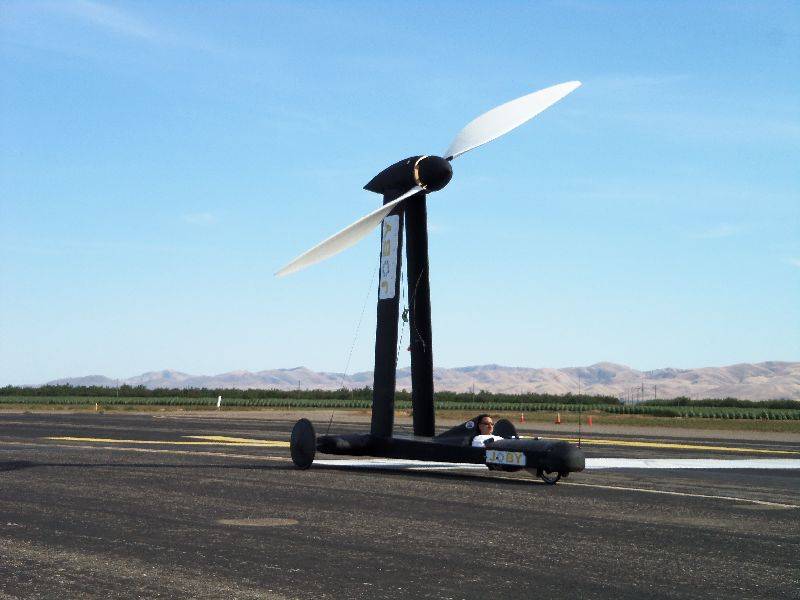
The Blackbird Landyacht which went 2.8x faster than the wind directly downwind, has been outfitted with a turbine and is now going directly upwind, faster than the wind. The official numbers are not in yet, but estimates are 1.5 - 2x windspeed.

The DUWFTTW blog:
https://fasterthanthewind.wordpress.com

100_0041.jpg


For comparison: At the http://en.wikipedia.org/wiki/Racing_Aeolus the upwind vechicles achieve max upwind speeds of 0.75 windspeed. But their rotor size is limited by the rules:


The old threads about directly downwind:
https://www.physicsforums.com/showthread.php?t=421733
https://www.physicsforums.com/showthread.php?t=562993
 
Last edited by a moderator:
Physics news on Phys.org
Very humbling when I am struggling to make any distance at all when 45 degrees off the wind in my dear ol' Westerly Centaur sailing cruiser, 'Sophie'. But you can't go below in that machine above and make a cup of tea!
 
sophiecentaur said:
Very humbling when I am struggling to make any distance at all when 45 degrees off the wind in my dear ol' Westerly Centaur sailing cruiser, 'Sophie'. But you can't go below in that machine above and make a cup of tea!

Some made boats like this. They also go directly upwind, but not as fast:

Windmill-Sailboat.jpg
 
Not available on eBay yet?
 
Nice work.

It's amazing how many people still don't think it's possible to sail directly up wind. Even when videos are available.
 
CWatters said:
Nice work.

It's amazing how many people still don't think it's possible to sail directly up wind. Even when videos are available.

Yes, no one can fake a video, right? BTW I'm not saying that these are fakes only that a video is not the best of proofs.
 
cosmik debris said:
I'm not saying that these are fakes only that a video is not the best of proofs.

That's why we documented everything about the project to the best of our ability and posted it in our build blog. We also set a record - not because we wanted a record, but because it would necessarily involve a trusted and disinterested 3rd party scrutinizing our efforts.

Finally, I posted a set of build videos so anyone could make their own working model for just a few bucks and demonstrate it for themselves on a treadmill in their own living room.

I tried to do everything but go door-to-door. Some people find that creepy.
 
CWatters said:
It's amazing how many people still don't think it's possible to sail directly up wind. Even when videos are available.

In Australia ME students have to build DUW carts in introduction courses:

https://www.youtube.com/watch?v=WH9Qnf8fwBo

One can also buy build sets:

https://www.youtube.com/watch?v=zmC2BaL0KOk

However, going 2.1x windspeed directly upwind would be significant. A paper by Blackford from 1978 claimed that 2x directly upwind would be the absolute theoretical limit. The response by Ruina was never published:
http://ruina.tam.cornell.edu/research/topics/miscellaneous/push-me_pull-you.pdf
 
  • #10
A.T. said:

Andy Ruina and I have become friendly acquaintances over the last couple of years. Interestingly, he's done some really good work on another topic that I've debated hotly on internet forums - namely bicycle dynamics (and particularly the need to counter-steer at all speeds). He's a very very sharp, friendly, and interesting guy.

Don't be too surprised if you see a paper on wind powered vehicles from him published after all.
 
  • #11
I seem to recall something in one of the previous threads that with similar efficiency, upwind would be about 1x slower than downwind, so if 3x downwind, then about 2x upwind.
 
Last edited:
  • #12
rcgldr said:
I seem to recall something in one of the previous threads that with similar efficiency, upwind would be about 1x slower than downwind,
[STRIKE]That is true for low total efficiency. The difference gets smaller for higher total efficiencies.[/STRIKE]

Check out equation 9 (upwind) and 20 (downwind)

http://orbit.dtu.dk/fedora/objects/orbit:55484/datastreams/file_3748519/content

Total efficiency -> wind-speed multiple:

attachment.php?attachmentid=48603&stc=1&d=1340618464.png


I assume the Blackbird reaches around 0.7 total efficiency at max. speed. Note that his total efficiency already includes aero-drag and rolling resistance.
 

Attachments

  • DUW_DDW.png
    DUW_DDW.png
    5 KB · Views: 1,115
Last edited:
  • #13
A.T. said:
The Blackbird Landyacht which went 2.8x faster than the wind directly downwind, has been outfitted with a turbine and is now going directly upwind, faster than the wind. The official numbers are not in yet, but estimates are 1.5 - 2x windspeed.[..]
When I heard about these things I first though" no way", based on wrong (simplistic) intuition - and it took me some time to figure out how/why it can work. :-p
spork said:
[.] I posted a set of build videos so anyone could make their own working model for just a few bucks and demonstrate it for themselves on a treadmill in their own living room. [..]
Link please? :smile:
 
  • #14
rcgldr said:
I seem to recall something in one of the previous threads that with similar efficiency, upwind would be about 1x slower than downwind ...

A.T. said:
downwind = 1 / (1-x) ... upwind = 1 / ((1/x) - 1)

Doing the math for (downwind - upwind):

1 / (1-x) - 1 / (1/x - 1) =
1 / (1-x) - 1 / (1/x - x/x) =
1 / (1-x) - 1 / ((1-x) / x) =
1 / (1-x) - x / (1-x) =
(1-x) / (1-x) =
1
 
Last edited:
  • #15
rcgldr said:
Doing the math for (downwind - upwind):
1 / (1-x) - 1 / (1/x - 1) = 1
Indeed.

rcgldr said:
However as mentioned before, the lower ground speed in the upwind case should result in lower ground speed related losses, so maybe a bit less than 1x wind speed difference.
On the other hand: for 2x upwind you have 1.5 times the relative headwind, of 3x downwind, so 2.25 times the drag. This is why that total efficiency is tricky, because it not only affects max. speed but also depends on the speed.

It is also not clear if the 2.8x (3.4x unofficial) was the Blackbird's limit for downwind. In stronger winds it might have gone even faster efficiency-wise, but was prevented by transmission power limits (chain broke).
 
  • Like
Likes Gleb1964
  • #17
However as mentioned before, the lower ground speed in the upwind case should result in lower ground speed related losses, so maybe a bit less than 1x wind speed difference.
A.T. said:
On the other hand: for 2x upwind you have 1.5 times the relative headwind.
I thought I already removed that part from my previous post. You have less ground speed but more wind speed for the upwind case, but I assume the formulas in that pdf article already took that into account, so I removed the comment about ground speed in the upwind case.
A.T. said:
It is also not clear if the 2.8x (3.4x unofficial) was the Blackbird's limit for downwind. In stronger winds it might have gone even faster efficiency-wise, but was prevented by transmission power limits (chain broke).
I'm thinking that 3.4x was closer to it's limits. I'm not sure if a stronger wind helps. There's probably an ideal wind speed, above which reduces efficiency, perhaps due to drag being related to speed2. The ice boats seem to get their best ratio of boat speed VMG (the directly downwind component) versus wind speed with a wind speed around 10 to 16 mph (16 to 26 kph), or at least the ratio at 10 to 16 mph is better than the ratio above 30 mph. Maybe the issue is the wind tends to be more gusty if the average wind speed is over 30 mph.
 
Last edited:
  • #18
rcgldr said:
The ice boats seem to get their best ratio of boat speed versus wind speed with a wind speed around 10 mph == 16 kph.

I don't know if that is true in the absolute sense, but in the case of their downwind VMG, the multiple definitely does get higher with higher wind speeds. And their limit is also determined by their structural strength.
 
  • #20
harrylin said:
Ah thanks - that looks not too difficult indeed!


If you build one you definitely have to let us know how it goes. You too can play a part in the grand hoax. :)
 
  • #21
Can someone link me to where I can learn more about the physics behind this.. I find this quite intriguing.
 
  • #22
ozone said:
Can someone link me to where I can learn more about the physics behind this.. I find this quite intriguing.

This paper handles both cases directly up & down wind faster than the wind:
http://orbit.dtu.dk/fedora/objects/orbit:55484/datastreams/file_3748519/content

This video explains the basic mechanical principle, also for both directions:

https://www.youtube.com/watch?v=pw_B2MnMqZs
 
  • #23
These may be silly questions, but that never stopped me before.

When going upwind, is the speed measured in multiples of the wind? So if you are doing twice the wind speed, the ground speed is twice the wind? So does that mean the wind felt by the craft is three times wind speed?

10mph wind. 20 mph up wind. Wind from the crafts POV is 30 mph?
 
  • #24
r-j said:
These may be silly questions, but that never stopped me before.

When going upwind, is the speed measured in multiples of the wind? So if you are doing twice the wind speed, the ground speed is twice the wind? So does that mean the wind felt by the craft is three times wind speed?

10mph wind. 20 mph up wind. Wind from the crafts POV is 30 mph?

You are correct.
 
  • #25
Google "Apparent wind"
 
  • #26
Some questions were posed via PM that I'd like to respond to on the thread (I've already responded by PM as well)...

First I had to make sense of what a propeller even does, and from what I gather it produces propulsion by pulling the vehicle into the air in front of it.

That's essentially correct. It's basically a couple of wings swung around an axis. The lift generated pulls the vehicle forward.

The wheel/propeller are connected through some sort of transmission.

That's correct. There is a fixed ratio transmission between the propeller and wheels in the downwind case, or between the turbine and wheels in the upwind case.

In both cases we use ratchets to let the prop or turbine spin freely if it gets ahead of the wheels. This relates to practical matters and allows us to prove we're not using stored energy. Ratchets are not a necessary part of the design.

Next the gearing is set so that the propeller has to spin faster than the wheels turn (not too sure of the exact ratio here but I think it needs to be greater than 2).

Not exactly. It's less about the rotational rate of the wheels and propeller, and more about the rate each advances through (or on) its medium. For the downwind cart, the prop needs to advance through the air more slowly than the wheels advance over the ground. It's exactly the opposite for the upwind vehicle.

In the initial accelerating phase i.e. when the cart is slower than the wind you are simply drawing power from the wind until you reach some cutoff point.

In the downwind case, the whole vehicle (prop included) is simply a bluff body being pushed by the wind initially. As it begins to move, the prop starts to turn (since it's geared to the wheels). This of course begins to produce thrust. There's a smooth transition between the bluff body phase and the thrust phase. Prop thrust is the sole contributor by the time we reach wind speed.

In the upwind case, the turbine is turned by the wind, and that in turn turns the wheels. There is no change in phase in this case.

Once you hit this cutoff point the cart then actually begins to draw power from its own forward movement...

Yes and no. We have to consider the relative wind over the vehicle when doing the analysis, but we never use any stored energy or momentum of the vehicle to our advantage.

Whether a wind powered vehicle can "make its own wind" is a bit more of a philosophical question, but my inclination (without going into a lot of detail) is to say that it really can't. You could argue either side of this, but you don't get something for nothing as it might otherwise imply.

...and the potential difference between the velocity of the wind at the propeller and the wind speed at ground level (this part is probably the most confusing aspect of the whole machine, and I am not entirely sure how this process works).

It sounds like you're talking about wind gradient. While it's possible to design a vehicle that exploits wind gradient, this one does not. This vehicle exploits the energy available from the relative velocity of the two media (ground and air).
 
  • #27
In the initial accelerating phase i.e. when the cart is slower than the wind you are simply drawing power from the wind until you reach some cutoff point. Once you hit this cutoff point the cart then actually begins to draw power from its own forward movement.
In both cases, the cart draws power from the wind by slowing the wind, extracting kinetic energy from the wind (using the Earth as a frame of reference). Even when the cart itself is moving faster than the wind, the thrust from the prop is slowing the wind (wrt earth).
 
  • #28
rcgldr said:
In both cases, the cart draws power from the wind by slowing the wind, extracting kinetic energy from the wind (using the Earth as a frame of reference). Even when the cart itself is moving faster than the wind, the thrust from the prop is slowing the wind (wrt earth).

Absolutely right. It's also worth mentioning that, while there's a sort of change in operation mode for the downwind cart, the change is not fundamental. For the downwind cart, the wheels turn the propeller - always - at all speeds both above and below wind speed.

For the upwind cart, the turbine always turns the wheels.
 
  • #29
There is an easy way to understand the feasibility of the upwind cart.. That's to understand that individual blades of the prop do not move directly upwind. They are "tacking" in 3D.
 
  • #30
Just wishful thinking. Then all the physics laws will violated by Youtube.
 

Similar threads

  • · Replies 15 ·
Replies
15
Views
3K
  • · Replies 69 ·
3
Replies
69
Views
16K
  • · Replies 3 ·
Replies
3
Views
2K
  • · Replies 5 ·
Replies
5
Views
2K
Replies
13
Views
8K
Replies
73
Views
28K
  • · Replies 7 ·
Replies
7
Views
5K
Replies
175
Views
35K
  • · Replies 1 ·
Replies
1
Views
4K
  • · Replies 2 ·
Replies
2
Views
7K