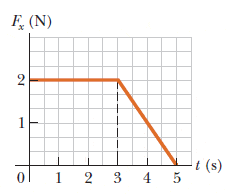
Finding Impulse and Velocity from Force vs. Time Graph

Click For Summary
SUMMARY

The discussion focuses on calculating impulse and final velocity from a force vs. time graph for an object with a mass of 1.7 kg. To find the impulse, participants emphasize using the impulse-momentum theorem, where impulse is defined as the product of force and time. The area under the force vs. time graph does not represent final velocity, contrary to some misconceptions. The final velocity can be determined using the impulse calculated and the initial conditions provided.

PREREQUISITES
  • Understanding of the impulse-momentum theorem
  • Knowledge of force vs. time graphs
  • Basic principles of kinematics
  • Familiarity with calculating area under a graph
NEXT STEPS
  • Study the impulse-momentum theorem in detail
  • Learn how to calculate impulse from force vs. time graphs
  • Explore kinematic equations for final velocity calculations
  • Investigate the differences between force vs. time and acceleration vs. time graphs
USEFUL FOR

Physics students, educators, and anyone involved in mechanics or dynamics who seeks to understand the relationship between force, impulse, and velocity.

MG5
Messages
60
Reaction score
0
Heres the graph.

6-p-015.gif


Heres the problem

Mass of the object is 1.7 kg.

(a) Find the impulse of the force.


(b) Find the final velocity of the object if it is initially at rest.


(c)Find the final velocity of the object if it is initially moving along the x-axis with a velocity of
−1.9 m/s.

Wouldn't the velocity be the area under the graph be the velocity?
 
Physics news on Phys.org
MG5 said:
Heres the graph.

6-p-015.gif


Heres the problem

Mass of the object is 1.7 kg.

(a) Find the impulse of the force.

(b) Find the final velocity of the object if it is initially at rest.

(c)Find the final velocity of the object if it is initially moving along the x-axis with a velocity of
−1.9 m/s.

Wouldn't the velocity be the area under the graph be the velocity?
No.

It's not an acceleration vs time graph.
 
Why don't you show us what you did and where you're stuck on a, b, and c.
 
howie8594 said:
Why don't you show us what you did and where you're stuck on a, b, and c.

Don't even know where to start.
 
MG5 said:
Don't even know where to start.
Well, you could use the impulse-momentum theorem.

Or

How is the graph related to an acceleration vs. time graph?
 
If you want to find the impulse, it's force * time. Look at your graph again. It alone should be enough to find the impulse. The area of the graph does not represent the final velocity.
 

Similar threads

Replies
7
Views
2K
  • · Replies 2 ·
Replies
2
Views
4K
  • · Replies 17 ·
Replies
17
Views
4K
Replies
1
Views
3K
  • · Replies 2 ·
Replies
2
Views
2K
  • · Replies 19 ·
Replies
19
Views
3K
Replies
3
Views
4K
Replies
57
Views
3K
  • · Replies 9 ·
Replies
9
Views
3K
Replies
14
Views
3K