New Reply

How does one do this question?

 
Share Thread Thread Tools
Nov20-12, 09:51 AM   #1
 

How does one do this question?


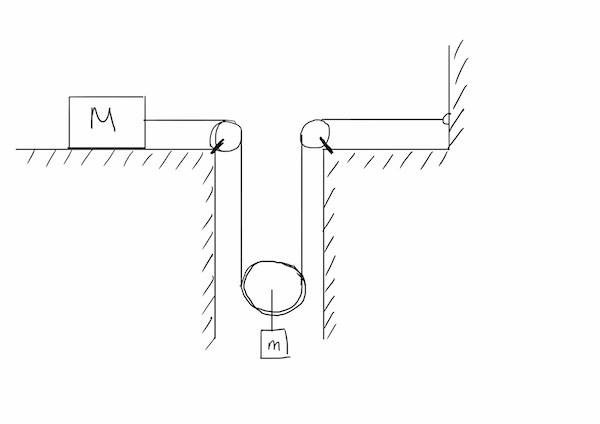
Figure attached below. You have a big block of mass M and a small block of mass m. When m=3kg, the acceleration of the large block is 0.6ms-2. When m=4kg, the acceleration of the large block is 1.6ms-2. The dynamic friction coefficient between the large block and the surface it slides on is μ. There is no friction between any other surface. Questions:

a) Express the relationship between the movement of block m and block M
b) Derive expressions for the motion of block m and block M.
c) Determine the mass of block M and the dynamic friction coefficient, μ, between it and the surface it slides on.
 
PhysOrg.com
PhysOrg
science news on PhysOrg.com

>> Front-row seats to climate change
>> Attacking MRSA with metals from antibacterial clays
>> New formula invented for microscope viewing, substitutes for federally controlled drug
Nov20-12, 10:02 AM   #2
 
Nice problem. So what have you got so far? How does the motion of mass m relate to the motion of mass M?
 
Nov20-12, 10:19 AM   #3
 
I know that [itex] x_m = 2 x_M [/itex], so that the small block moves two times as much as the big block. My problem is decomposing the forces.
 
Nov20-12, 10:32 AM   #4
 
Recognitions:
Homework Helper Homework Help

How does one do this question?


Draw free body diagrams. Start with the mass m. What forces are acting on m?
 
New Reply

Tags
decomposition, friction, mass, mechanics, tension
Thread Tools


Similar Threads for: How does one do this question?
Thread Forum Replies
Trend in Square roots question [Curious Math Newb question] General Math 3
Centrifugal and centripetal force question: race-car and banked curve question Introductory Physics Homework 12
Insanely easy question - trig functions, need a quick question answered Precalculus Mathematics Homework 1