Histspec's latest activity
-
HHistspec reacted to Sagittarius A-Star's post in the thread Undergrad Comparing the clocks via synchronization with
 Like.
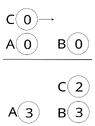
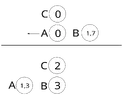
Both "scenarios" describe the same events: Meeting ##(C=0, A=0)## Meeting ##(C=2, B=3)##
Like.
Both "scenarios" describe the same events: Meeting ##(C=0, A=0)## Meeting ##(C=2, B=3)## -
HHistspec replied to the thread Undergrad Comparing the clocks via synchronization.In Scenario 2, clock C indicates 0 at the start, advances by interval 2 during motion and therefore indicates time C=2 when it meets B...
-
HHistspec replied to the thread Undergrad Comparing the clocks via synchronization.As you can see on the images, in both scenarios the clock indications of B and C when they meet are B=3 and C=2, thus $$C=2<B=3$$ But...
-
HHistspec replied to the thread Undergrad Comparing the clocks via synchronization.You may have a look at the images in the German Wikipedia that precisely describe, and solve, your scenarios: In scenario 1 (rest frame...
-
-
HHistspec replied to the thread Undergrad Was Richard Feynman's explanation of the twin paradox wrong?.In defense of Laue it should be clarified that he was talking about changing frames in which the clocks were at rest (in The principle...
-
HHistspec reacted to A.T.'s post in the thread Undergrad Was Richard Feynman's explanation of the twin paradox wrong? with Like.
Depends on what one means by "reason why". Try this analogy: The rate at which an odometer reading increases is not directly affected...
-
HHistspec reacted to PeroK's post in the thread Undergrad Was Richard Feynman's explanation of the twin paradox wrong? with Like.
There's no single, correct way to explain the twin paradox. People on YouTube who prefer a certain explanation like to say that everyone...
-
HHistspec replied to the thread Undergrad Was Richard Feynman's explanation of the twin paradox wrong?.Pretty much everything related to the twin paradox has already been discussed and solved between 1910 and 1921. History of the twin paradox
-
HHistspec replied to the thread High School Einstein equations don't work at large scale?.You may be interested in the following paper: Relativity for Retired Engineers https://arxiv.org/abs/2605.21660