Floating Buoyancy:
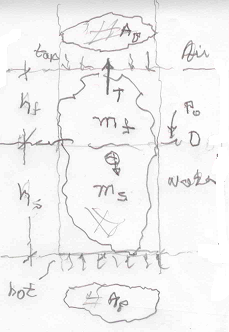
A solid in equilibrium on Earth rests upon solid Earth or is supported in some floating freely partially or fully submerged in a fluid, perhaps assisted in equilibrium by an external tether or such which, in turn, rests or anchors to solid Earth. There are a number of possible arrangements.
Stable solid/fluid configurations depend upon the mass of the solid and fluid densities. Here we consider the case of a solid floating beneath air and above water.
Shown right is sketch of a mass of arbitrary shape. The mass "floats" as we say. The part that floats (notated "f") is above the water level surrounded by air. The part of the mass surrounded by water is notated "s" for submerged. A vertical projection of the mass (its area seen from the "vertical") is needed: "A." What does Newton's 2nd Law tell us?

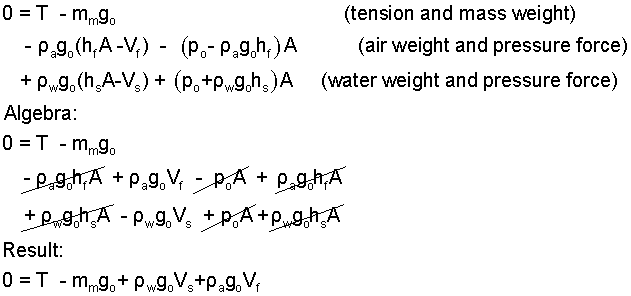
The final equation above indicates that the required tension, T is diminished by the presence of both the air and the water and this is in proportion to the "displaced " air or water, respectively. Next we do a tad more algebra to obtain as below:
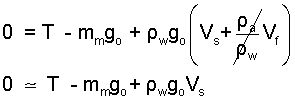
The third, right-most term of the equation above is called the "buoyant force." Notice this is the mass of water displaced. The volume of which is the volume "submerged."