Crate Pushed Uphill
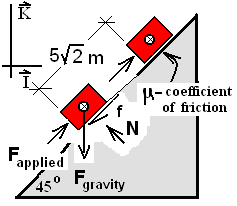
This concerns the simple task of pushing a crate slowly up a plane inclined at 45 degrees. The surface opposes the motion; it has a coefficient of friction, μ. The simple geometry permits both the energy change and work of the event to be calculated then compared. Note: Earth-and-Block together are taken as system.
Calculate the energy change of the crate.
♦ Moving slowly means kinetic energy changes are zero. The slope of the incline is 45° and the crate displaces 5√2 meters up the incline. The vertical component of this displacement is 5 meters. Thus the change of potential energy of the crate is:

Calculate the work of the event.
♦ The system sketch shows the crate as a free-body. Below we write the momentum equation with the applied force written first and the others listed, going clockwise:

Next write the forces in magnitude-direction form. The unit vector directions of the forces are parallel or perpendicular to the incline.
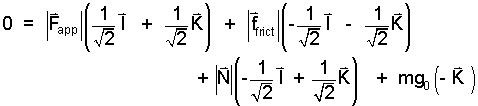
Vector algebra is required. One procedure would be to collect all of the terms having the unit direction, I and the others having the unit direction, K. The vector with these components equals zero, so the magnitudes of the components themselves must equal zero.
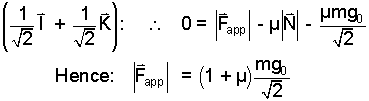
A second solution path is to multiply the equation by a unit vector perpendicular to the plane, and then multiply it by a vector parallel to the plane. The "perpendicular to slope" unit vector and the result of its multiplication of the above equation are:

The "parallel to the slope" unit vector and its multiplication of the above equation are:
The work is the integral of the applied force through its displacement.
 I + (1/√2) K) and dS = ((1/√2) I + (1/√2) K) ds; W_event = ∫ from 0 to 5√2 of [(1 + μ) m g_o/√2]((1/√2) I + (1/√2) K) • ((1/√2) I + (1/√2) K) ds; W_event = (1 + μ)(m g_o/√2)(5√2) = m g_o (5 m) + μ m g_o (5 m)](up_incline_eqn_5.gif)
The result above shows work of the applied force identified as two components. The applied force did work to elevate the crate and also to overcome friction.
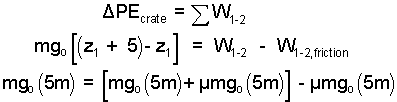
Thus we see a strict accounting of energy for pushing the crate uphill shows a work effect that is in excess of the energy change of the system. It is tempting to update the Mechanical (or Extrinsic) Energy Equation to include friction as:

That creates complications. Where does the energy transfer of friction work come from or go? The energy equation applies to the system. For movement of the block, all of the energy of friction "came from" the agent that pushed the block. The energy of the block increased by the work; temporarily the block temperature increased. But upon arriving "uphill" the block will have passed that energy ro the surface of the inclined plane and surrounding atmosphere. Some call the work, "lost work." Others call it "irreversible work." Friction is difficult to analyze in a general way. Thermodynamics texts generally avoid friction by studying only "quasi-static" processes.