ZULIA ~ Side-Casting Dredge
The shipping channel from the Caribbean Sea to the port of Caracas, Venezuela, passes through a long pond-like expanse of water called Lake Maracaibo.
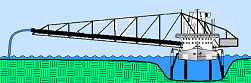 Since the water is too shallow for commercial shipping, the side-casting dredge, ZULIA, must dredge constantly and arduously to maintain the shipping channel. Day by day, years pass as ZULIA'S diesel-powered pumps dredge a slurry of water and mud from the bottom of the channel and side-cast it the length of its 400 foot boom to ever-restore the ever-filling channel.
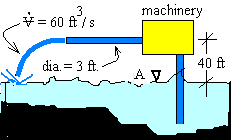 Least Pumping Horsepower: Use information of the sketch to estimate the "least" steady pumping horsepower of the dredge.
♦ We take the lake water inside the dredge, as it passes though, as the system. This is an "open system." The pumped slurry exits our system at the pipe-end, "out" is at the end of the boom. But where is the entrance (our "in") located? The schematic shows the letter, A, beside a "free-surface" notation (an inverted Δ). Our choice is to set the datum for potential energy to be zero at the surface of the water near A. Our entrance, how we will model the "in" of this system, was described in the second proof of a previous writing ~ Torricelli's Theorem.
Mass Equation
First we address the mass equation for the system event.
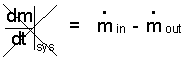
ulates within the pump or piping.
The term, "dm/dt," represents the change of mass of water within the pumps and piping. There is none: this term equals zero. Knowing the density of water and the volumetric rate yields the mass rate through the system. The volume flow rate and exiting pipe diameter are known. Hence the mass rate "out" can be calculated. We assume the density of the slurry equal to that of water.

rate yields the mass rate through the system.
Energy Equation
The flow of this fluid is steady and it is incompressible. We write the steady energy equation for an incompressible fluid applies. Frictional power loss equal to zero corresponds to "least" pump power required:

losses are assumed equal to zero.
The entering and leaving mass rates are equal. Pressures "in" and "out" are atmospheric and the velocity "in" is zero. To re-group on like terms is logical.

nothing to do with the pump power required.
Just one more line of algebra.
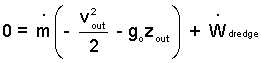
The volumetric flow past a plane equals the average velocity of the flow times the flow area. This fact yields the average velocity of the water at the system exit.

velocity of the slurry.
Numbers can be applied to the reduced Energy Equation, Eqn-5. Note: Please resist the urge to "do algebra" on this equation. It has meaning that is lost upon algebraic rearrangement.
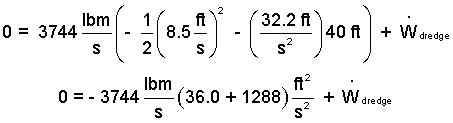
ALL numbers, with only one unknown remaining,
represented by its symbol.
Conversion to HP requires unit manipulation...
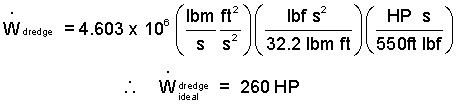
necessary unit conversions.
First, the answer is positive, meaning energy of the system (the water flow) was increased. Next, the answer we obtain is ludicrously small. There are inexpensive motorcycles that require 260 horsepower engines. This being a beginning level discussion, we have assumed friction nonexistent. Friction is never zero; it is BIG. To include effects of friction requires advanced study and/or expensive experimentation.