Could reflected light interfere in a time dilation model?

2 replies · 1K views · last reply
Eshu
Messages
2
Reaction score
0
I have some newbie kind of confusion The model in question is taken from wikipedia:
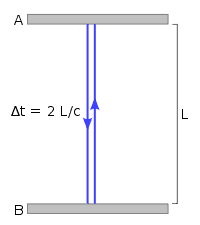
Light clock diagram: two horizontal mirrors labeled A (top) and B (bottom), separated by distance L, with a blue light pulse bouncing vertically between them and the label Δt = 2 L/c.


and

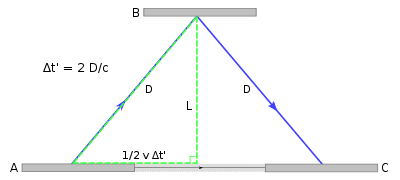
Light clock diagram: a light pulse travels diagonally from A to a mirror at B and back at distance D, with vertical height L and horizontal shift 1/2 v Δt' to C; labeled Δt' = 2 D/c.


If, in the first model, the light ray is reflected back to its source, could there be some kind of detectable interference at the midpoint (where the blue arrows are)? If the answer is yes, would this happen in the second model, since from the outside perspective, at the midpoint the light ray does not appear to be reflected back on itself.

Thanks for any help!
 
Both diagrams are showing the path of a single short pulse, not a beam. So there is no interference in either case because at any point there is only light going up or light going down or (most of the time) nothing.

You could have a continuous beam of light bouncing back and forth and the first diagram would be valid and you would indeed get interference anywhere the beam crosses itself. However, the second diagram would need some modification. Instead of a thin line you would have a very fat line, so fat that the tail end of the upward traveling beam overlapped the front of the downward traveling beam, and you would get interference in the overlap region. You would also need to draw both mirrors all the time, as a pair of long horizontal lines, since there would always be light bouncing off them, instead of just showing them a couple of times.

Hope that makes sense.

Edit: Here's a sketch of what I mean - for a very short pulse you get the top diagram. If you stand at the bottom mirror, you'll only see flashes of light every time the pulse reaches the bottom, and since the upward going rays (in red) never cross the downward going rays you get no interference. However, if you have a long pulse, as in the bottom diagram, then the red rays and the blue rays (representing evenly spaced points along the beam) do overlap and you do get interference.
Two diagrams of a light pulse bouncing between two horizontal mirrors; the top shows a thin zigzag path, the bottom a thick hatched band with overlapping colored regions.
 
Last edited:
  • Like
Likes   Reactions: Nugatory and Dale