Finding the distance between parallel lines using Snell's law

3 replies · 2K views · last reply
Shaun97
Messages
5
Reaction score
0
I can't seem to find the proof for the distance between the two parallel lines.
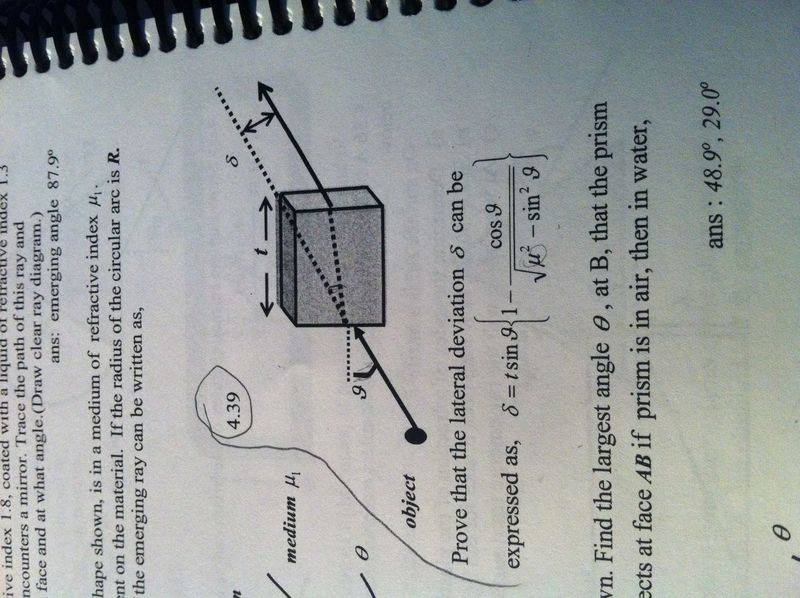
Textbook diagram of a light ray entering a rectangular glass block of thickness t at angle θ, refracting inside and emerging parallel to the incident ray, with lateral deviation δ marked; printed problem text asks to prove δ = t sinθ[1 − cosθ / √(μ² − sin²θ)].


Homework Equations

: Snells law: μ1sinθ1=μ2sinθ2
Sin (A+B)= sinAcosB + sinBcosA[/B]

The Attempt at a Solution

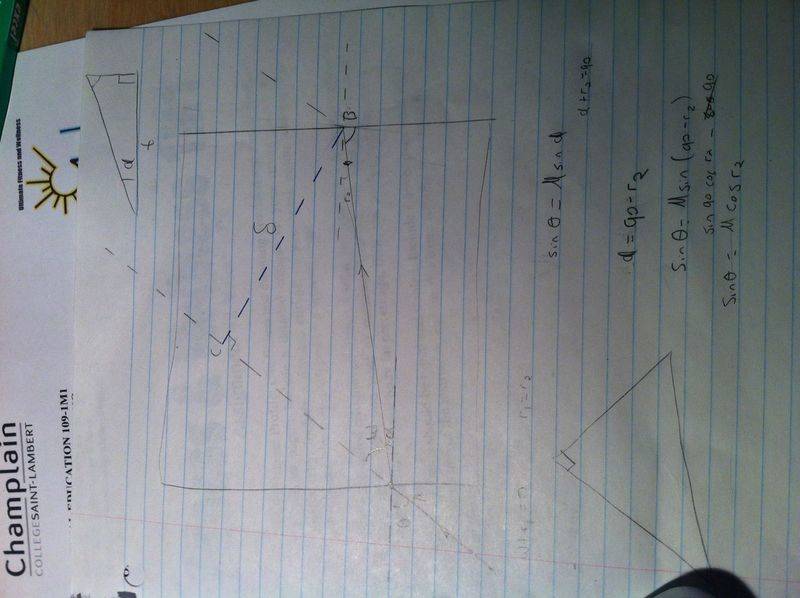
: tried using the parallel lines to get a result in terms of the initial angle of incidence ϑ, as the lateral deviation creates a right angle triangle.
Handwritten ray-optics diagram, rotated on the page: a rectangular glass block with a ray entering at angle theta and exiting parallel to its original path, labelled with a displacement d and angles r1 and r2. Beside it, handwritten working for sin theta = M sin(q - r2) and sin theta = M cos r2.
[/B]
 
Thats a good start... you need the other angles too.
There's another rt angled triangle that may be useful in there.
It also helps to explicitly state exactly what you want to prove.
 
there's the rt angled triangle with alpha (α) as one of the angles and with t as the height of it, and as the answer is also in terms of t I assume it's necessary to do something with this triangle but at the same time the answer only contains one angle, ϑ.
 
You have to start by writing down relations involving the different triangles ... then you can think about how you can use them to get the relation you need to prove.

Clearly you need to find a way to get rid of the terms that are not in the final form. Don't forget that some of the angles are related through Snell's Law. Make sure you have identified all the triangles ...
 
Last edited: