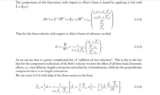
The idea is to calculate the three-velocity ##\vec{w}## first for the simplifying case that ##\vec{v}=v \vec{e}_1##. Then one makes use of the fact that ##\vec{w}=\vec{W}/W^0## is a "three-vector", i.e., it transforms under rotations as a three-vector, and thus one can get the expression for an arbitrary ##\vec{v}## by writing (1.5.2) in a form that is kovariant under rotations; you can indeed check that when setting ##\vec{v}=v \vec{e}_1## in (1.5.3) you get back (1.5.2). Since (1.5.3) is written in a kovariant form under rotations, it must be correct for the general case, if it's correct for the special case.