Two dice are rolled...

  • Thread starter Thread starter DaveC426913
  • Start date Start date
Join the discussion
Registration is free. Ask a follow-up in this thread, or start your own.
14 replies · 392 views
DaveC426913
Gold Member
2025 Award
Messages
24,698
Reaction score
9,111
I'm putting this is the Fun 'n Games forum because if I put it in the Math forum I'd get answers in the form of formal probability notation, with elements and sets and unions and intersections.

While that's fine for those who know the notation, it's not very accessible for those who don't. I'm hoping for intuitive solutions that make the head-scratching readers say "Ah. I get it now."

And ... partly because I spent an inordinate amount of time - at an uncivilized hour of the night - producing intuitive visualizations that don't require more than a very basic understanding of probability.
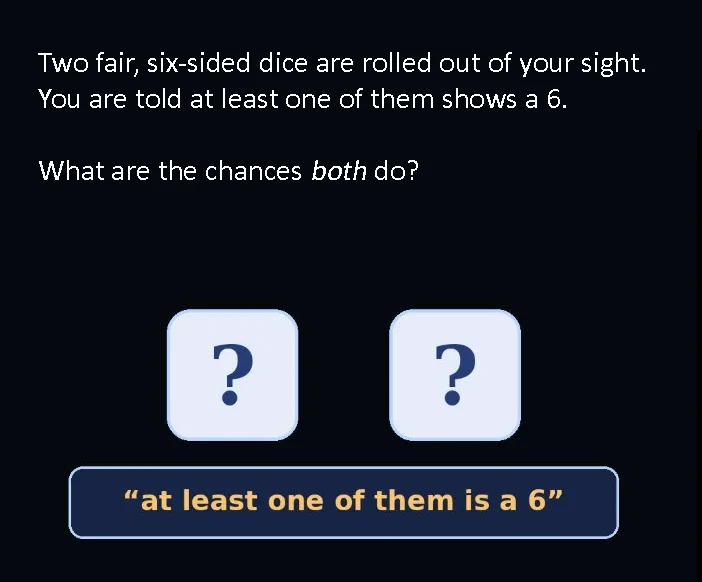
1791559686558.webp
 
Physics news on Phys.org
I think you also need to say that if either of them are 6, you would be told that. Otherwise, there is not enough information.
You haven't asked for spoiler's, but I'll do that anyway.
When the die are tossed, there are 36 possible combinations. 11 of them will result in the "one of them is a 6" report. Of those 11 reports, only one of them is a double 6. So the chance that both are sizes is 1/11.
 
.Scott said:
I think you also need to say that if either of them are 6, you would be told that. Otherwise, there is not enough information.
Like this?? 🤔

1791561709767.webp


Or this?? 🤔 🤔

1791561831549.webp


.Scott said:
You haven't asked for spoiler's, but I'll do that anyway.
You got the answer of course, but I was hoping for answers that show, as clearly and concisely as possible, how to get there (for those not familiar with probability notation).


To clarify: an astonishing number of people - myself included initially - assumed that the problem reduces to this logic:

You are told one die is a six. Therefore its chance of being six is 1. They are independent events, therefore that die's result is done. The only calculation left to do is the other die. They are independent events, so the 2nd die is simply 1:6. So: the chances of a double 6 are 1:6.

Or, even more simply, this:

Colour the dice red and blue.
If the red turns up 6, then there are 6 options for the blue die.
If the blue turns up 6, then there are 6 options for the red die.
Thus: 12 possible states. 12:36 = 1:6.


(You and I know they contain flawed logic, but my goodness it's hard to point out the flaw to others!)
 
Last edited:
DaveC426913 said:
Like this?? 🤔

1791561709767.webp


Or this?? 🤔 🤔
I think @.Scott's point is that you must always be told if there's a six, or at least you have to be able to assume no bias. If there's bias in it (e.g., the die-thrower only says there's at least one six if it was on the red die not the blue die, or only if it's actually a double six, or something) your restriction is still satisfied but the odds might shift.

There are 36 equiprobable outcomes of rolling two dice:$$\begin{array}{|c|c|c|c|c|c|}
\hline
1,1&1,2&1,3&1,4&1,5&1,6\\
\hline
2,1&2,2&2,3&2,4&2,5&2,6\\
\hline
3,1&3,2&3,3&3,4&3,5&3,6\\
\hline
4,1&4,2&4,3&4,4&4,5&4,6\\
\hline
5,1&5,2&5,3&5,4&5,5&5,6\\
\hline
6,1&6,2&6,3&6,4&6,5&6,6\\
\hline
\end{array}$$The constraint that "at least one was a six" tells you that the outcome was one of the eleven cells with a six (the right hand column or bottom row). Only one of them is a double six, so the chance of the outcome is 1/11 (given the "no bias" assumption).
 
A.T. said:
?
Indeed. That was a mistake on my part. Plz ignore.
 
DaveC426913 said:
I was hoping for answers that show, as clearly and concisely as possible
These are somewhat opposed goals. The clearest way to show it is the least concise brute force method of listing all outcomes and counting (see post #4). People playing board games know this table well.
 
DaveC426913 said:
Like this?? 🤔

1791561709767.webp


Or this?? 🤔 🤔


1791561831549.webp
No. @Ibix understood.
The phrasing of the report is not the issue.
The issue is under what conditions the report is made.
For example, if the instructions to the reporter are as follows:
If the roll includes at least one "1", then report that "at least one of them is a 1".
Otherwise, if the roll includes at least one "2", then report that "at least one of them is a 2".
Otherwise, if the roll includes at least one "3", then report that "at least one of them is a 3".
Otherwise, if the roll includes at least one "4", then report that "at least one of them is a 4".
Otherwise, if the roll includes at least one "5", then report that "at least one of them is a 5".
Otherwise, if the roll includes at least one "6", then report that "at least one of them is a 6".

In that above case, the answer would be different.
The most straight forward way I can think of explaining this is as follow:
The die are rolled yielding one of 36 results:
A) In 25 cases, both dice show 1 to 5, and no report is made.
B) In 5 cases, this first dice is 1 to 5, the second dice is 6, and the report is made.
C) In 5 cases, this second dice is 1 to 5, the first dice is 6, and the report is made.
D) In 1 case, both die are 6 and the report is made.

If a report is made, then:
the 25 "A" cases are eliminated.
In the remaining 11 cases, only 1 has both die as 6.

Hence 1/11
(but I am probably a bad jusge of "simple".)
 
Last edited:
.Scott said:
For example, if the instructions to the reporter are as follows:
If the roll includes at least one "1", then report that "at least one of them is a 1".
Otherwise, if the roll includes at least one "2", then report that "at least one of them is a 2".
Otherwise, if the roll includes at least one "3", then report that "at least one of them is a 3".
Otherwise, if the roll includes at least one "4", then report that "at least one of them is a 4".
Otherwise, if the roll includes at least one "5", then report that "at least one of them is a 5".
Otherwise, if the roll includes at least one "6", then report that "at least one of them is a 6".
That's much better than my slightly malicious ideas - it's systematic, and gives a 100% chance of a double six given that the reporter says "at least one six", because a six and anything else would be reported as "at least one of the 'anything else'".
 
I'd say it is one in eleven. That's the number of possibilities and all are equally likely.
 
.Scott said:
No. @Ibix understood.
The phrasing of the report is not the issue.
The issue is under what conditions the report is made.
For example, if the instructions to the reporter are as follows:
If the roll includes at least one "1", then report that "at least one of them is a 1".
Otherwise, if the roll includes at least one "2", then report that "at least one of them is a 2".
Otherwise, if the roll includes at least one "3", then report that "at least one of them is a 3".
Otherwise, if the roll includes at least one "4", then report that "at least one of them is a 4".
Otherwise, if the roll includes at least one "5", then report that "at least one of them is a 5".
Otherwise, if the roll includes at least one "6", then report that "at least one of them is a 6".
I don't really get how you interpret it that way; it seems overly pedantic, but I allow the possibility that what I take for granted is not what you take for granted.

.Scott said:
The most straight forward way I can think of explaining this is as follow:
The die are rolled yielding one of 36 results:
A) In 25 cases, both dice show 1 to 5, and no report is made.
B) In 5 cases, this first dice is 1 to 5, the second dice is 6, and the report is made.
C) In 5 cases, this second dice is 1 to 5, the first dice is 6, and the report is made.
D) In 1 case, both die are 6 and the report is made.

If a report is made, then:
the 25 "A" cases are eliminated.
In the remaining 11 cases, only 1 has both die as 6.

Hence 1/11
(but I am probably a bad jusge of "simple".)
Yes. That is a third way. Eliminate all the invalid possibilities and you are left with an unequivocal answer. This solution has the advantage of competely side-stepping a "double-dipping" pitfall.
 
Hornbein said:
I'd say it is one in eleven. That's the number of possibilities and all are equally likely.
Correct. But can you explain it to someone who might struggle with complex probabilities?
 
DaveC426913 said:
I don't really get how you interpret it that way; it seems overly pedantic, but I allow the possibility that what I take for granted is not what you take for granted.
You're presuming it's someone who will say "at least one of them is a six" each time a die roll shows a six.
But, I suspect it's a salesman too busy showing shoes to a potential customer to pay any attention to the die roll.
 
.Scott said:
You're presuming it's someone who will say "at least one of them is a six" each time a die roll shows a six.
No! There's no "each time".

One roll of two dice. Full stop.

Yes. We take them to be honest.

They have seen the result. They tell you enough that you can deduce two things:
1] One is a six.
2] The other one might be a six.

Your job is to determine - first how many possibilities are valid, of the total 36 possible configurations - and subsequently, the odds of a double six, (but that's the easy part).
 
DaveC426913 said:
Correct. But can you explain it to someone who might struggle with complex probabilities?
There are eleven possibilities, each equally likely.

1 6
2 6
3 6
4 6
5 6
6 6
6 5
6 4
6 3
6 2
6 1

This is the only way I know to solve problems like this. Trying to do it operationally or intuitively is too tricky.

I've done calculations of odds with bridge hands which are similar but with larger numbers. Something you see all the time is the opponents have an even number of cards split between two hands. Let's say six. Then a 4-2 split is about twice as likely as 3-3 since there are two ways it can happen vs. one.

Or there's craps. The dice total 4. Rolling 3-1 or 1-3 is twice as likely as 2-2. 2-2 is called "the hard way."

The whole thrust of probability is to get a static timeless situation instead of thinking of it as a process. Get get a set of all possibilities. That set has measure one. Then find the measures of subsets.