Discussion Overview
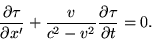
The discussion revolves around solving an algebra problem related to the electrodynamics of moving bodies, specifically focusing on the manipulation of equations involving the speed of light and relative velocities. Participants are examining their calculations and attempting to identify errors in their algebraic steps.
Discussion Character
- Technical explanation
- Debate/contested
- Mathematical reasoning
Main Points Raised
- One participant expresses confusion over a sign discrepancy in their calculations, specifically between fractions in an equation.
- Another participant provides a detailed breakdown of the algebraic steps leading to a common denominator, suggesting that the error may lie in the movement of fractions across the equation.
- A different participant mentions a PDF that may provide an alternative approach to the problem, indicating that it might help clarify the issue.
- One participant acknowledges a mistake in their own PDF, noting a typographical error in the equations presented, which they believe contributed to the confusion.
- Another participant confirms they are experiencing the same issue and plans to review the material to identify the source of the problem.
- One participant expresses relief upon discovering the error was not theirs, indicating a shared sense of confusion among participants.
- A later reply indicates that the PDF has been corrected and now reflects the accurate equations as discussed in the thread.
Areas of Agreement / Disagreement
Participants generally agree that there was a misunderstanding or error in the equations being discussed, but the specific nature of the errors and their resolutions remain contested. Some participants have identified their own mistakes, while others continue to seek clarity on the algebra involved.
Contextual Notes
There are unresolved mathematical steps and dependencies on the accuracy of the equations presented in the PDF. The discussion highlights the challenges of tracking errors in complex algebraic manipulations.