PDA

View Full Version : Tension problem


metalmagik
Oct22-06, 02:33 PM
Part a of the drawing shows a bucket of water suspended from the pulley of a well; the tension in the rope is 101.0 N. Part b shows the same bucket of water being pulled up from the well at a constant velocity. What is the tension in the rope in part b?
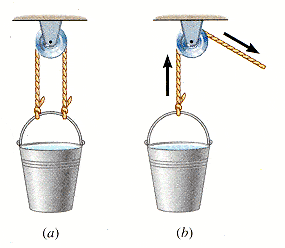
http://www.webassign.net/CJ/p4-46.gif

Is the tension the same? that's all i can think about for it, since it's moving at a constant velocity in (b), which means its not accelerating, it should have the same tension, I believe. Any hints please?

radou
Oct22-06, 02:38 PM
Is the tension the same? that's all i can think about for it, since it's moving at a constant velocity in (b), which means its not accelerating, it should have the same tension, I believe. Any hints please?

Draw a free body diagram for part (a) to determine the weight of the bucket. Then you can determine the tension of the rope in (b) by drawing a free body diagram of the bucket again. (Hint: constant velocity implies that you must use the equation of equilibrium, i.e. the sum of vertical forces acting on the bucket must equal zero.)

metalmagik
Oct22-06, 02:44 PM
Thanks for the response radou.

So in (b), since there are two tension forces...doesn't this not matter? Isn't there still only one going up and the tension is the same, 101 N?

radou
Oct22-06, 02:48 PM
Thanks for the response radou.

So in (b), since there are two tension forces...doesn't this not matter? Isn't there still only one going up and the tension is the same, 101 N?

In (a), there are two same tension forces. In (b), there is one tension force.

metalmagik
Oct22-06, 02:59 PM
I see...so in (b), is the tension in the rope holding the bucket 50.5? If so, I still do not understand how to calculate the other tension, since it is not directly acting on the bucket. This just does not make sense to me. I figured out the bucket has a mass of 10.3 kg...and that's about as far as I got calculation wise.

radou
Oct22-06, 04:32 PM
I see...so in (b), is the tension in the rope holding the bucket 50.5? If so, I still do not understand how to calculate the other tension, since it is not directly acting on the bucket. This just does not make sense to me. I figured out the bucket has a mass of 10.3 kg...and that's about as far as I got calculation wise.

Again, first look at (a). The bucket is at rest, so you can apply the equation of equilibrium, i.e. it is intuitive clear that the following must hold: mg=2*101 = 202. Now, since you know the weight of the bucket (the force of gravity acting on it), you can jump to part (b). Since there is constant velocity involved, you can apply the equations of equilibrium, too (the sum of vertical forces applied onto the bucket must equal zero), so, you have mg = T, where T is the tension you need to find.

metalmagik
Oct22-06, 05:06 PM
I don't know why I can't think straight tonight...I do have a little bit of a cold...sorry for all of this...

since mg = 2 * 101 and mg = T...T must equal 202 N, correct?

radou
Oct22-06, 05:15 PM
I don't know why I can't think straight tonight...I do have a little bit of a cold...sorry for all of this...

since mg = 2 * 101 and mg = T...T must equal 202 N, correct?

Correct. :smile:

metalmagik
Oct22-06, 05:16 PM
Thank you very much...If you're not busy with anything else and are in the mood for helping, respond to this...doing a webassign while sick is no picnic...if not thank you very much anyway.