WarPhalange
I already took 3 quarters of EM and I'm ashamed to say I didn't learn anything the final quarter, where we covered the most interesting topics. Bah.
One thing that I'm still confused about are plane waves. I understand the description of a regular sine wave on string. If you wiggle it once, you'll get a single wave traveling along the string and I can tell you the amplitude and how fast it's going and where it is.
I've also seen pictures like this depicting a photon:
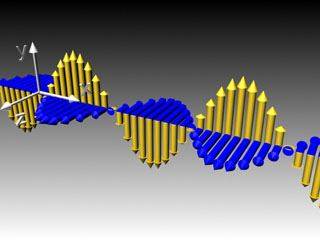
Where E and B are perpendicular to one another and the photon is traveling in the direction of propagation of both. But what I don't get are the E and B fields actually. A more energetic photon will have higher frequencies for the E and B fields, correct?
But where are these fields? Let me explain. I'll take the Yellow arrows as being the E field, and I am standing at a point where E = 0. Then, as a photon zooms by me, will I gradually feel the E-field increase to a maximum and then decrease back to 0, then go negative, and finally back to 0 and then it will stay at 0 forever? Where the time it takes for this to happen is the 1/frequency of the photon (so one wavelength).
Because that picture makes it seem like the E and B fields extend infinitely in the x direction, which is where the photon is traveling.
One thing that I'm still confused about are plane waves. I understand the description of a regular sine wave on string. If you wiggle it once, you'll get a single wave traveling along the string and I can tell you the amplitude and how fast it's going and where it is.
I've also seen pictures like this depicting a photon:
Where E and B are perpendicular to one another and the photon is traveling in the direction of propagation of both. But what I don't get are the E and B fields actually. A more energetic photon will have higher frequencies for the E and B fields, correct?
But where are these fields? Let me explain. I'll take the Yellow arrows as being the E field, and I am standing at a point where E = 0. Then, as a photon zooms by me, will I gradually feel the E-field increase to a maximum and then decrease back to 0, then go negative, and finally back to 0 and then it will stay at 0 forever? Where the time it takes for this to happen is the 1/frequency of the photon (so one wavelength).
Because that picture makes it seem like the E and B fields extend infinitely in the x direction, which is where the photon is traveling.
