PDA

View Full Version : Galaxy rotation and light bending


lalbatros
Nov6-08, 12:27 AM
Hello,

Reading a news on Yahoo, I was asking myself a little question.

I assume there are today extensive data about galaxies rotation as well as light bending by the same galaxies.
The question is: how consistent are these data?
The rotation curve of a galaxy is known to be flatter than "expected"
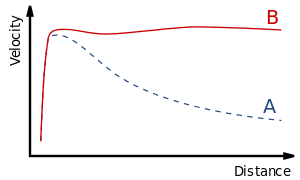
http://upload.wikimedia.org/wikipedia/commons/thumb/b/b9/GalacticRotation2.svg/300px-GalacticRotation2.svg.png
(http://en.wikipedia.org/wiki/Galaxy_rotation_problem).
Would that also imply something about the light bending from the same galaxy?
Would that imply a lower bending of light or a higher bending of light?
And what are the experimental data and correlations?
And are the experimental data consistent with the expectations?

Thanks

Mentz114
Nov6-08, 07:13 AM
The observed galaxy rotation curves are a puzzle. I can't see how gravitational lensing can play a part in this - can you provide a model ? Maybe frame dragging also produces a doppler effect ?

The literature is infested with articles claiming to have solved the rotation curve anomally, but so far nothing really hits the spot.

Naty1
Nov6-08, 09:14 AM
Your wiki reference says:
Dark matter also correctly predicts the results of gravitational lensing observations.


So are your questions related to how closely these lensing observations meet theoretical predictions?

As you likely know, galactic stars some distance from galactic centers do not appear to rotate at expected speeds based on visible matter...to explain the spiral galaxy rotational velocities additional dark matter (mass) is required in the outer portions of galaxies....more mass curves light more but how the closely observational data correlates to various dark mass distribution proposals I don't know. And it could vary for different galaxy types.

THE TROUBLE WITH PHYSICS, by Lee Smolin discusses discuss galactic velocity mass/velocity discrepancies beginning pg 210. He notes In each galaxy where the problem is found it affects only stars moving outside a certain oribit....at a certain distance from the center? No...at a certain star density? no..As one moves further out from the center of a galaxy..there turns out to be a critical acceleration rate that marks the breakdown of Newton's law of gravity....its close to c^2/R, (R is the scale of the observable universe) the cosmological constant! (Discovered in the 1980's it's now called Milgrom's law....his theory: MOND in the Wikipedia article)...MOND does not work outside galaxies...does not make much sense to physicsts...works within about 80 of 100 galaxies studies..

Smolin footnote: More on MOND and supporting data: www.astro.umd.edu/~ssm/mond/.