PDA

View Full Version : bus topology question


Math Is Hard
Oct3-09, 08:34 PM
http://en.kioskea.net/contents/initiation/topologi.php3
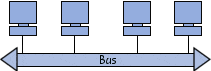
Bus topology is the simplest way a network can be organised. In bus topology, all computers are linked to the same transmission line by using a cable, usually coaxial. The word "bus" refers to the physical line that joins all the machines on the network.

http://static.commentcamarche.net/en.kioskea.net/pictures/initiation-images-bus.gif

What connects the cables coming from the computers to the "bus"? I can't quite get the idea of connecting these cables to another cable when connecting devices aren't mentioned.

mgb_phys
Oct3-09, 10:19 PM
The bus is just the cable running between each computer.
Like an ethernet cable - it's called a bus when it's shared (like the original ethernet) it would be better drawn with the wire looping form one machine to the nex

Math Is Hard
Oct3-09, 11:03 PM
Thanks, MGB. So would it actually look more like this if it was physically set up?

mgb_phys
Oct4-09, 08:44 PM
Ironically it would be better to draw it as a star. The point of a bus is that a voltage on it is immediately seen by all interfaces connected to the bus.

(A star network is different - there is usually some logic in the hub to control where the data goes)

Math Is Hard
Oct4-09, 11:01 PM
Ironically it would be better to draw it as a star. The point of a bus is that a voltage on it is immediately seen by all interfaces connected to the bus.

hmm.. I'm having trouble drawing it as a star configuration without a hub (or switch) since, as you said, then I have a star topology. I less trouble envisioning it wirelessly, but I know that these networks were originally set up using coaxial cable, so there must be a way to diagram that design.

(A star network is different - there is usually some logic in the hub to control where the data goes)
Do you mean a switch? From what I've been reading, hubs seem pretty dumb, just sending the data on to every other host on the network. But I think you could have either a hub or a switch to connect the star network (I don't know this for sure).

Thanks again for your help.

Math Is Hard
Oct5-09, 07:32 PM
I found the solution. The cables can be connected to other cables with T-connectors.

berkeman
Oct5-09, 08:00 PM
The two choices for connecting your devices to a multi-drop doubly-terminated bus are Daisy-Chain or with stubs.

For a given network type, there will be a specification for how long the stubs can be. For RS-485, for example, zero-length stubs (Daisy-Chain routing of the network twisted pair) are mandatory. For some networks, like the 78kbps control network that my company makes transceivers for, the stubs are allowed to be up to 3 meters long.

Math Is Hard
Oct5-09, 10:23 PM
The two choices for connecting your devices to a multi-drop doubly-terminated bus are Daisy-Chain or with stubs.

For a given network type, there will be a specification for how long the stubs can be. For RS-485, for example, zero-length stubs (Daisy-Chain routing of the network twisted pair) are mandatory. For some networks, like the 78kbps control network that my company makes transceivers for, the stubs are allowed to be up to 3 meters long.

Thanks, Berkeman. What is meant by "multi-drop" and what are "stubs"?

berkeman
Oct6-09, 01:44 AM
Thanks, Berkeman. What is meant by "multi-drop" and what are "stubs"?

Your cat is scaring me. But I'll try to answer under duress... :tongue2:

Multi-drop means more than one TX node and one RX node. Two nodes is point-to-point at the ends of the DT bus, which is regular Ethernet comm. >Two nodes is multidrop.

But in control networks and other specialized networks, you want up to 64 nodes all working together, and that's when the multidrop 64 node network comes into play.

berkeman
Oct6-09, 01:49 AM
And sorry. Stubs are the short lengths of twised pair cables that you use to connect the main bus TP to the nodes. They need to be electrically short,

Math Is Hard
Oct6-09, 03:33 PM
Thanks mucho. I'll change my avatar later. Just for you. :wink: