PDA

View Full Version : Trying to wirelessly power an LED.


md5fungi
Oct21-09, 04:47 PM
I'm part of a Senior Design project involving Wireless Energy Transfer. We are trying to power a standard red LED as a demo, via resonant inductive coupling. Our setup is as follows:

We have a 40.64 cm diameter transmitter coil (magnet wire) with 6 turns, hooked up to a signal generator. Our receiver coil has a 2 cm diameter, with 21 turns. We measured the respective resonant frequencies of these two coils, and used 522 pF of equivalent capacitance in parallel with our load (LED) to tune the receiver's resonant frequency to match the transmitter's.

We placed the receiver coil inside the transmitter coil on a table with our signal generator at the resonant frequency. The result was a very very dimly lit LED, and it became brighter when we moved the receiver coil outwards, i.e closer to the transmitter coil. When we look at the output waveform on an oscilloscope, we get ~ 5 V peak-to-peak, and when we rotate the receiver coil so that it is perpendicular to the transmitter coil, the amplitude drops quite a bit, which seems to indicate that resonant inductive coupling is occurring.

The thing is, we're not quite sure why the LED is barely lit. Adjusting the capacitance on our receiver coil does not seem to help, and changing the frequency only makes it dimmer. We are guessing that very very little current is going through our LED, which is why 5 V does not suffice to turn it on. We have tested the LED by hooking it up directly to the signal generator, and it lights up quite brightly.

Any ideas why we are getting such poor efficiency? Even when the receiver coil is very close to the transmitter the LED barely lights up...

Note: We got the LED to bright up very lightly when untwisted the twisted pair of alligator clips we used to connect the receiver coil to the LED. This would seem to indicate that the alligator clips were forming a loop and coupling with our other two loops, however, and that is not what we want.

This is our setup. We've tried this with and without that resistor, we just did that because we thought it might increase the Q:
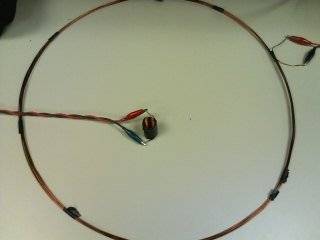
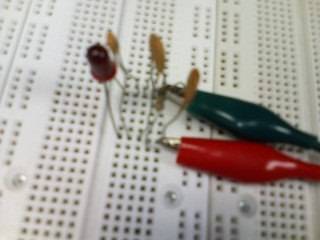
http://yash.srivastava.88.googlepages.com/1021091538.jpg

http://yash.srivastava.88.googlepages.com/1021091538a.jpg

Bob S
Oct21-09, 05:08 PM
The thing is, we're not quite sure why the LED is barely lit. Adjusting the capacitance on our receiver coil does not seem to help, and changing the frequency only makes it dimmer. We are guessing that very very little current is going through our LED, which is why 5 V does not suffice to turn it on. We have tested the LED by hooking it up directly to the signal generator, and it lights up quite brightly.

Any ideas why we are getting such poor efficiency? Even when the receiver coil is very close to the transmitter the LED barely lights up.[/IMG]
Two possibilities.
1) You have a voltage divider, because the small coil is intercepting only a small fraction of the magnetic flux from the large coil.
2) You have a lot of leakage inductance from poor coupling.

See Smythe, "Static and Dynamic Electricity", 3rd edition, page 335; coupling of circular loops.
Bob S

waht
Oct21-09, 05:10 PM
From what I understand, the main coil is connected directly to the signal generator via a twisted pair transmission line (crocodile clips).

For max power transfer, you need to do some impedance matching - the impedance of the signal generator, to the transmission line, and then to the coil loop where the energy is to be dumped, otherwise some of the signal is reflected from the coil back to the generator and thus wasting power.


Chances are that the pick up coil is highly untuned in your setup, the breadboard adds capacitance, and you have it going between the crocodile clips. Try putting the capacitor banks together with the coil, and add a small trimmer cap to tune with screw driver. Make sure that the tank is resonating at the desired frequency by checking it using a sweep generator or a network analyzer if there is one lying around somewhere.


Also, air core coils don't have a high Q, increase the Q by adding a ferromagnetic core.

md5fungi
Oct21-09, 10:17 PM
Thanks for your responses. I will try your suggestions and see what I get.

seb7
Oct22-09, 04:06 AM
Try a SEC exiter.
http://www.youtube.com/watch?v=y9aJohml130
http://www.youtube.com/watch?v=NU2V-tRWR-E

famousken
Oct24-09, 11:28 PM
In the photo, I see you have a single led and the impedance matching capacitors. The problem I see is that your transmitting and receiving coils are both AC devices and an led is a DC device. The led will present a load only to one half of the voltage swing, which may lead to saturation of your coil, I would try placing another led in anti-parallel with the other led.

Phrak
Oct25-09, 12:37 AM
Also, air core coils don't have a high Q, increase the Q by adding a ferromagnetic core.

Watt, wouldn't the addition of core material also increase the coupling? Wireless energy transmission is beyond my kin so I can't comment on this problem.

Would powdered iron core material also be an option?

iulian28ti
Oct28-09, 01:11 PM
Hmmm.... more turns and a core were the first things which came to my mind.

But.... if you're using a high frequency, that core can become a problem.
As Phrak said, perhaps a powedered core will do the trick.

Bob S
Oct28-09, 02:20 PM
two things:

1)At higher frequencies, ferrite cores become lossy, and reduce the Q of the circuit. if you use a ferrite core, if possible choose a frequency under ~ 1 MHz.

2) The impedance of the circuit at resonance is sqrt (L/C), so choose a lower inductance and higher capacitance. This will increase the resonant current in the coil. (Remember that the impedance of a simple antenna is near 72 ohms.) Using sqrt(L/C) over 300 ohms is too high.

Bob S

waht
Oct28-09, 06:29 PM
Watt, wouldn't the addition of core material also increase the coupling?

not much, the magnetic core would have to be closed like in a transformer.

Would powdered iron core material also be an option?

yes, but as stated, different magnetic cores respond differently to different frequency ranges. you have to choose a type that works at the frequency you want to use.

Bob S
Oct28-09, 07:05 PM
Originally Posted by Phrak
Watt, wouldn't the addition of core material also increase the coupling?
not much, the magnetic core would have to be closed like in a transformer..
Ferrite rod antennas are often used for AM reception 550-1600 kHz.
Bob S

md5fungi
Oct28-09, 07:17 PM
Hi, I would just like to provide an update of our project.

We haven't had a chance to look into all of your suggestions, but the impedance matching on our transmitter made a HUGE difference. The LED lit up at what looks like full brightness.

We calculated our power transfer, and seems like we're supplying 92 mW to our transmitter and receiving 46 mW on our receiver at the closest range. The receiver can be a little more than a foot away from the transmitter before the LED turns off fully.

We aren't positive about our power calculations, however... When we hook up an oscilloscope probe (with the ground clip too), the power over our load drops significantly, and our LED turns off. Is there a trick to measuring the voltage of an ungrounded circuit? The best we could do was hook up two probes without the ground clips across our load, and take the difference of the voltages we got.

We are going to explore different antenna designs now; if you could maybe lend some insight regarding this oscilloscope probe, we'd be grateful. My best guess right now is that the probe's impedance is changing the resonant frequency of our receiver... which definitely makes it difficult to take accurate measurements.

vk6kro
Oct28-09, 08:29 PM
A LED is a very non-linear load. That is its resistance varies a lot with the current that is flowing in it.
For measurements, you could try to get a metal film (non inductive) 51 ohm resistor and take your readings with an oscilloscope across this. Not as spectacular as the LED but more useful.

For low impedance drive and low impedance loads, you probably should be using series turned circuits, with the coil in series with the capacitor for the transmit and receive coils.

You will get best coupling between the coils if they are of similar diameter. About a foot would be OK.

What frequency are you using?