SUMMARY
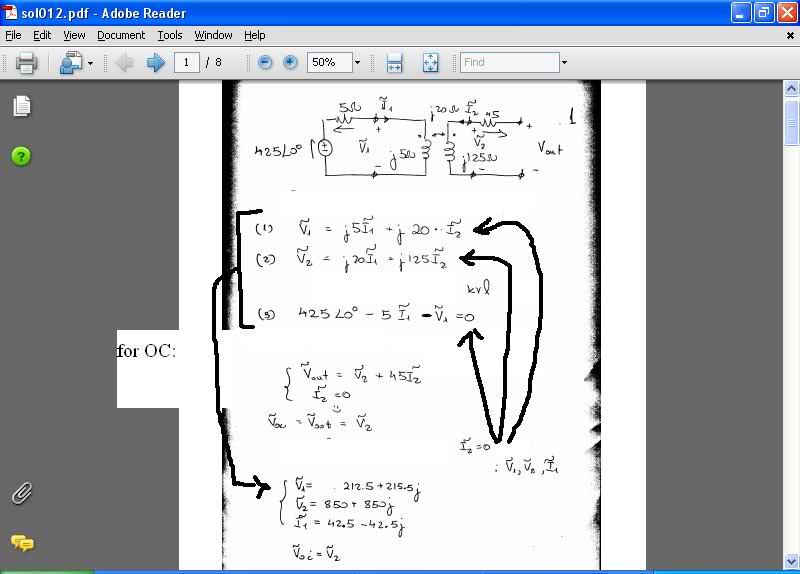
The discussion focuses on solving for I1 from a set of equations after setting I2 to zero. By substituting I2=0 into the equations, the expression for I1 is derived as I1 = 425/(5 + j5). This solution is obtained by manipulating the equations, specifically transforming equation 1 into V1 = j5*I1 and subsequently substituting into equation 3. The final step involves using this value of I1 to find V2 from equation 2.
PREREQUISITES
- Understanding of complex numbers and their representation in electrical engineering.
- Familiarity with basic circuit equations and Ohm's Law.
- Knowledge of algebraic manipulation of equations.
- Experience with phasor analysis in AC circuits.
NEXT STEPS
- Study complex impedance and its applications in AC circuit analysis.
- Learn about phasor representation and calculations in electrical engineering.
- Explore the derivation of voltage and current relationships in RLC circuits.
- Investigate the use of MATLAB for solving complex circuit equations.
USEFUL FOR
Electrical engineers, students studying circuit theory, and professionals involved in AC circuit analysis will benefit from this discussion.