How Do You Solve Complex Pulley System Problems in Physics?

  • Thread starter Thread starter HobieDude16
  • Start date Start date
  • Tags Tags
    Couple Figure
Click For Summary

Homework Help Overview

The discussion revolves around solving complex pulley system problems in physics, specifically involving multiple masses connected by cords and pulleys. Participants are grappling with two specific problems related to the tension in cords and the distance moved by a mass over a given time.

Discussion Character

  • Mixed

Approaches and Questions Raised

  • Participants express frustration in identifying the correct formulas and approaches to solve the problems. Some share their experiences of seeking help from other forums, while others discuss the importance of showing work to receive assistance. There are mentions of free body diagrams and calculations related to acceleration and forces acting on the masses.

Discussion Status

The discussion is ongoing, with participants sharing their attempts and reasoning. Some have provided partial calculations and insights into the problems, while others continue to seek clarification and assistance. There is no explicit consensus on the solutions, but hints and methods are being explored.

Contextual Notes

Participants mention constraints such as the need to adhere to homework guidelines and the challenge of understanding the setup of the problems. There is an acknowledgment of the complexity of the pulley systems involved.

HobieDude16
Messages
70
Reaction score
0
HELP! pulley problems, can't figure formula out...

ok, for physics here at uf, there are 2 problems in this homework i just can't figure out, and I am sure I am just being stupid, but can anyone help me? here they are...

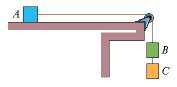
In Figure 5-50, three ballot boxes are connected by cords, one of which wraps over a pulley having negligible friction on its axle and negligible mass. The masses are mA = 22.0 kg, mB = 40.0 kg, mC = 18.0 kg.

Fig. 5-50
W0084-N.jpg


(a) When the assembly is released from rest, what is the tension in the cord that connects boxes B and C?
N
(b) How far does box A move in the first 0.250 s (assuming it does not reach the pulley)?
m

and the other is

Figure 5-55 shows three blocks attached by cords that loop over frictionless pulleys. Block B lies on a frictionless table; the masses are mA = 7.00 kg, mB = 8.00 kg, mC = 10.5 kg. When the blocks are released, what is the tension in the cord at the right?
N
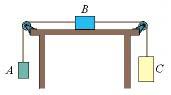
W0080-N.jpg
 
Last edited:
Physics news on Phys.org
i tried for about 3 hours to get these, but i can't seem to figure out what formulas to use, does anyone have any ideas?
 
I have the same problems lol, and no clue how to do them either. I hope someone can help. :)
 
yeah, i can't figure it out, but apparently nobody else on this board can either, nor any of my friends... so i don't think I am going to be able to figure them out
 
Yeah no one i know can solve these problems either.
 
ha, i got the help from a car forum... funny how a car forum would help me before a physics help forum...!
 
how did you do it?
 
Actually, if you both show your work... then people will be more willing to help out!. Remember we're not here to do your homework, but we will gladly provide hints, so you can do it.
 
Last edited:
ah, well, i just asked for some formulas that yall thought would work, not to just give me the answers... which is what the other forum did, and i figured out how to use them, and got the answer!
 
  • #10
With the same argument I used in the first one, calculate the acceleration of the system, do a free body diagram of the body supported by the string in question. In b)

F = ma = (-7kg+10.5kg) *g = 3.5g

Total mass = 25.5 kg

So acceleration of system = g*3.5/25.5

Thus with a downward force of mg on block C (10.5kg) the rest of the force is the tension = 10.5kg*g*22/25.5 = 88.9N

thats how they explained the 2nd one to me, makes a lot of sense when you think about it... and yeah, that's using the numbers from my problem, so if yours are different, change them
 
  • #11
As for rate of acceleration, the same applies. The driving force is the unsupported mass, i.e. (Mass B + Mass C)*g, but its actually accelerating an additonal mass that is not falling also, so it doesn't accelerate at g.

Acceleration = Force/Mass = (Mass B + Mass C)*g / (Total Mass)

= g * 58/80

Then s=ut+0.5*a*t^2 and u = 0

Distance traveled with t = 0.250s...

s = 0.5 * accelerationfromabove * 0.250^2 = 0.22m

there's part b of the first one
 
  • #12
i think this is part a too
We know my g*58/80 is the correct acceleration because it answered section b. Think of block C as a free body diagram. It has force mg downwards obviously, but is only moving downwards at g*58/80. Therefore IT MUST have an upward force of mg*22/80 provided by the string to make it balance.
k, I am leaving now, hope it helps
 
  • #13
hey, hobie, i got same problem, i figure out part b, but wat about part a, i am still confuse about it, thx.
 

Similar threads

Replies
3
Views
2K
  • · Replies 4 ·
Replies
4
Views
3K
Replies
8
Views
5K
  • · Replies 15 ·
Replies
15
Views
3K
Replies
76
Views
9K
  • · Replies 9 ·
Replies
9
Views
2K
  • · Replies 8 ·
Replies
8
Views
5K
  • · Replies 3 ·
Replies
3
Views
2K
  • · Replies 6 ·
Replies
6
Views
4K
  • · Replies 6 ·
Replies
6
Views
3K