PDA

View Full Version : spacetime bending


flyerpower
May16-11, 09:49 AM
I'm having some troubles understanding how spacetime actually looks and what causes gravity and unifying the idea with the general relativity consequences, like light bending.

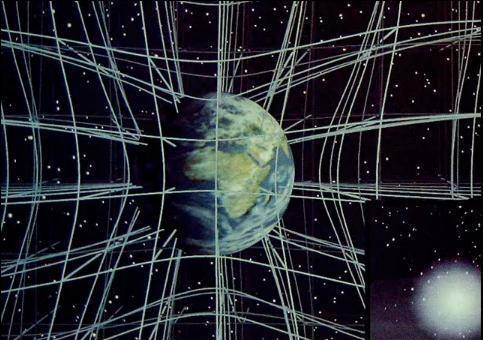
So, if spacetime is bent by massive objects like in this picture:
http://www.physicsforums.com/attachment.php?attachmentid=35613&stc=1&d=1305557173

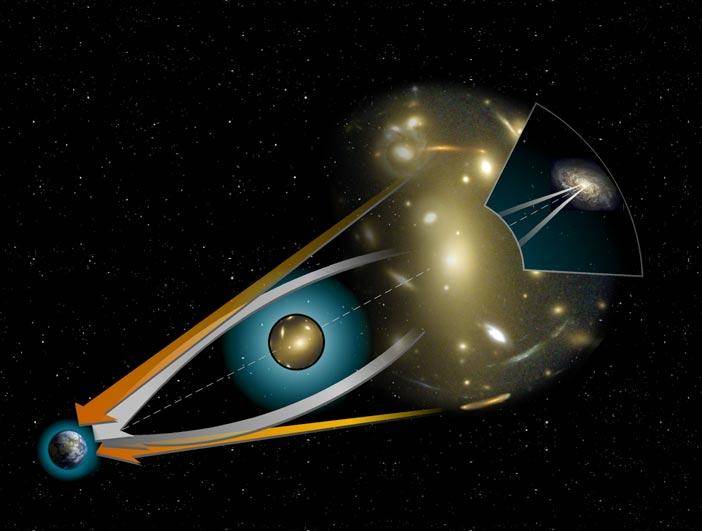
HOW does the light bend outwards that massive object like in this picture :

http://upload.wikimedia.org/wikipedia/commons/0/02/Gravitational_lens-full.jpg

Shouldn't it bend inwards if the spacetime lines are pointing inwards the object?
If the spacetime looks like in the first picture is very easy how to figure out where the gravity comes from.

Nabeshin
May16-11, 11:36 AM
Ultimately, you cannot understand general relativity by hoping to look at pictures and see how spacetime "bends". The only way to do that is to look at and understand the equations.

At any rate, it's much easier if you move the problem down into two dimensions (So you can use the third two denote curvature, i.e. the bowling ball on a rubber sheet analogy). Then it should appear fairly obvious to you why the light rays behave how they do in the 2nd picture.

flyerpower
May16-11, 11:46 AM
Ultimately, you cannot understand general relativity by hoping to look at pictures and see how spacetime "bends". The only way to do that is to look at and understand the equations.

At any rate, it's much easier if you move the problem down into two dimensions (So you can use the third two denote curvature, i.e. the bowling ball on a rubber sheet analogy). Then it should appear fairly obvious to you why the light rays behave how they do in the 2nd picture.

Well, i don't have yet the necessary math knowledge to understand the equations, so i'm just trying to understand the concept.

If i look at the curvature in two dimensions the light bending is obvious for me, but the gravity doesn't, that would mean the gravity force would not point to the center of the earth.

yenchin
May16-11, 11:50 AM
Ultimately 4-dimensional spacetime curvature cannot be visualized, we can only talk so much about imagining a curved 2-dimensional surfaces etc. but it is not the real thing. All these analogies really don't teach you much other than give you a very rough idea (which will break down if you try to go into the details of the analogy too much)

http://imgs.xkcd.com/comics/teaching_physics.png

yenchin
May16-11, 11:55 AM
Having said that, maybe you can try this: http://arxiv.org/abs/0708.2483
But I have not read this article in details.

HallsofIvy
May16-11, 12:01 PM
I'm having some troubles understanding how spacetime actually looks and what causes gravity and unifying the idea with the general relativity consequences, like light bending.

So, if spacetime is bent by massive objects like in this picture:
http://www.physicsforums.com/attachment.php?attachmentid=35613&stc=1&d=1305557173

HOW does the light bend outwards that massive object like in this picture :

http://upload.wikimedia.org/wikipedia/commons/0/02/Gravitational_lens-full.jpg

Shouldn't it bend inwards if the spacetime lines are pointing inwards the object?
If the spacetime looks like in the first picture is very easy how to figure out where the gravity comes from.
I don't understand your question. In both pictures, the lines are bending inward, not outward.

Passionflower
May16-11, 12:33 PM
HOW does the light bend outwards that massive object like in this picture :

http://upload.wikimedia.org/wikipedia/commons/0/02/Gravitational_lens-full.jpg

Shouldn't it bend inwards if the spacetime lines are pointing inwards the object?

Actually the picture does not show light bending outwards.

Remember that the light leaves the nebula from all directions! All rays in the picture bend towards the gravitating object.

flyerpower
May16-11, 12:43 PM
Actually the picture does not show light bending outwards.

Remember that the light leaves the nebula from all directions! All rays in the picture bend towards the gravitating object.

Probably you are referring to the earth, i meant the object between the earth and the source of light.

yenchin
May16-11, 12:49 PM
Probably you are referring to the earth, i meant the object between the earth and the source of light.

I think we are still somewhat confused. The light also bends inward (note the curvature is *toward* not *away*) the object between Earth and source of light. The white curve denotes the light ray that would have otherwise go in straight line but bent *inward* by its gravity instead and therefore towards Earth.

flyerpower
May16-11, 01:03 PM
Oh, now i see, i didn't pay much attention to what Passionflower said
Remember that the light leaves the nebula from all directions! All rays in the picture bend towards the gravitating object.

Thanks.

jambaugh
May16-11, 01:15 PM
http://imgs.xkcd.com/comics/teaching_physics.png

LOL!!!! Beautifully Perfect cartoon... where did you find it??

yenchin
May16-11, 01:24 PM
lol!!!! Beautifully perfect cartoon... Where did you find it??

xkcd :-)

jambaugh
May16-11, 01:26 PM
How I found to "visualize" it is to firstly not ignore time. I imagine (with one less spatial dimension) a central mass as a (heavy) line in the t direction. Then imagine fluid flow (its velocity representing reciprocal of clock ticks for an array of clocks around the mass). The central mass slows down clocks (spreading out ticks and thus shorter reciprocal ticks). Now imagine other objects being sheared inward toward the central mass as lines refracting toward slower time.

Use relativity of simultaneity to arbitrarily match up parallel ticks as a spatial surface (with time-like normal) and notice how as you propagate forward to later ticks the normal turns inward. I'll work up a diagram and post it in a bit.

A.T.
May16-11, 03:20 PM
How I found to "visualize" it is to firstly not ignore time.
See also related discussion and links in this post:
http://www.physicsforums.com/showthread.php?p=2046692&postcount=4


I imagine (with one less spatial dimension) a central mass as a (heavy) line in the t direction. Then imagine fluid flow (its velocity representing reciprocal of clock ticks for an array of clocks around the mass). The central mass slows down clocks (spreading out ticks and thus shorter reciprocal ticks). Now imagine other objects being sheared inward toward the central mass as lines refracting toward slower time.


That is a way to get 2 + 1 spacetime in a 3d picture. Instead of embedding curved 2 space or 2 + 1 spacetime in 3d, we can represent intrinsic curvature as varying density of spacetime. Then we can use the analogy between the worldlines of freefallers in that spacetime and a laser beam in a medium of varying optical density. Both are bend towards the denser area. With two spatial dimensions and time we can visualize orbits, by a laser beam spiraling around a denser column in the medium.

And if we use the propertime as the time dimension, we can even visualize gravitational by a laser that advances slower along that dimension, when going trough a denser area.