PDA

View Full Version : Was Halton Arp hard done by? Need some clarification. some pictures


Yesifeed
May30-11, 09:40 AM
Some time ago Halton Arp made a prediction that big red shifted galaxies are connected to smaller red shifted galaxies. Does anybody know what exactly was his prediction.

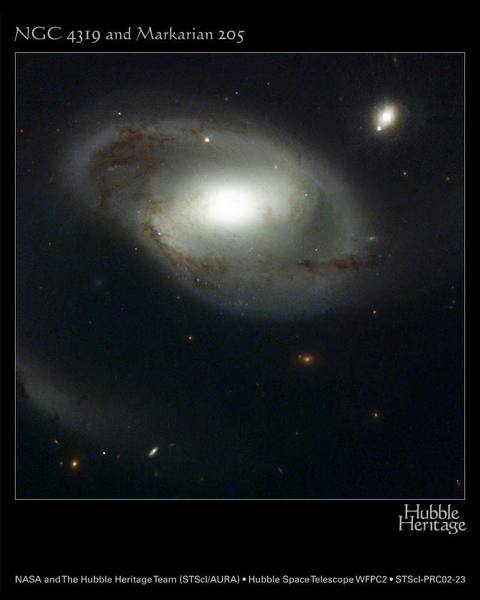
Anyway so NASA and The Hubble Heritage Team tried to discredit him using this image:

http://i.imgur.com/RBWHO.jpg


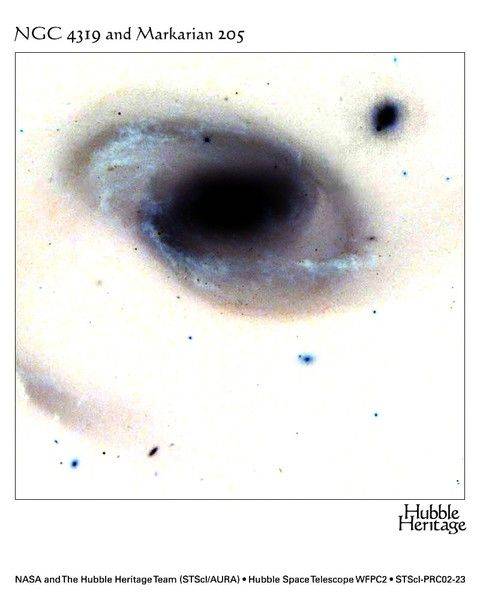
But look what happens when you invert that image:

http://i.imgur.com/V9FdO.jpg


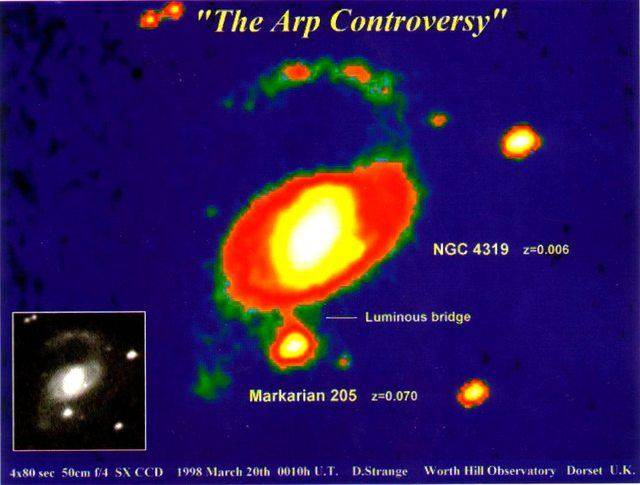
The same thing from a different source and correct me if i am wrong, measuring the redshift.

http://i.imgur.com/KkkLal.jpg

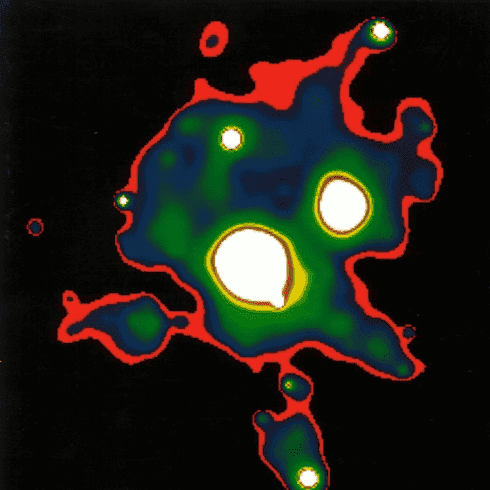
This is the same thing via an Xray.

http://i.imgur.com/dS0yh.jpg

I hear he got "lepered" in Germany. I am curious as to what Arp did that was so wrong?

Mentor Note: Please size pictures to no larger than 650 x 490.

turbo
May30-11, 10:18 AM
Arp argued that redshift was not an absolute indicator of cosmological distance and recession, but there was some component of redshift that is intrinsic to the objects being observed. Such a view was heresy, and as a result, the time allocation committee cut off his observation time at Palomar, then at the telescope in Chile. An observational astronomer with no access to telescopes... not good!

Hurkyl
May30-11, 11:43 AM
Anyway so NASA and The Hubble Heritage Team tried to discredit him using this image:
Surely you mean "tried to refute his theory"?

But look what happens when you invert that image:
So?

I hear he got "lepered" in Germany.
:confused:

I am curious as to what Arp did that was so wrong?
:confused:


Such a view was heresy
Surely you're just trying to be humorous rather than trolling for a response, right?

Dotini
May30-11, 01:11 PM
Wasn't (isn't?) Arp a creationist - or at least one who occasionally alludes to "God"? Perhaps this would tend to partially explain why he is shunned by more respectable academics and institutions?

Respectfully submitted,
Steve

turbo
May30-11, 02:15 PM
Surely you're just trying to be humorous rather than trolling for a response, right?Not in the least. Even Edwin Hubble was not convinced that redshift was proof of recession/cosmological expansion. In private correspondence a few weeks after the 1988 "Cosmology in Retrospect" symposium, Arp told me that in Hubble's old papers, Hubble always said "if redshift means velocity", and mentioned that in a paper published in 1953 after his death, Hubble said "c x z = velocity is not formally correct".

Halton Arp, the Burbidges, et al may be quite wrong in invoking intrinsic redshifts. They have dug up many examples of apparently-interacting objects with discordant redshifts. My collaborators and I assembled a large catalog of M-51-type galaxy associations, and published that paper in a Springer journal. The smaller companions are overwhelmingly redshifted WRT their host galaxies. This may be entirely an artifact of chance projection, though it is hard to make such a case when the spiral arm connecting to the companion is distorted and/or asymmetrical.

Yesifeed
May30-11, 05:54 PM
I apologize for the large pictures, i will resize but it will take a 1/4 of an hour or so.

Do i need to resize the original 2 images?


Surely you mean "tried to refute his theory"?

I think maybe "tried to discredit his prediction" as in "put into doubt" is more accurate, i am not sure that you can really "refute" something like this with a single picture.


So?

You cant see the faint gaseuos bridge?

George Jones
May30-11, 06:31 PM
You cant see the faint gaseuos bridge?

Read

http://heritage.stsci.edu/2002/23/supplemental.html.

D H
May30-11, 06:31 PM
You cant see the faint gaseuos bridge?
There's no bridge there. At least that is the scientific consensus.

Think of it this way. You're driving down the road and see a radio tower in the distance that just happens to look like it is coming out of the top of a nearby building. The tower of course is not coming out of the top of the building. It just happens to look like it is.

Another way to look at it: People have grouped stars into constellations since before written history. Many of those stars that we see as being close together are in fact very, very far apart. When we see two stars as being close to one another, what we are seeing is a small angular separation from the perspective of our particular location in the galaxy. The perspective from some other location might well be something quite different.

Arp spent his time looking for objects that appeared to be close together. Some of the objects he found truly are close together but others are not. NGC 4319 and Markarian 205 are in the latter category.

Hurkyl
May30-11, 06:45 PM
Not in the least.
(Irrelevant words snipped) Then care to provide a reference for your assertion that he was cut off for heretical views?

(note: arguing whether his theories are right or wrong is completely irrelevant for your assertion)

matt.o
May30-11, 06:56 PM
My collaborators and I assembled a large catalog of M-51-type galaxy associations, and published that paper in a Springer journal. The smaller companions are overwhelmingly redshifted WRT their host galaxies.

Your claim that the smaller companions are "overwhelmingly redshifted" has been previously examined and the evidence has been shown to be rather underwhelming. See the following post:

http://physicsforums.com/showpost.php?p=2397153&postcount=41

Yesifeed
May30-11, 07:10 PM
Thanks for the input. I read that link you gave George Jones. Interesting. They say the issue is debateable but as more and more images are gotten the less likely that it is the case.

Hurkyl
May30-11, 07:18 PM
You cant see the faint gaseuos bridge?
No. I see a small fuzzy circle near to a large fuzzy ellipse.

While I can see what you are making out to be a "faint gaseous bridge", it simply doesn't look to me like anything other than a small fuzzy circle next to a large fuzzy ellipse.

I know some of the sorts of artifacts that can appear in this sort of image to give a misleading appearance -- but I don't even see those artifacts here. You are only seeing a bridge because you want to see one, or are possibly suffering an optical illusion.

I really don't trust eyes and brains for doing this sort of image classification.


I decided to have a fun image-making experiment. The pictures below contain two disks. Nothing else -- just two disks.

I processed the image by smearing them out (to make a fringe), applying a threshold value for white and black, and interpolating between the thresholds with shades of gray.

Here is the image.
http://www.physicsforums.com/attachment.php?attachmentid=36059&stc=1&d=1306800803
There's the clear appearance of a faint bridge, despite such a thing simply not existing in the underlying picture.


I moved the circles a bit closer and did the same process.
http://www.physicsforums.com/attachment.php?attachmentid=36060&stc=1&d=1306800789
It doesn't even look like a bridge anymore -- they look actually connected!


Here is the unprocessed image. (for the second case of the circles being slightly closer)
http://www.physicsforums.com/attachment.php?attachmentid=36061&stc=1&d=1306801036

Yesifeed
May30-11, 07:37 PM
Thanks it does seem i was suffering an optical illusion, i looked at it again after reading what you wrote it seems less connected. But what of the other 2 images?

Hurkyl
May30-11, 07:45 PM
Thanks it does seem i was suffering an optical illusion, i looked at it again after reading what you wrote it seems less connected. But what of the other 2 images?
Your third image could very well be the sort of processing artifact I made a sample of.

The difference between red and green looks very steep to the human eye, but I have absolutely no idea how the colors correspond to actual data, or otherwise what processing was done on the image.

I don't have the expertise to tell the difference between an actual object and an artifact -- especially since I have no clue as to the underlying data.


I can't figure out what the fourth image is showing.

Yesifeed
May30-11, 07:57 PM
Fair enough. The 4th image is of Markian 205 aswell apparently and the bridge is to the top right for some reason.

EDIT: The third image was of the image measuring redshift, i am not aware that other post processing was done.

turbo
May30-11, 11:16 PM
Your claim that the smaller companions are "overwhelmingly redshifted" has been previously examined and the evidence has been shown to be rather underwhelming. See the following post:

http://physicsforums.com/showpost.php?p=2397153&postcount=41http://arxiv.org/abs/0805.1492

There is the data. "underwhelming" may be your caricaturisation, but we can't pick and choose in observational astronomy. Either the universe follows some rules, or it's Katy Bar The Door.

matt.o
May30-11, 11:25 PM
http://arxiv.org/abs/0805.1492

There is the data. "underwhelming" may be your caricaturisation, but we can't pick and choose in observational astronomy. Either the universe follows some rules, or it's Katy Bar The Door.

Thanks for the link to the paper. Keen readers (i.e., those that bothered to read the post I linked to) will note that those were the data used in the linked post above.

Chalnoth
May31-11, 05:03 AM
It is always sad when a formerly-good scientist goes down the road of complete crackpot. Arp is one of the more prominent examples, though there are so many others. His primary offense is that he stopped paying attention to anybody else's arguments, and more importantly stopped paying attention to the evidence, and continued to parrot his theories anyway. That is a heresy that science cannot abide: the heresy of divorcing yourself from reason and evidence.

In this particular case, Arp never presented a compelling argument for how this redshift might be "intrinsic". Also bear in mind that today we have correlated redshift with a number of different distance measures across an obscene range of distance (many billions of light years). We have also been able to resolve the host galaxies of many quasars, such as in this image above (Arp believed that quasars were objects ejected from galaxies, instead of just being the cores of active galaxies).

twofish-quant
Jun1-11, 12:20 AM
Such a view was heresy, and as a result, the time allocation committee cut off his observation time at Palomar, then at the telescope in Chile.

Telescope time is an extremely precious commodity, and giving time to him means taking it away from someone else.

Also, if we are *that* wrong about quasars, then you should be able to think of some way of showing that with telescope time that is less in demand.

twofish-quant
Jun1-11, 12:30 AM
That is a heresy that science cannot abide: the heresy of divorcing yourself from reason and evidence.

And note that no one is burning him at the stake or anything like that.

If you have a weird unconventional theory, that's fine. If you have a weird and unconventional theory and something to prove it, then you have a problem. If you want to look for the Loch Ness monster, that's fine, but if you want to use my boat and have me pay for your expenses, then you have a problem.

In this particular case, Arp never presented a compelling argument for how this redshift might be "intrinsic".

And this poses a problem because telescope time in large telescopes is too precious to use for fishing expeditions.

Arp believed that quasars were objects ejected from galaxies, instead of just being the cores of active galaxies.

And note that this was a perfectly reasonable thing to believe in 1970. The problem is that during the 1970's, people came up with more and more reasons to think that quasars are distant objects, so Arp just got left behind as the crowd moved forward.

Also, every physicist has some crackpot ideas, but one trick you have to learn in being a productive crackpot is how not to look like a crackpot. My *real* motivation might be to look for the Loch Ness monster, but to get the boat and the crew I just tell everyone that I'm interested in studying the effect of greenhouse gases and pollution on Scottish lakes. If I'm in charge of environmental protection in Scotland, I don't really care if you are looking for the Loch Ness monster, as long as I get my numbers.

Arp isn't the only one that has to do this. Scientists generally have to sell their research priorities to funders and telescope allocation committees, and I don't see that this is a bad way of dividing up scarce resources.

Hurkyl
Jun1-11, 12:12 PM
Also, every physicist has some crackpot ideas,
Really, no idea is crackpot. It's the mindset that goes with the idea that can be crackpot. One can very easily be a crackpot pushing an idea that is actually correct, as well as being a perfectly professional scientist pursuing an idea that is wrong, (or likely to be so).

twofish-quant
Jun1-11, 09:44 PM
Really, no idea is crackpot. It's the mindset that goes with the idea that can be crackpot.

That doesn't quite fit what I've seen. There are a lot of examples of extremely productive and brilliant scientists that have had totally weird ideas (Robert Penrose and neuroscience , Fred Hoyle and cosmology, is another, Thomas Gold and natural gas, Newton and Einstein about a lot of things).

There is a Nobel Prize winner that people knew never to mention black holes around, because the second you did, you'd get this long rant about how they didn't exist. There is also a member of the National Academy of Sciences that has some very unconventional ideas on galactic jets (he doesn't believe they exist).

One thing that is interesting is that what makes someone a totally brilliant scientist can also make them a crackpot. A crackpot is someone that holds on to an idea despite all evidence to the contrary, and sometimes that person can be totally brilliant if he is lucky and right. Sometimes someone can be wrong about one thing, but no one cares because they are brilliant in something else (Penrose).

One can very easily be a crackpot pushing an idea that is actually correct, as well as being a perfectly professional scientist pursuing an idea that is wrong, (or likely to be so).

A crackpot that pushes an idea that turns out to be correct wins the Nobel Prize. Something about "productive crackpots" is that they are often working on several weird ideas. The one that works gets them the world fame. The ones that don't, people forget about.

There are a lot of professional scientists that are crackpots about some things. Personally, I don't think that you can be a productive scientist without being a semi-crackpot.

I think the difference is not having weird ideas or even being irrationally transfixed with ideas. I think the difference is whether you have a sense of humor and aren't annoying to be around. The astrophysicist that I know who has weird ideas about galactic jets, is actually quite nice, and he started his talk with "Yes, I know everyone thinks I'm nuts, but since you asked me to talk about what I think about galactic jets......." It also helps to have a dozen different ideas. If you have irrational ideas about a dozen things, then you might get ultra-lucky with one of them.

If you go around telling about how "they are trying to get you" then people stop wanting to talk to you, especially if you happen to be "them."

TrickyDicky
Jun2-11, 04:55 AM
That doesn't quite fit what I've seen. There are a lot of examples of extremely productive and brilliant scientists that have had totally weird ideas (Robert Penrose and neuroscience , Fred Hoyle and cosmology, is another, Thomas Gold and natural gas, Newton and Einstein about a lot of things).

There is a Nobel Prize winner that people knew never to mention black holes around, because the second you did, you'd get this long rant about how they didn't exist. There is also a member of the National Academy of Sciences that has some very unconventional ideas on galactic jets (he doesn't believe they exist).

One thing that is interesting is that what makes someone a totally brilliant scientist can also make them a crackpot. A crackpot is someone that holds on to an idea despite all evidence to the contrary, and sometimes that person can be totally brilliant if he is lucky and right. Sometimes someone can be wrong about one thing, but no one cares because they are brilliant in something else (Penrose).


A crackpot that pushes an idea that turns out to be correct wins the Nobel Prize. Something about "productive crackpots" is that they are often working on several weird ideas. The one that works gets them the world fame. The ones that don't, people forget about.

There are a lot of professional scientists that are crackpots about some things. Personally, I don't think that you can be a productive scientist without being a semi-crackpot.

I think the difference is not having weird ideas or even being irrationally transfixed with ideas. I think the difference is whether you have a sense of humor and aren't annoying to be around. The astrophysicist that I know who has weird ideas about galactic jets, is actually quite nice, and he started his talk with "Yes, I know everyone thinks I'm nuts, but since you asked me to talk about what I think about galactic jets......." It also helps to have a dozen different ideas. If you have irrational ideas about a dozen things, then you might get ultra-lucky with one of them.

If you go around telling about how "they are trying to get you" then people stop wanting to talk to you, especially if you happen to be "them."

I'm not totally sure this picture is correct, but I would like to think it is.

In the end the key point is: no matter how crackpot an idea may be, does it work? and another very important point , does it fit in the general working model in cosmology?
The specific problem in cosmology is that many hypothesis can be neither experimentally tested nor directly observed, so basically there is not really a good way to know if they work or not, so the default mode is to declare valid only those ideas that fit in the general working model (that is known to be working within some limitations like too many tweakable fudge parameters but that's another story).
This is the logical way to act if you wanna be practical, and being practical is very important in science.
In this sense probably the way Arp carried himself about his insights on quasars and redshift was not very clever, he might have kept his telescope time just by being more diplomatic and first and foremost he should have developed a general model that worked in order to fit in his "observations".
The reality is that Arp's pictures can be explained in different ways and the most practical thing to do is picking the interpretations that fit in the general working model.

twofish-quant
Jun3-11, 01:55 AM
In the end the key point is: no matter how crackpot an idea may be, does it work? and another very important point , does it fit in the general working model in cosmology?

The latter isn't very important. The standard model could be very wrong in some areas. It's not that astrophysicists are against weird ideas in general, but people have a strong reaction to particular weird ideas because they just don't match what people see.

It's fine to say that the Loch Ness monster exists, but you will get some strange looks if you insist that it lives in Times Square.

The specific problem in cosmology is that many hypothesis can be neither experimentally tested nor directly observed, so basically there is not really a good way to know if they work or not.

That's not a problem, and one of the big misconceptions is that we are in the dark. We have tons and tons and tons of observations. One reason almost no one believes that quasars are nearby is that we can use VLBI observations to zoom in on them and see what they are, and they appear to be massive black holes.

People look at quasars every day. They aren't mysterious objects.

The default mode is to declare valid only those ideas that fit in the general working model

Not true. If you insist that general relativity is wrong, then no one is going to think that you are weird.

In this sense probably the way Arp carried himself about his insights on quasars and redshift was not very clever, he might have kept his telescope time just by being more diplomatic and first and foremost he should have developed a general model that worked in order to fit in his "observations".

The problem is that Arp's views weren't that unusual for 1965, and they are quite reasonable if you limit yourself to what was known about quasars in 1965. Part of the problem is that in 1965, no one could come up with a way of generating the type of energy that you need to power them. The current idea of gas falling into a black hole works nicely. Trouble is that the idea of a black hole was invented in 1968.

Also people somehow assume that Arp is some creative genius when in fact what has happened is that he has stuck to some old ideas long, long, long after the data convinced pretty much everyone else that those ideas were wrong. People will cut you a lot of slack for coming up with nutty ideas if they are *new* nutty ideas. Arp's ideas aren't.

The reality is that Arp's pictures can be explained in different ways and the most practical thing to do is picking the interpretations that fit in the general working model.

No. That's not true.

The problem is that if I show you a blurry picture of Times Square, then I can't prove that this isn't the Loch Ness monster. The reason I don't think the Loch Ness monster lives in Times Square is that people pass there every day, and there ain't no monster.

The sad thing is that if you are obsessed with looking for the Loch Ness monster, you'll miss the UFO and Bigfoot that was there. I'm pretty sure that if you put me into a time machine and traveled back to 1965 and had me a debate with Arp based only on the evidence that existed in 1965, I'd lose badly, and people there would think that I'm was a lunatic.

Q: So what powers these quasars?

Me: Black holes.

Q: What's a black hole?

Me: Well there are these million solar mass objects which are so massive that light can't escape....

Q: Oh.... And what evidence do you have that these so called "black holes" can exist?

Me: Well, if you point a VLBI, oh.... Hasn't been invented yet. Well if you take space based gamma ray.... Oh... Hasn't been invented either...... Well they are like pulsars.... But people haven't seen those..... Well, you can simulated them with supercomputers that .... Oh. You don't have supercomputers.... Ummmm...

TrickyDicky
Jun3-11, 03:36 AM
The latter isn't very important. The standard model could be very wrong in some areas. It's not that astrophysicists are against weird ideas in general, but people have a strong reaction to particular weird ideas because they just don't match what people see.

It's fine to say that the Loch Ness monster exists, but you will get some strange looks if you insist that it lives in Times Square.


That's not a problem, and one of the big misconceptions is that we are in the dark. We have tons and tons and tons of observations. One reason almost no one believes that quasars are nearby is that we can use VLBI observations to zoom in on them and see what they are, and they appear to be massive black holes.

People look at quasars every day. They aren't mysterious objects.


Not true. If you insist that general relativity is wrong, then no one is going to think that you are weird.


The problem is that Arp's views weren't that unusual for 1965, and they are quite reasonable if you limit yourself to what was known about quasars in 1965. Part of the problem is that in 1965, no one could come up with a way of generating the type of energy that you need to power them. The current idea of gas falling into a black hole works nicely. Trouble is that the idea of a black hole was invented in 1968.

Also people somehow assume that Arp is some creative genius when in fact what has happened is that he has stuck to some old ideas long, long, long after the data convinced pretty much everyone else that those ideas were wrong. People will cut you a lot of slack for coming up with nutty ideas if they are *new* nutty ideas. Arp's ideas aren't.


No. That's not true.

The problem is that if I show you a blurry picture of Times Square, then I can't prove that this isn't the Loch Ness monster. The reason I don't think the Loch Ness monster lives in Times Square is that people pass there every day, and there ain't no monster.

The sad thing is that if you are obsessed with looking for the Loch Ness monster, you'll miss the UFO and Bigfoot that was there. I'm pretty sure that if you put me into a time machine and traveled back to 1965 and had me a debate with Arp based only on the evidence that existed in 1965, I'd lose badly, and people there would think that I'm was a lunatic.

Q: So what powers these quasars?

Me: Black holes.

Q: What's a black hole?

Me: Well there are these million solar mass objects which are so massive that light can't escape....

Q: Oh.... And what evidence do you have that these so called "black holes" can exist?

Me: Well, if you point a VLBI, oh.... Hasn't been invented yet. Well if you take space based gamma ray.... Oh... Hasn't been invented either...... Well they are like pulsars.... But people haven't seen those..... Well, you can simulated them with supercomputers that .... Oh. You don't have supercomputers.... Ummmm...
I don't now what all those "Not true" are about whent after saying it you go on to either explain the same thing I meant with different words or just miss completely the point of what I was referring to.
My post was agreeing with your previous post about crackpots ideas, I guess you debate for the sake of debating, I bet you have great arguments with yourself.
Not a single one of my statements is untrue, in the general ones I'm not referring to quasars specifically but to cosmology in general, and when I speak about Arp's pictures, I'm acknowledging that with the current knowledge the mainstream explanation is the most likely to be true, among the possible mechanisms that the pictures by themselves allow.
When I say that no matter how crackpot an idea sounds, if it fits in the cosmological model (LCDM)(previously modified to fit it in) then it will be accepted, I think of ideas like Dark matter, inflation or worm holes. Not strictly referring to GR since this theory admits a high number of different solutions that can be applied to differnt settings (from FRW solutions for cosmological redshift to static solutions for solar system problems, etc).
Are you denying that cosmology is still a highly speculative science? I'm not saying we are in the dark, sure we have many observations, but are you denying that in cosmology experiment is harder that in the rest of the physical science and that some objects can't be directly observed (say black holes) or that there are hypothesis that can't be verified and have to rely on theory dependent interpretations? This is all basic stuff, IMHO.

twofish-quant
Jun3-11, 04:28 AM
I don't now what all those "Not true" are about whent after saying it you go on to either explain the same thing I meant with different words or just miss completely the point of what I was referring to.

I think you put too much brief in the standard model of cosmology, and you vastly underestimate the amount of data that is available.

I'm pretty sure that there are significant parts of the standard model that are wrong, and we've found major bits wrong in the last ten years. It's just that I don't think that it is wrong in the way that Arp thinks that it is.

I'm acknowledging that with the current knowledge the mainstream explanation is the most likely to be true, among the possible mechanisms that the pictures by themselves allow.

I'm pretty sure we have several significant things wrong. It will be interesting to see what they are.

When I say that no matter how crackpot an idea sounds, if it fits in the cosmological model (LCDM)(previously modified to fit it in) then it will be accepted, I think of ideas like Dark matter, inflation or worm holes.

One should note here that Arp's idea that quasars are local doesn't contradict LCDM.

Ultimately LCDM just produces a curve. It turns out that curve precisely fits observations. If it turns out that we've messed up something, then LCDM is out the window. Before 1998, CDM was the model. People added L when CDM wouldn't work. I wouldn't be terribly surprised if we start talking about xLCDM.

Also it depends on what you mean by "accepted." Most of the ideas that are flying around are mutually exclusive, if it is X then it can't be Y.

Not strictly referring to GR since this theory admits a high number of different solutions that can be applied to differnt settings (from FRW solutions for cosmological redshift to static solutions for solar system problems, etc).

It's been seriously proposed that at large scales, GR is wrong. There is an industry producing alternative gravity models to explain acceleration.

Are you denying that cosmology is still a highly speculative science?

Yes, I am. Cosmology is no more speculative than planetary science, and we know a lot more about the cosmic microwave background than hot Jupiters or monetary policy.

Pre-inflationary stuff is weird and speculative, but anything that happens after that is no more speculative than atoms or lunar physics.

I'm not saying we are in the dark, sure we have many observations, but are you denying that in cosmology experiment is harder that in the rest of the physical science and that some objects can't be directly observed (say black holes)

Yes I am. Black holes are not much harder to observe than atoms, and easier to observe than small exo-planets. And you can directly observe black holes. We have some nice pictures of them.

There are hypothesis that can't be verified and have to rely on theory dependent interpretations? This is all basic stuff, IMHO.

You can get into deep philosophical questions about the nature of scientific evidence, but cosmology is no worse at having unverifiable hypothesis and theory dependent interpretations than oceanography or botany, and the philosophical issues that you have in cosmology are much less bad than in economics or sociology.

Yes this is basic stuff, which is why I'm peeve when popular science works get it wrong.

Chalnoth
Jun3-11, 05:53 AM
The problem is that Arp's views weren't that unusual for 1965, and they are quite reasonable if you limit yourself to what was known about quasars in 1965. Part of the problem is that in 1965, no one could come up with a way of generating the type of energy that you need to power them. The current idea of gas falling into a black hole works nicely. Trouble is that the idea of a black hole was invented in 1968.
I'm pretty sure that his idea that these objects were ejected from galaxy cores was pretty nonsensical from the start, because not only was there no model whatsoever for what they actually were within Arp's idea, but they also had spectra of the quasars at that time. With no known physical method for producing such large redshifts except by either large recession velocities or gravitational redshift, Arp's idea that these redshifts were "intrinsic" was nutty from the start.

TrickyDicky
Jun3-11, 07:42 AM
I'm pretty sure that there are significant parts of the standard model that are wrong, and we've found major bits wrong in the last ten years. It's just that I don't think that it is wrong in the way that Arp thinks that it is.
We agreed on this all along.


One should note here that Arp's idea that quasars are local doesn't contradict LCDM.

Ultimately LCDM just produces a curve. It turns out that curve precisely fits observations. If it turns out that we've messed up something, then LCDM is out the window. Before 1998, CDM was the model. People added L when CDM wouldn't work. I wouldn't be terribly surprised if we start talking about xLCDM.

And this only goes to show that when you have a model that can be made to accomodate anything just by adding one more letter to its acronym, their proponents might just be either fooling themselves or pulling your leg.


It's been seriously proposed that at large scales, GR is wrong. There is an industry producing alternative gravity models to explain acceleration.

Maybe it's not GR that is wrong but the specific solutions with problems at large scales.


Yes I am. Black holes are not much harder to observe than atoms, and easier to observe than small exo-planets. And you can directly observe black holes. We have some nice pictures of them.
Are you serious? Atoms are currently easy to observe. Can't you make the distinction between indirect and direct observation?
Show me a picture of a BH, not that something that could also reasonably be a different thing. By definition, you can't directly observe a black hole.

Chalnoth
Jun3-11, 07:50 AM
And this only goes to show that when you have a model that can be made to accomodate anything just by adding one more letter to its acronym, their proponents might just be either fooling themselves or pulling your leg.
Now that is a rather asinine mischaracterization. The cosmological constant absolutely, positively does not allow the standard cosmological model to "accommodate anything". Quite the opposite in fact: many other alternative explanations have already been shown to be false, while the cosmological constant has so far proven to be the best explanation for the observed acceleration.

Finally, if you think that one extra free parameter can ever explain "anything", then you've lost your mind.

Maybe it's not GR that is wrong but the specific solutions with problems at large scales.
Except that it is at large scales that our solutions are the most under control.

TrickyDicky
Jun3-11, 07:59 AM
Now that is a rather asinine mischaracterization. The cosmological constant absolutely, positively does not allow the standard cosmological model to "accommodate anything". Quite the opposite in fact: many other alternative explanations have already been shown to be false, while the cosmological constant has so far proven to be the best explanation for the observed acceleration.

Finally, if you think that one extra free parameter can ever explain "anything", then you've lost your mind.


Wow, when you have to recur to such ofensive expressions as asinine and "you've lost your mind" I might be on the right track.
Anyway I was developing what Twofish-quant posted:"If it turns out that we've messed up something, then LCDM is out the window. Before 1998, CDM was the model. People added L when CDM wouldn't work. I wouldn't be terribly surprised if we start talking about xLCDM."
is his characteization also asinine and is he out of his mind or is it just me? :biggrin:

Chalnoth
Jun3-11, 08:54 AM
Wow, when you have to recur to such ofensive expressions as asinine and "you've lost your mind" I might be on the right track.
Or you could just learn a little bit.

In cosmology, the primary effect of dark energy is on the rate of expansion. So what we're fitting for is a function H(z). To date, we have a tremendous number of individual observations, from supernovae to galaxy distributions to the CMB, which all provide separate, independent constraints on this function. It is a fundamental impossibility for the addition of a single parameter to fit any potential H(z). It cannot be done.

Anyway I was developing what Twofish-quant posted:"If it turns out that we've messed up something, then LCDM is out the window. Before 1998, CDM was the model. People added L when CDM wouldn't work. I wouldn't be terribly surprised if we start talking about xLCDM."
is his characteization also asinine and is he out of his mind or is it just me? :biggrin:
No, his statement was perfectly reasonable. Yours was asinine, because it claimed something completely and utterly false, while at the same time being insulting.

TrickyDicky
Jun3-11, 11:37 AM
I'll say it again, you tell me where the insulting part is: when you have a model that can be made to accomodate anything just by adding one more letter to its acronym (this was referring to this words by twofish-quant:"I wouldn't be terribly surprised if we start talking about xLCDM") their proponents might just be either fooling themselves or pulling your leg.

turbo
Jun3-11, 11:50 AM
I'm pretty sure that his idea that these objects were ejected from galaxy cores was pretty nonsensical from the start, because not only was there no model whatsoever for what they actually were within Arp's idea, but they also had spectra of the quasars at that time. With no known physical method for producing such large redshifts except by either large recession velocities or gravitational redshift, Arp's idea that these redshifts were "intrinsic" was nutty from the start.Well, put yourself in their shoes. (Arp, Margaret and Geoffrey Burbidge, et al). Yes, quasars have some pretty impressive redshifts. Logically, though, their redshifts can't possibly originate from the peculiar motions of quasars, since that would place the Earth in a very special place in the universe, with each and every quasar receding from us. It was not such a leap to consider that quasars may have some property(ies) such that their redshifts are intrinsic. It's easy to call such an idea "nutty" in retrospect, but look back a few decades, and try to imagine a better reason for the redshifts.

Chalnoth
Jun3-11, 12:53 PM
I'll say it again, you tell me where the insulting part is: when you have a model that can be made to accomodate anything just by adding one more letter to its acronym
This is the insulting part, because it just isn't the case. I'll say it again: many other proposed models of the observed acceleration have failed. LCDM has survived because it fits the data better.

TrickyDicky
Jun3-11, 04:46 PM
This is the insulting part, because it just isn't the case. I'll say it again: many other proposed models of the observed acceleration have failed. LCDM has survived because it fits the data better.

And that sentence in no way contradicts what you claim here, other models just don't have the plasticity or malleability to adapt to observations like supernovae Ia light curves. I don't know how that can be insulting, unless it is insulting only when I say it, I'm precisely highlighting that property of the concordance model, its ability to survive any observation.

Chalnoth
Jun3-11, 05:24 PM
And that sentence in no way contradicts what you claim here, other models just don't have the plasticity or malleability to adapt to observations like supernovae Ia light curves.
The amount of placticity/malleability is set by the number of parameters. Adding one single additional parameter to the CDM model is a simple as you can possibly get and still explain the observations. And what's more, the particular parameter that is "added" was in the theory all along, it was just assumed to be zero because simple arguments showed it had to be very small. Nobody, however, has ever found a convincing way to set it to zero, so in a sense, it was never added in the first place. Instead it had been taken out previously for no good reason.

I don't know how that can be insulting, unless it is insulting only when I say it, I'm precisely highlighting that property of the concordance model, its ability to survive any observation.
Except it isn't able to survive any observation. If the CMB wasn't there, or if the cosmological parameters derived from CMB observations didn't match the cosmological parameters from baryon acoustic oscillations or supernova, then the theory would have basically been falsified. It is very very easy to come up with potential observations that wouldn't fit. But this just isn't the case.

twofish-quant
Jun4-11, 05:03 AM
And this only goes to show that when you have a model that can be made to accomodate anything just by adding one more letter to its acronym, their proponents might just be either fooling themselves or pulling your leg.

You can't accomodate everything. If the primordial helium abundance goes below 20%, we have serious problems. There are a lot of things that we *could* have observed that would have tossed out the LCDM, but we didn't observe them.

The thing about LCDM is that it fits the vast amount of data that we have, so we are pretty sure that whatever the right answer is, it has to be close enough to LCDM to explain what LCDM explains. Just like it may be that GR and Newtonian physics may be wrong, but we know that at some levels it's close to what is going on.

Maybe it's not GR that is wrong but the specific solutions with problems at large scales.

GR gives specific predictions for what happens at large scales. If the actual universe deviates from those predictions then GR is wrong. There is an industry that in f(R) models in which you invent a theory of gravity that looks like GR at small scales, but is different at large scales. The reason you need things to agree with GR at small scales is that we have a lot of small scale experiments that puts limits on how far you can move from GR.

Are you serious? Atoms are currently easy to observe. Can't you make the distinction between indirect and direct observation?

And black holes are not that much more difficult to observe than atoms. Also, I'm not sure what the difference is between direct and indirect observation or how we see black holes less indirectly than atoms.

Show me a picture of a BH, not that something that could also reasonably be a different thing.

I can show you a picture of a black hole. If you insist that it's not really a black hole that's something different, but you can also play that game with atoms. Show me a picture of a atom that can't possibly be something other than an atom.

By definition, you can't directly observe a black hole.

Yes you can for a reasonable definition of "directly observe." You can come up with a silly definition of "directly observe" but it's really hard to come up with a definition by which black holes cannot be directly observed and the cup in front of me can be. Black holes don't directly emit light, but neither does the cup in front of me. I can see the cup in front of me because the cup reflects and distorts light from other sources. Same for black holes.

Black holes are black. So is my winter overcoat, and it's easy to spot something that is black if it happens to be in the middle of a white room.

Yes you can play lots of philosophical word games, but what I'm saying is that black holes are easier to observe than exo-planets or ocean currents and cosmology is no more speculative than botany, chemistry, or oceanography. It's actually a lot *less* speculative than economics or sociology.

twofish-quant
Jun4-11, 05:12 AM
I'm pretty sure that his idea that these objects were ejected from galaxy cores was pretty nonsensical from the start, because not only was there no model whatsoever for what they actually were within Arp's idea, but they also had spectra of the quasars at that time.

I'd argue that in 1965, it was not as nutty as assuming that quasars were at cosmological distances.

With no known physical method for producing such large redshifts except by either large recession velocities or gravitational redshift, Arp's idea that these redshifts were "intrinsic" was nutty from the start.

However it was known from the start that if quasars were at cosmological redshifts, then it required an energy source that was vastly more efficient than nuclear fusion. Nuclear fusion only convert a few percent of mass energy into energy, whereas quasars require 50% of mc^2 to get converted into energy.

One thing that is cool is that you read the textbooks from 1965, and you have supporters of distant quasars coming up with very weird and unconvincing models of how quasars are so energetic. The two ideas that people were using was that somehow there was antimatter in quasars or chain reactions of supernova. Both these ideas have serious problems.

It wasn't until the 1970's that people figured out that you could get the energy from dropping matter into a black hole, and that nicely explained why there were no nearly quasars. Black hole eats up all the gas. No gas. No quasar.

It's fun to read old textbooks, and watch people try to figure out a mystery.

twofish-quant
Jun4-11, 05:18 AM
Wow, when you have to recur to such ofensive expressions as asinine and "you've lost your mind" I might be on the right track.

That's a heuristic, but often not a good one.

Anyway I was developing what Twofish-quant posted:"If it turns out that we've messed up something, then LCDM is out the window. Before 1998, CDM was the model. People added L when CDM wouldn't work. I wouldn't be terribly surprised if we start talking about xLCDM."
is his characteization also asinine and is he out of his mind or is it just me? :biggrin:

The reason I wouldn't be surprised is that while we do have very good data for the rate of universe expansion at recent eras, we are still in the process of getting that information for early eras. That information is rapidly coming in from WMAP. Once we have expansion rates for the early universe, we can see if it fits into a cosmological constant scenario. It wouldn't surprise me if we found that it doesn't and we have to add another parameter to characterize the expansion. On the other hand, it wouldn't surprise me if we didn't.

However that's a very different thing from saying that anything fits.

Chalnoth
Jun4-11, 05:25 AM
I'd argue that in 1965, it was not as nutty as assuming that quasars were at cosmological distances.


However it was known from the start that if quasars were at cosmological redshifts, then it required an energy source that was vastly more efficient than nuclear fusion. Nuclear fusion only convert a few percent of mass energy into energy, whereas quasars require 50% of mc^2 to get converted into energy.

One thing that is cool is that you read the textbooks from 1965, and you have supporters of distant quasars coming up with very weird and unconvincing models of how quasars are so energetic. The two ideas that people were using was that somehow there was antimatter in quasars or chain reactions of supernova. Both these ideas have serious problems.

It wasn't until the 1970's that people figured out that you could get the energy from dropping matter into a black hole, and that nicely explained why there were no nearly quasars. Black hole eats up all the gas. No gas. No quasar.

It's fun to read old textbooks, and watch people try to figure out a mystery.
Right, but my point was that the spectra of quasars that they had starting in 1962 were extremely strong evidence that they were at cosmological redshifts. These other ideas were pretty crazy, but they definitely aren't as obviously wrong as Arp's idea.

twofish-quant
Jun4-11, 05:34 AM
And that sentence in no way contradicts what you claim here, other models just don't have the plasticity or malleability to adapt to observations like supernovae Ia light curves.

Which is why they are considered to be wrong.

Where Chalnoth and I very strongly disagree with you is the idea that LCDM can fit *anything*. It can't. If the supernova Ia light curves were something very different from what we observed, then you couldn't tweak LCDM to fit it. The expansion rates, deuterium abundances, helium abundances, CMB spectrum, galaxy correlation functions, yadda, yadda, yadda are such that we can tweak LCDM to match the data. If we observed something *very* different, then LCDM wouldn't work.

There are things that LCDM doesn't quite fit, but right now those things are not big enough to suggest that we got something basically wrong.

I don't know how that can be insulting, unless it is insulting only when I say it, I'm precisely highlighting that property of the concordance model, its ability to survive any observation.

Except it doesn't have that property. There are thousands of things that we *could* have observed that would have killed the LCDM. If you find a star with less than 20% helium, then BBN will not work. If the galactic correlation spectrum is something different that what we see, then LCDM won't work. I remember when the first COBE results came out and showed that the CMB was this perfect isotropic blackbody. I remember it because we were talking about the results, and someone pointed out that if we wait another three months and those results *still* show a perfect isotropic blackbody then it means that we got something very seriously wrong, and then a week later COBE released something showing variations in the CMB.

We *could* have observed a thousand things that could have killed LCDM. It just so happens that we didn't.

Two points....

1) One point is that cosmology is data driven. It's not any different from botany or oceanography. Observing the early universe and trying to make sense of the data isn't that different from observing ocean currents or orchids in the Amazon rain forest (and we have better maps of the early universe than we do some parts of the Amazon rain forest).

2) The other point is that theorists really get disappointed when everything matches. It's no fun when there are no mysteries. I remember when a high energy physics theorist said that he was jealous of the cosmologist because there were so many interesting problems in cosmology when in HEP everything matches the standard model. Also one reason I got into supernova theory, is that no one knew exactly how core collapse supernova work, and we still really don't.

twofish-quant
Jun4-11, 05:41 AM
Right, but my point was that the spectra of quasars that they had starting in 1962 were extremely strong evidence that they were at cosmological redshifts.

At which point you had a major problem with energy generation. Now if you assume that quasars are nearby then you also have problems, but as of 1965, it wasn't clear what was nuttier. By 1970, people had observed things that changed the debate, namely CMB and pulsars, and by 1975, people figured out quasar evolution.

You can imagine an alternative universe when by 1970 we'd discovered an "megastar" which is something that produces high enough gravitational fields that causes major gravitational redshift when generating hydrogen and it turns out if you look at the CMB closely it consisted of point sources from ultra z=3000 galaxies that through GR effects caused ultra-redshifting which prevents Olber's paradox from happening.

You can imagine that, but that's not what we ended up seeing.

Also I saw this sort of something similar first hand in the early-1990's when you had the same debate over gamma ray bursters. If you assume that gamma ray bursters are at cosmological distances, then you have problems with energy generation, but it turns out that you can come up with plausible energy generation mechanism and beaming, and I knew people that were involved in that effort.

Now again you could imagine this alternative universe when people tried for a few years to come up with GRB energy generation methods and then found out that nothing worked, and then you take more observations of GRB and find that their position is coorelated with either the ecliptic or the galactic plane.

Again, you can imagine this, but that's not what we ended up seeing.

These other ideas were pretty crazy, but they definitely aren't as obviously wrong as Arp's idea.

Obviously wrong in 1975. Not in 1965. All of the ideas for energy generation in 1965 turned out to be wrong.

One other thing is that in 1965, the big bang still hadn't won (people hadn't seen CMB). One argument against cosmological quasars that would have worked in 1965 is that if you accept cosmological quasars then you have to accept the idea that the universe as a whole was evolving, which gets you problems like "what happens before the BB" that you don't have to answer if you assume the universe was in steady-state.

It's a perfectly good philosophical argument that would likely win if cosmology were about philosophy rather than observation.

But it isn't.

One reason I like science is that you *can't* figure things out from pure thought. At some point you just have to look into the telescope and how you believe how the universe works is based on what you see,

twofish-quant
Jun4-11, 05:51 AM
Also in addition to red shifts there is a lot of other pretty direct evidence now that quasars are at cosmological distances:

1) you see gravitational lensing of quasars,

2) you see things like the Lyman-alpha forest or the Gunn-Peterson trough. What happens is that if you see a quasar at redshift of say z=1, you'll see a whole bunch of absorption lines from hydrogen clouds at redshifts between z=0 and 1. If the quasar is sufficiently high redshift, then you see a general depression from the un-ionized early universe.

These are thing that you see everyday.

TrickyDicky
Jun4-11, 06:12 AM
However that's a very different thing from saying that anything fits.

Which is why they are considered to be wrong.

Where Chalnoth and I very strongly disagree with you is the idea that LCDM can fit *anything*. It can't. If the supernova Ia light curves were something very different from what we observed, then you couldn't tweak LCDM to fit it. The expansion rates, deuterium abundances, helium abundances, CMB spectrum, galaxy correlation functions, yadda, yadda, yadda are such that we can tweak LCDM to match the data. If we observed something *very* different, then LCDM wouldn't work.

There are things that LCDM doesn't quite fit, but right now those things are not big enough to suggest that we got something basically wrong.


Except it doesn't have that property. There are thousands of things that we *could* have observed that would have killed the LCDM. If you find a star with less than 20% helium, then BBN will not work. If the galactic correlation spectrum is something different that what we see, then LCDM won't work. I remember when the first COBE results came out and showed that the CMB was this perfect isotropic blackbody. I remember it because we were talking about the results, and someone pointed out that if we wait another three months and those results *still* show a perfect isotropic blackbody then it means that we got something very seriously wrong, and then a week later COBE released something showing variations in the CMB.

We *could* have observed a thousand things that could have killed LCDM. It just so happens that we didn't.


Ok, I see where you and Chalnoth are confused about what I wrote:
I was not claiming LCDM can fit anything, since I was not referring to LCDM specifically but to the way of constructing models by adding parameters. When you said that if we find a new observation that the LCDM couldn't fit you wouldn't be terribly surprised if we started talking about xLCDM, that is defining a mechanic, a model producing proccess, so that when we'd find another observation that would make xLCDM not work we could add a new parameter so that we'd start talking about $xLCDM.
Can't you see the pattern?, it's this pattern that has the plasticity, but you should be able this is the pattern of the ptolemaic epicycles. Nothing wrong with this pattern, in a way it works, it adapts to empirical observations, but eventually it comes to a point where the number of fudge factors is absurdly high, then you have two options: either you come up with a different model that explains observations without the fudge factors,and that probably make you reconsider something you thought it was obvious, or if you don't find the alternative you keep the model with the alphabet soup but with a suspicious rat smell you can't get rid of.

twofish-quant
Jun4-11, 06:16 AM
The other thing about universe expansion is that if you start with the premise that

1) there are no preferred directions or location in the universe
2) GR is more or less right

There aren't that many different ways that the universe can expand.

TrickyDicky
Jun4-11, 06:22 AM
The other thing about universe expansion is that if you start with the premise that

1) there are no preferred directions or location in the universe
2) GR is more or less right

There aren't that many different ways that the universe can expand.

Does this belong to this thread?

twofish-quant
Jun4-11, 06:48 AM
When you said that if we find a new observation that the LCDM couldn't fit you wouldn't be terribly surprised if we started talking about xLCDM, that is defining a mechanic, a model producing proccess, so that when we'd find another observation that would make xLCDM not work we could add a new parameter so that we'd start talking about $xLCDM.

That's not what I'm saying. Again it's all about observation, and you have to go into the details of the observations.

Right now we have very good expansion curve observations for relatively late periods, but we don't have that sort of information about the early universe. It so happens given our knowledge about the early universe, we *could* parameterize everything with a single number for lambda and still hit observational constraints. It may turn out that we can't once the observations are better, at which point we have to put in a function for lambda.

Can't you see the pattern?, it's this pattern that has the plasticity, but you should be able this is the pattern of the ptolemaic epicycles. Nothing wrong with this pattern, in a way it works, it adapts to empirical observations, but eventually it comes to a point where the number of fudge factors is absurdly high, then you have two options: either you come up with a different model that explains observations without the fudge factors,and that probably make you reconsider something you thought it was obvious, or if you don't find the alternative you keep the model with the alphabet soup but with a suspicious rat smell you can't get rid of.

Sure but reality is messy. However......

1) If you can figure out something with fewer fudge factors that explains the observations, then people will go gaga over this. The problem is that people can't. It's not that people aren't looking or questioning models. The problem is that if you reduce the number of parameters, you just don't fit the data.

Also once you have something that works with a number of fudge factors, you don't give up. At that point you look at each of the numbers that you put in and ask why that number is that number.

2) The number of parameters in cosmological models really isn't that large. Twelve or so numbers and you've explained the universe. Think of the number of parameters you need to model the aerodynamics of a car or ocean currents. You typical solar model has dozens of parameters.

But these parameters aren't just random numbers. They *mean* something. If you have to set lambda to something to make everything work, then you scratch your head and think about what lambda is. And you can't set those numbers to anything. If you have to set the baryon mass of the universe to -1 to get it to work, then you have a problem.

3) Talking about Ptolemy is interesting because if you look at any model of the solar system, what you end up it quite more complex than anything Ptolemy every came up with, and it turns out that any model of the solar system has a lot of parameters that you have to set to make everything work (and curiously a solar system model has more parameters than a cosmology model).

It turns out that those aren't *free* parameters, but they correspond to physically relevant qualities (namely the mass of all of the planets). Same with LCDM. People aren't putting random numbers into the models. Each of the numbers *means* something, and then you can figure out the implications of the parameters being what they are.

It's not a matter of not looking. If you can get rid of a parameter, great!!!! It's a matter of getting things to work. It's not that people aren't very actively looking for alternatives.

Also more data makes the problem worse. Our solar system models are a lot more complicated than anything that Ptolemy came up but we can predict the location of the planets to within 1 meter and within fractions of seconds, and that's nothing that he was able to do.

Ultimately you have to deal with the data. If you can come up with a simple model to deal with the data, then GREAT!!! But if you have to come up with something really messy and complex to deal with the data because you can't come up with anything better, than that's the just the universe works. And if the universe turns out to be more complicated than you like, that's something you have to take up with God since I can't help you with that.

Chalnoth
Jun4-11, 06:48 AM
Can't you see the pattern?, it's this pattern that has the plasticity, but you should be able this is the pattern of the ptolemaic epicycles.
This is just wrong, wrong, wrong.

For quite a while now, basically every year we have doubled the amount of astronomical/cosmological data we have obtained. This means that every year we obtain as much new information as in the rest of human history combined. And despite this, the LCDM cosmology remains the most accurate fit to the data.

Since the cosmological constant was suspected by theorists in the early 80's, we have layered on a wide swath of new sorts of observations that all support a cosmological constant, from supernovae to CMB to baryon acoustic oscillations to cluster counts to weak lensing. We have gone, in the last 15 years, from not being able to detect the accelerated expansion at all to nailing down the time variation of dark energy to within a few percent.

One way to see this is to take a simple extension of LCDM, where we allow the pressure of the dark energy to be a constant times its energy density. For a pure cosmological constant, this constant w = -1. The latest combination of WMAP, supernovae, and baryon acoustic oscillations constrains w = -0.999 +/- 0.056 (source (http://lambda.gsfc.nasa.gov/product/map/current/params/owcdm_sz_lens_wmap7_bao_snconst.cfm)), so it's a cosmological constant to within 5%, and future experiments will nail that down even further.

TrickyDicky
Jun4-11, 06:55 AM
This is just wrong, wrong, wrong.

For quite a while now, basically every year we have doubled the amount of astronomical/cosmological data we have obtained. This means that every year we obtain as much new information as in the rest of human history combined. And despite this, the LCDM cosmology remains the most accurate fit to the data.

Since the cosmological constant was suspected by theorists in the early 80's, we have layered on a wide swath of new sorts of observations that all support a cosmological constant, from supernovae to CMB to baryon acoustic oscillations to cluster counts to weak lensing. We have gone, in the last 15 years, from not being able to detect the accelerated expansion at all to nailing down the time variation of dark energy to within a few percent.

One way to see this is to take a simple extension of LCDM, where we allow the pressure of the dark energy to be a constant times its energy density. For a pure cosmological constant, this constant w = -1. The latest combination of WMAP, supernovae, and baryon acoustic oscillations constrains w = -0.999 +/- 0.056 (source (http://lambda.gsfc.nasa.gov/product/map/current/params/owcdm_sz_lens_wmap7_bao_snconst.cfm)), so it's a cosmological constant to within 5%, and future experiments will nail that down even further.
You are wrong, wrong ,wrong. I'm talking about the pattern, not the specific observations, do you know what a pattern is? It does not depend on the specifics.
You keep answering you prejudiced notions of what you think I'm saying, would you try for a change and respond to what I actually say?

twofish-quant
Jun4-11, 06:56 AM
For quite a while now, basically every year we have doubled the amount of astronomical/cosmological data we have obtained. This means that every year we obtain as much new information as in the rest of human history combined. And despite this, the LCDM cosmology remains the most accurate fit to the data.

And you can do it with 12 or so parameters. That's pretty damn good as scientific models go.

Standard model of particle physics has about 20. Solar system models have about 20. Solar models and supernova have about 30 parameters. If you put in climatic models and ocean current models, you end up with tons of parameters.

TrickyDicky
Jun4-11, 07:03 AM
And you can do it with 12 or so parameters. That's pretty damn good as scientific models go.

Standard model of particle physics has about 20. Solar system models have about 20. Solar models and supernova have about 30 parameters. If you put in climatic models and ocean current models, you end up with tons of parameters.

Once again I'm talking about the pattern of ever adding new parameters, not about the specific number of parameters a specific model uses.
Do you agree that in general a good property for a model is that it explains observations with the minimum number of arbitrary parameters?

twofish-quant
Jun4-11, 07:03 AM
You are wrong, wrong ,wrong. I'm talking about the pattern, not the specific observations, do you know what a pattern is? It does not depend on the specifics.

I don't see how we can have this conversation without talking about specific observations. Cosmology and science is all about specific observations. If the observations were different, then things would be different. If we could explain the universe with simple models, then we use simple models. If you can't use simple models to explain the universe then we use complex models. If it turns out that the universe is not modelable at all, well then life stinks.

But all this depends on what people actually observe and how people respond to what people actually see, and what I'm telling you is that you *can't* have this conversation without reference to specific observations.

You keep answering you prejudiced notions of what you think I'm saying, would you try for a change and respond to what I actually say?

The problem is that I think you are arguing that astrophysicists have philosophical beliefs that they don't actually have, which causes problems because you are arguing with astrophysicists that don't believe what you think we believe.

You have said that cosmology is speculative, and I'm trying to tell you that it's as data-driven as oceanography. What cosmologists do in modelling the universe is no different than what oceanographers do in modelling ocean currents or petroleum geologists do in modelling oil wells.

I think you are saying that I think X when in fact I don't think X.

TrickyDicky
Jun4-11, 07:07 AM
Cosmology and science is all about specific observations. If the observations were different, then things would be different.


Sure, but not only about observations, you need models to deal with the observations, and that is all about patterns, ever heard about how important patterns are in physics and math?

Chalnoth
Jun4-11, 07:18 AM
Once again I'm talking about the pattern of ever adding new parameters, not about the specific number of parameters a specific model uses.
Then you're just talking about your own personal feelings that have no relevance whatsoever to reality. I show how specific observations could have required extra parameters (specifically, a parameter allowing dark energy to vary), and despite massive improvements in experimental accuracy, from not being able to detect the acceleration at all to being able to nail down its variation to within 5%, there fails to be any evidence that such extra parameters are needed.

This is pretty much as strong a proof as you can get that your gut feeling of a pattern has no relationship whatsoever to reality.

Do you agree that in general a good property for a model is that it explains observations with the minimum number of arbitrary parameters?
Which is precisely why the cosmological constant is the most likely explanation for the accelerated expansion. It has the minimum number of parameters required to explain the observations: one.

twofish-quant
Jun4-11, 07:19 AM
Do you agree that in general a good property for a model is that it explains observations with the minimum number of arbitrary parameters?

Sure, but I don't see what this has to do with LCDM, since none of the parameters in the model are arbitrary.

If you say that you need X amount of dark energy to make the model work, then you have to go out and start looking for that dark energy, and that X amount of dark energy is going to affect a thousand other things. If you find that a reason that you can't have more than 0.5 X amount of dark energy in the universe, then you have a puzzle.

This actually makes it different from the standard model of particle physics where you do have parameters that are arbitrary. It's also different from models of the sun and stellar evolution where you have parameters like convection and mass loss that aren't constrained by fundamental physics. Anytime you have convection and/or magnetic fields, then you end up having to but in messy fudge factors, but the processes that force you to put in arbitrary fudge factors don't seem to be present at cosmological scales.

As scientific models go, LCDM is a pretty "clean" model.

Again we can go into deep philosophical discussions about the nature of scientific modelling, but I don't see why you are picking on LCDM, when models of say hurricane behavior have a lot more arbitrary parameters than LCDM has.

twofish-quant
Jun4-11, 07:24 AM
Sure, but not only about observations, you need models to deal with the observations, and that is all about patterns, ever heard about how important patterns are in physics and math?

Yes, from popular science books that get it wrong.......

Part of the reason that I get into these conversations is that there are a lot of popular misconceptions about how astrophysicists actually think.

TrickyDicky
Jun4-11, 07:51 AM
Then you're just talking about your own personal feelings that have no relevance whatsoever to reality.

This is pretty much as strong a proof as you can get that your gut feeling of a pattern has no relationship whatsoever to reality.

So far, you're the only person who's gotten emotional in this thread, maybe it's your "gut feeling" that needs revision.

Yes, from popular science books that get it wrong.......

I see, so it is wrong, I think you are the only one that holds that . Curious.


Again we can go into deep philosophical discussions about the nature of scientific modelling, but I don't see why you are picking on LCDM, when models of say hurricane behavior have a lot more arbitrary parameters than LCDM has.

I'm not picking on LCDM, I was drawing the inevitable pattern from something you said.
If you disagree now with what you said is your problem.

Chalnoth
Jun4-11, 08:18 AM
So far, you're the only person who's gotten emotional in this thread, maybe it's your "gut feeling" that needs revision.
You are the one that brushed away hard data based upon your own gut feeling.

TrickyDicky
Jun4-11, 09:13 AM
You are the one that brushed away hard data based upon your own gut feeling.

This is not about hard data and i can assure you I don't have any feeling about this, I derived a pattern from a proposition put forth by twofish-quant. It was a logic exercise, nothing to do with data. Maybe eventually you'll get it

Chalnoth
Jun4-11, 10:02 AM
It was a logic exercise, nothing to do with data.
You can pretend all you want, but ultimately this has everything to do with the data. Heck, even your original (asinine) claim was very much data-based.

You see, one of the important things to learn about patterns is that most of the time, they are spurious. This becomes blindingly obvious when you start to investigate any science in a noticeable amount of detail. We humans are really, really good pattern-finding machines. Too good, in fact, very often seeing patterns where none exist.

And if you want to know whether something which you think is a pattern really is, you have to delve into it in detail. We've been showing that when you do this, there simply isn't anything at all to this "pattern" you claim to see.

TrickyDicky
Jun4-11, 10:09 AM
You can pretend all you want, but ultimately this has everything to do with the data. Heck, even your original (asinine) claim was very much data-based.

You see, one of the important things to learn about patterns is that most of the time, they are spurious. This becomes blindingly obvious when you start to investigate any science in a noticeable amount of detail. We humans are really, really good pattern-finding machines. Too good, in fact, very often seeing patterns where none exist.

And if you want to know whether something which you think is a pattern really is, you have to delve into it in detail. We've been showing that when you do this, there simply isn't anything at all to this "pattern" you claim to see.

Your asinine post shows very clearly you are never going to get it, you don't even try. Calm down and forget it, it is not that important.

twofish-quant
Jun4-11, 11:00 PM
Also, I don't see what the problem is of adding new parameters. If you do a model of a satellite orbiting the earth, you'll find that you have to have 50 parameters to have something useful, and about 20 of those are parameters that involve the precise shape of the earth. I don't see why it is so objectionable to have 12 parameters in LCDM (none of which are arbitrary) when in any other physics model of anything else, you have tons more parameters. If I have to describe the cup in front of me, I just can't do it with 12 parameters. The number of numbers that I need to describe the cup is in the thousands.

It's weird that you can get away with as few parameters as you can for LCDM, and there is a reason for that. One of the basic assumptions (and testable assumptions) of any cosmological model is that at large scales, there are no preferred directions or locations in the universe. Once you have a model that incorporates that assumption, then the number of parameters drops dramatically.

Also, it so happens that models of the universe have few parameters, but that's the way the universe works. I don't see why that is a physical necessicity. After all, you can't model a car or a building without having a ton of parameters.

twofish-quant
Jun4-11, 11:08 PM
Your asinine post shows very clearly you are never going to get it, you don't even try. Calm down and forget it, it is not that important.

I don't "get it" either. As far as I can tell you are trying to impose philosophical constraints on the universe that don't exist. If we can explain the universe with a simple model, that's great, but if we can't, then we can't.

What I don't understand is why do you think cosmology is special? The point that I've been trying to make is that cosmology is no different than oceanography or meteorology, and if you have a model of the Gulf Stream or hurricane behavior that has a ton of parameters (and they do) and turns out to be frighteningly complex (which they are), then I don't think that you'd consider it a bad thing.

So why is cosmology different than oceanography or botany?

Also it *is* important, a lot of the basic philosophical issues that you run into with cosmology are those that you face in economics and meteorology and that matters for things like mortgage backed securities dynamics or models of climate change. If you get those wrong, then you wrecking the world economy and trashing the planet.

My guess is that you are suffering from the "Stephen Hawking syndrome." It turns out that a lot of people get their ideas about what cosmology is about from Stephen Hawking. One problem is that he isn't a cosmologist, and while he is a brilliant scientist, and so if you listen to Hawking through the various media distortion filters, you get a wildly messed up idea of how cosmologists think and what they do.

Part of the media distortion filters emphasizes the "gee-whiz" this is different and weird part of cosmology. "BLACK HOLES ARE WEIRD AND EXOTIC." In fact, black holes are no weirder than taco trucks in Los Angeles or tornados in Oklahoma. They are weird when you see then for the first time, but once you get used to living in LA or Oklahoma, you run into them all the time.

Also the popular press focuses on the "weird physics" parts of cosmology, and misses the point that most of the physics isn't weird, A lot of cosmology depends on the behavior of hydrogen/helium gas at various temperatures, and if you want to figure out how hydrogen behaves at 6000K, you just turn on an oven and see.

TrickyDicky
Jun5-11, 06:06 AM
If we can explain the universe with a simple model, that's great, but if we can't, then we can't.
Very true.

What I don't understand is why do you think cosmology is special? The point that I've been trying to make is that cosmology is no different than oceanography or meteorology, and if you have a model of the Gulf Stream or hurricane behavior that has a ton of parameters (and they do) and turns out to be frighteningly complex (which they are), then I don't think that you'd consider it a bad thing.

So why is cosmology different than oceanography or botany?
I actually don't think cosmology is so special (even if it has some particular features), I rather refer to the way cosmology is treated by some cosmologists.
Why is cosmology different than botany? Hmm, in botany nobody proposes the existence of plants nobody has ever seen to explain some botanic observation, made up of something not known to exist, and that either contradicts know laws of nature or belongs to a realm where the known laws of nature don't work anymore. This doesn't happen in oceanography or meteorology either.
In cosmology this happens, but it is even worst, this speculative entities are pillars of the model, so that without them the model collapses. For instance DM, what happens if you take away this parameter from the LCDM model? And let's remember this parameter was only added in the 80's. The conclusion for some is that DM has got to exist, it must. Well, other think that's not the only possibility, these others must be the crackpots of course.

Also it *is* important, a lot of the basic philosophical issues that you run into with cosmology are those that you face in economics and meteorology and that matters for things like mortgage backed securities dynamics or models of climate change. If you get those wrong, then you wrecking the world economy and trashing the planet.

Judging by how the "experts" have wrecked the world economy and trashed the planet, they must have got those very wrong.


My guess is that you are suffering from the "Stephen Hawking syndrome." It turns out that a lot of people get their ideas about what cosmology is about from Stephen Hawking. One problem is that he isn't a cosmologist, and while he is a brilliant scientist, and so if you listen to Hawking through the various media distortion filters, you get a wildly messed up idea of how cosmologists think and what they do.

Part of the media distortion filters emphasizes the "gee-whiz" this is different and weird part of cosmology. "BLACK HOLES ARE WEIRD AND EXOTIC." In fact, black holes are no weirder than taco trucks in Los Angeles or tornados in Oklahoma. They are weird when you see then for the first time, but once you get used to living in LA or Oklahoma, you run into them all the time.

Also the popular press focuses on the "weird physics" parts of cosmology, and misses the point that most of the physics isn't weird, A lot of cosmology depends on the behavior of hydrogen/helium gas at various temperatures, and if you want to figure out how hydrogen behaves at 6000K, you just turn on an oven and see.

I see you are very comfortable with your guesses about my getting ideas from pop science books and Stephen Hawking, which lead you to totally irrelevant rants. If you wanna take my word (but i don't care if you think I worship Hawking) I have never agreed with Hawking theories, or at least what I remember of them,(the last and only thing I read of Hawking was in 1987 :History of time), as for pop science books I confess I never got beyond Asimov, and I don't remember reading any in the last 15 years except one by Wilczek that wasn't directly related to cosmology. I have see some documentary and generally found them horrendous caricatures of science.

twofish-quant
Jun5-11, 07:29 AM
I actually don't think cosmology is so special (even if it has some particular features), I rather refer to the way cosmology is treated by some cosmologists.

Name some names. Off hand, I can't think of any working cosmologists that approach the field in the way that you think that they do.

Why is cosmology different than botany? Hmm, in botany nobody proposes the existence of plants nobody has ever seen to explain some botanic observation, made up of something not known to exist, and that either contradicts know laws of nature or belongs to a realm where the known laws of nature don't work anymore. This doesn't happen in oceanography or meteorology either

For number one, one thing that botanists do do nowadays is that map the evolutionary history of plants and that often involves assuming the existence of plants that haven't been observed.

For number two, cosmologists just don't do this unless they are in a situation where the known laws of physics are known not to work (i.e. Planck's length), and that realm is irrelevant for pretty much all of the situations we are talking about. Anything post-inflation we are working with very well known laws of physics, which poses a problem in explaining stuff, because if you create a model using *only* what is definitely known then it doesn't work. At this point, you look at gaps in what is known, and see what explanations work.

There is precedent for this. The discovery of Neptune and the mapping of the Kupier belt. For that matter our information about the shape and gravitational structure of the earth comes largely from fitting in satellite orbits.

The major predictions of LCDM involve gas dynamics, and we know that pretty well.

In cosmology this happens, but it is even worst, this speculative entities are pillars of the model, so that without them the model collapses. For instance DM, what happens if you take away this parameter from the LCDM model?

It doesn't fit observations. If you assume that Neptune doesn't exist, then your predictions of planetary motion doesn't work. If I assume the sun doesn't exist, then it's hard to explain why I'm hot at noon.

I'm not sure why you think this is a problem. If you assume that something doesn't exist, things don't make sense. That's evidence that something exists. You then look for that something and see if you can find it. It helps if you have different independent pieces of evidence that something exists. For example, lets forget about LCDM. If you don't have dark matter, then you have a difficult time explaining galaxy rotation curves or why galaxies are bound even without cosmology. Also, we are at the point that we can *map* the existence of dark matter using graviational lensing.

Now if you can make observations work without dark matter, then that's wonderful. People have tried with alternative gravity theories, but you have to do something. The reason that people like LCDM is that right now, it's the model with the fewest "crazy assumptions." You have to invoke the tooth fairy twice, but you have to wave the magic wand only twice and everything works out. Alternative gravity solutions require you to wave the magic wand many different t times in different ways.

Note, that this is just the way things turned out. It's possible to imagine an alternative universe in which alternative gravity models work better than dark matter. It's also possible to imagine an alternative universe in which you don't have to assume anything out of the ordinary to explain what we see. It's just that we don't live in that universe.

And let's remember this parameter was only added in the 80's. The conclusion for some is that DM has got to exist, it must.

Name names. The conclusion that *something* has exist or else galaxy rotation curves don't work.

*No one* that I know professionally things that dark matter has to exist just because. Based on known laws of physics, there are only two explanations that people have come up with, and one of those two has to be correct.

Well, other think that's not the only possibility, these others must be the crackpots of course.

There are two classes of theories. Dark matter and alternative gravity. Dark matter is winning right now because of things like gravitational lensing of the Bullet cluster, and because no one has come up with an alternative gravity theory that doesn't have to be tuned for every situation. Alternative gravity isn't quite dead yet, but it's lost a lot of blood.

Unless we've missed something basic then either you must have dark matter *or* some sort of alternative gravity. The calculation that *something* is weird with galaxy rotation curves is a very simple calculation that a first year physics freshman can do.

Also people that work on MOND and f(R) models aren't considered crackpots. Now if the evidence continues to go in the direction it's been going then in about ten years someone that stubbornly insists on modified gravity might be considered a crackpot. But then again, it's possible that someone will come up with new data, and the MOND and f(R) might turn out to be right after all.

And then there is some interesting work from Whitshire that says that we've got our GR calculations wrong and there is no dark energy.

It's possible that we have missed something, but it's not for lack of looking.

Judging by how the "experts" have wrecked the world economy and trashed the planet, they must have got those very wrong.

Well yes. That's why it's important to get your models right. The worst that Arp can do is to annoy some cosmologists. Robert Lucas and the economics professors of the University of Chicago are showing some crackpotness that are seriously cause major economic problems now.

I see you are very comfortable with your guesses about my getting ideas from pop science books and Stephen Hawking, which lead you to totally irrelevant rants.

OK. Where do you get your ideas from, since they don't make any sense to me. You are assuming that cosmologists view the world in a way that they don't view the world, so I'm wondering where you get your ideas on how cosmologists think from. You are talking to one active cosmologist in this thread and one former astrophysicist. There are also about a dozen other professional scientists that aren't shy about saying what they think, and no one has come to your defense.

I have see some documentary and generally found them horrendous caricatures of science.

So where do you get your information on cosmology and astrophysics from? If it's not from Hawking or popular science books, then where? The reason I'm wondering is that whoever taught you cosmology has done a bad job of it, and you are under some serious misconceptions about what cosmologists believe and why they believe it. I'm wondering where those misconceptions come from.

TrickyDicky
Jun5-11, 01:28 PM
Name some names. Off hand, I can't think of any working cosmologists that approach the field in the way that you think that they do.
I can't either, therefore I must be wrong in your democratic view about science?

For number one, one thing that botanists do do nowadays is that map the evolutionary history of plants and that often involves assuming the existence of plants that haven't been observed.
Well plants are something pretty well known to exist already. It demands few extra assumptions wrt physical or biological laws to expect new plants not yet observed, and the possible existence of this maybe weird plants is not a key pillar of our botanic models, they can survive whether those hypothetical plants exist or not. Perhaps all this is very subtle.

If you assume that Neptune doesn't exist, then your predictions of planetary motion doesn't work. If I assume the sun doesn't exist, then it's hard to explain why I'm hot at noon.
Same as above, planets are something difficult to compare with new not yet observed matter because before Neptune we knew about other planets such as the Earth or Mars. And once you see it with a telescope there is not much point in suspecting it doesn't exist.
Note that I'm referring to the hypothetical particles of DM, not to the astrophysical observations that can't be fit so far in the gravitational theories unless the DM parameter is added.

The reason that people like LCDM is that right now, it's the model with the fewest "crazy assumptions." You have to invoke the tooth fairy twice, but you have to wave the magic wand only twice and everything works out.
...

And then there is some interesting work from Whitshire that says that we've got our GR calculations wrong and there is no dark energy.

It's possible that we have missed something, but it's not for lack of looking.

It's good at least you concede that, I bet Chalnoth doesn't agree with you on this.


OK. Where do you get your ideas from, since they don't make any sense to me. You are assuming that cosmologists view the world in a way that they don't view the world, so I'm wondering where you get your ideas on how cosmologists think from. You are talking to one active cosmologist in this thread and one former astrophysicist. There are also about a dozen other professional scientists that aren't shy about saying what they think, and no one has come to your defense.

I'm not sure if you are advocating here for a "unique thinking" in science that prosecutes any discrepancy with that homogeneous doctrine, or maybe it only seems so because you are referring to the Forum microcosmos where there are rules to obey.
Well in the hope you are not acting as some kind of "ideas police" I can say I work at a University and have access to lots of Physics textbooks, but don't blame the books for my ideas, since I'm basically self-taught I'm the one that has done the bad job, but some day I'll learn to follow the flock.

Chalnoth
Jun5-11, 03:31 PM
Well, people have been suspecting for a long time that inhomogeneity might explain the accelerated expansion, but the detailed observations we have today now rule out that possibility.

Chronos
Jun5-11, 07:26 PM
Mentioning Arp around here is like running through a pack of hyenas in meat armor.

Dotini
Jun5-11, 08:22 PM
Mentioning Arp around here is like running through a pack of hyenas in meat armor.

Indeed! But the poor man is not yet rendered into dead meat. Will a final stake be thrust through his heart? Or will he linger like some tormented ghost in the haunted castle of astronomy?

Wouldn't the humane and merciful thing to do be to lock the thread and put "Arp" on the taboo list? Or is it plain just too much fun to klck the man in the teeth?

twofish-quant
Jun5-11, 09:50 PM
I can't either, therefore I must be wrong in your democratic view about science?

It's a matter of getting the facts right. I assert that cosmologists believe X and not Y, and I can give you the names of the specific cosmologists that I've known that believe X and not Y. Since I've mentioned that I've been at MIT and UTexas Austin, you can look at their web pages for the people I've run into.

You say that cosmologists believe Y. I don't think it would be too much to ask to ask you to name one cosmologist that you think believes Y. Once I have a name, then we can continue the discussion. Also, there are a lot of scientists in this forum, and if anyone of them says twofish, you are wrong, and some cosmologists do believe Y, we can also continue the discussion.

Same as above, planets are something difficult to compare with new not yet observed matter because before Neptune we knew about other planets such as the Earth or Mars. And once you see it with a telescope there is not much point in suspecting it doesn't exist.

Except that you have to know where to point the telescope. If you just point your telescope randomly, you are never going to see Neptune. You need theorists to tell you. Something is weird, and we think if you point your telescope *here* you'll see something.

I don't see how that's different from dark matter. It's not as if people are saying "dark matter, end of story". It's "we think that there is dark matter with properties X, Y, and Z." and people are actively looking for X, Y, and Z. Also, maybe they won't find it. The same people that predicted Neptune, also predicted Vulcan and Pluto. Vulcan was due to GR effects, and Pluto is a funny story.

Also, people that do observations of quasars see things like gravitational lensing and the lyman-alpha forest. Once you see gas clouds in front of quasars and clusters lensing quasars, it's really hard to argue that quasars are at close distances.

Note that I'm referring to the hypothetical particles of DM, not to the astrophysical observations that can't be fit so far in the gravitational theories unless the DM parameter is added.

And if you look at the observations, you will find out that some types of dark matter just don't work. Once you get rid of things that just don't work, you are forced by the observations to conclude that dark matter must have properities X, Y, and Z or else the observations don't work.

Where I strongly object to is this idea that somehow there is this ideological preference for dark matter, and anyone that suggest otherwise is considered a crackpot just because..... In fact, people are quite open to explanations other than dark matter. It's just that none of them work.

The problem that you have is that in the areas we are talking about, the physics is well known. If we are talking about Planck's time, you can make up any physics you want. For dark matter, you have gas and gravity. If you put in the known rules for gas and gravity, things just don't work, so you have to assume that there is something else going on, and you are very limited into what you can put in without breaking some observation.

It's good at least you concede that, I bet Chalnoth doesn't agree with you on this.

This is a fact based discussion and there is another thread on Whitshire's ideas. The last post that I read a month or two ago says that current observations haven't ruled it out. Maybe things have changed.

Well in the hope you are not acting as some kind of "ideas police" I can say I work at a University and have access to lots of Physics textbooks, but don't blame the books for my ideas, since I'm basically self-taught I'm the one that has done the bad job, but some day I'll learn to follow the flock.

Hey, I'm self-taught too.

I don't think you can really learn "real science" from textbooks or lecture style classes. If you think that science is what's wrriten in the textbooks, it's not surprising that you have a distorted view about what science is about. Textbooks promote a "received wisdom" style of learning that doesn't work that well with science. One problem is that it takes a few years to write a textbook, and that works badly when knowledge changes every few months.

If you want to learn science, you really have to interact with real scientists, and a lot of that involves going to seminars and astrophysics lunches and watching people argue. The reason that I don't think that cosmologists are closed minded about dark matter is that I ended up in astrophysics lunches and the people there didn't seem particularly closed minded about this. Also, if you go to these lunches, you'll find that a lot of the talk is about politics. Putting put a CMB mapper is really expensive, so you end up talking about NASA funding, and then you end up talking about schedules. By date, X, we should have data Y, which will let us rule out theory Z, but we'd really like a probe that gets us W.

The forum and wikipedia gets you closer to real science than any textbook.

The other thing is that you why the conventional wisdom exists is what it is so that you can overturn it. If you want to come up with an alternative to dark matter, then you have to know the evidence for dark matter cold so that you can give a talk saying "here is are major reasons why people believe that dark matter exists, but BWWAHHAHAHAHAHAH!!!! I can show that what people are really seeing is not dark matter but ......" You don't get any prizes in science for following the conventional wisdom.

Chronos
Jun6-11, 12:13 AM
The big picture, as noted by Chalnoth and two-fish, is not that complicated, trickydick. Unless you are fact challenged, and a crackpot advocate, you would already realize that. Read some credible papers on cosmology.

Chronos
Jun6-11, 12:53 AM
Indeed! But the poor man is not yet rendered into dead meat. Will a final stake be thrust through his heart? Or will he linger like some tormented ghost in the haunted castle of astronomy?

Wouldn't the humane and merciful thing to do be to lock the thread and put "Arp" on the taboo list? Or is it plain just too much fun to klck the man in the teeth?
Arp has cried foul for decades - deprived of scope time nor taken seriously - he has responded by appealing to popular opinion to blast 'mainstream' scientists as high priests of the new order - oblivious and hard wired to dogmatic views. Brilliant.

TrickyDicky
Jun6-11, 04:14 AM
It's a matter of getting the facts right. I assert that cosmologists believe X and not Y, and I can give you the names of the specific cosmologists that I've known that believe X and not Y. Since I've mentioned that I've been at MIT and UTexas Austin, you can look at their web pages for the people I've run into.

You say that cosmologists believe Y. I don't think it would be too much to ask to ask you to name one cosmologist that you think believes Y. Once I have a name, then we can continue the discussion. Also, there are a lot of scientists in this forum, and if anyone of them says twofish, you are wrong, and some cosmologists do believe Y, we can also continue the discussion.

Well, I wouldn't make this debate a question of who knows more about what cosmologists think, probably you know more about that.
I just gave my opinion about why Arp was or wasn't mistreated and what degree of responsability he had on that.
And I innocently :rolleyes: derived a logic pattern from a sentence you wrote, not exactly from what I believe cosmologists think. You assure me that is not a pattern followed by the majority of cosmologists, ok, that is your informed opinion, and it might be so. OTOH it might be an unconsciously followed pattern. But this is more sociology or psychology and therefore likely to be outside the scope of a physics forum.
The OP, in the way the initial question was formulated ("was Halton har done by?"" had a sociological side anyway.
In the more physical side I agreed from the beginning that the "bridge" appearance of most of the famous Arp photos could be explained by optical perspective effects and unless one has a very powerful model that accommodates the "bridge" explanation one should stick to the cosmological redshift measured for the quasars.

The problem that you have is that in the areas we are talking about, the physics is well known.

It wouldn't hurt to leave open the possibility that maybe something of the physics we think is so well known is not so well known. It's just a suggestion.

Chronos
Jun6-11, 11:38 PM
That suggestion has not been taken seriously for decades. Are we talking about abandoning GR or brushing aside observational evidence from the last ten years? That is not progress, IMO. Current modeling is very good and came at the price of very expensive telescope time. That is why people like Arp are denied scope time - it is too precious to waste on fairies. Had Arp merely claimed to be doing galactic surveys, or some similarly productive research, he might still have scope priveleges. But, no, he insisted on chasing fairies. He is not the only cosmologist with 'out there' ideas, just one of the stubborn few who can't seem to blend them in with legitimate research proposals.

twofish-quant
Jun7-11, 07:28 AM
But this is more sociology or psychology and therefore likely to be outside the scope of a physics forum.

Sociology and psychology is really important in science. One thing that people really *do* worry about in grant proposal review is the question of whether or not the review process does discourage people from being bold.

Also, I think that in physics education, sociology and psychology is really important. It's likely that most of the facts that I learned when I did my Ph.D. could be wrong, but the point of graduate education is to teach a culture.

The OP, in the way the initial question was formulated ("was Halton har done by?"" had a sociological side anyway.

Sure.

In the more physical side I agreed from the beginning that the "bridge" appearance of most of the famous Arp photos could be explained by optical perspective effects and unless one has a very powerful model that accommodates the "bridge" explanation one should stick to the cosmological redshift measured for the quasars.

And I strongly disagreed with you. It's not a model, but rather coming up with other observations that suggest that quasars really are far away. If you just have those pictures, then quasars *could* be close by. That's where we were in 1965. It's not where we are now. Something that wouldn't be terribly difficult to do with those pictures is to look at the spectrum for a Lyman-alpha forest.

Also one thing that I very much try to do with theories is to avoid the term "believe". I state the theories and state the evidence that supports them. If the evidence changes then things change.

It wouldn't hurt to leave open the possibility that maybe something of the physics we think is so well known is not so well known. It's just a suggestion.

"The physics is well known" means "we've already considered the possibility that we are wrong, we've looked at the evidence, and it doesn't seem likely so lets try something else." If you are going to look for bigfoot, it is more likely that you'll find him in some remote region no one has seen before, rather than in Time Square.

Lets for example, consider the possibility that hydrogen-helium gas causes some redshift. OK. We take hydrogen-helium, shine a laser, no redshift, and we get the same result now the millions of times we've done the experiment before. A lot of cosmology is like that.

Also, if you are getting your science from textbooks, you are getting a seriously distorted version of how science works. The textbooks just tell you about what works, they don't spend that much time going through all of the things that didn't work and why they didn't work.

twofish-quant
Jun7-11, 07:35 AM
That suggestion has not been taken seriously for decades. Are we talking about abandoning GR or brushing aside observational evidence from the last ten years?

More like the last forty years.

Also there is an entire industry with papers that argue that GR is wrong, but most of them start with the fact that GR seems to work for a lot of things, so the way those papers work is to come up with a theory that looks like GR in places that we've done experiments and are different (sometimes wildly different) in places that aren't.

One other curious thing is that changing gravity theories makes less difference in cosmological models than you may first think.

Had Arp merely claimed to be doing galactic surveys, or some similarly productive research, he might still have scope privileges.

Part of the issue is that you want to have something useful *even if you are wrong*. People will be more tolerant of your looking for fairies, if you can convince them that you'll get something useful done even if you don't find them.