Why is the Voltmeter Showing 220V in a Broken Circuit?

  • Thread starter Thread starter otomanb
  • Start date Start date
Click For Summary

Discussion Overview

The discussion revolves around the behavior of a voltmeter in a broken circuit, specifically why it shows a reading of 220V despite the circuit being open. Participants explore the implications of circuit theory, voltmeter characteristics, and the interpretation of measurements in this context.

Discussion Character

  • Exploratory
  • Technical explanation
  • Debate/contested
  • Mathematical reasoning

Main Points Raised

  • Some participants assert that a voltmeter has infinite internal resistance, leading to no current flow and questioning the expected voltage drop across resistors.
  • One participant provides a mathematical analysis of the voltmeter's internal resistance and its effect on the voltage reading, suggesting it must be very high to register 220V.
  • A participant recounts a personal experience where they answered 0 volts on an exam, but a software simulation indicated 220V, prompting a question about correctness.
  • Another participant emphasizes that with an open circuit, the current is zero, leading to a voltage of 0V according to Ohm's law, which contradicts the software's reading.
  • Some participants discuss the concept of the voltmeter being applied in parallel with the load and express confusion about its placement in the circuit diagram.
  • A later reply clarifies that the voltmeter indicates the source voltage of 220V because there is no significant voltage drop across the resistors due to their high resistance compared to the voltmeter.
  • One participant suggests that electrons are "waiting" for the circuit to be completed, indicating a conceptual understanding of circuit continuity.

Areas of Agreement / Disagreement

Participants express disagreement regarding the expected voltage reading in a broken circuit, with some supporting the voltmeter's reading of 220V and others insisting it should be 0V. The discussion remains unresolved, with multiple competing views on the interpretation of the situation.

Contextual Notes

There are limitations in the assumptions made about the circuit configuration and the characteristics of the voltmeter, as well as the sensitivity of the measurement. The discussion reflects varying interpretations of circuit theory and practical measurements.
otomanb
Messages
59
Reaction score
0
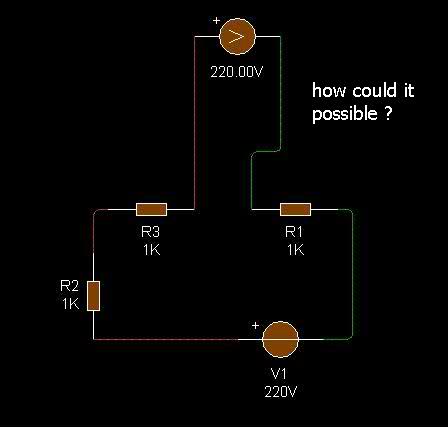
As every body knows in series voltage drops and voltmeter is applied in parallel but look at this image . as the circuit is broken and voltmeter is applied but still Vmeter is showing 220V?
how?


52jkvo.jpg
 
Physics news on Phys.org
The voltmeter has infinite internal resistance, so there is no current flowing in the circuit. What's the drop over the resistors? What did you expect?
 
If the internal resistance of the voltmeter is r, then, the voltage drop across it is:

[tex] V = \frac{(220 \, \mathrm{V}) \, r}{1 \, \mathrm{k \Omega} + 1 \, \mathrm{k \Omega} + 1 \, \mathrm{k \Omega} + r}[/tex]

If the voltmeter is digital and the precision is 0.01 V, it means that everything above 219.995 V will be rounded up to 220 V, so:

[tex] \frac{(220 \, \mathrm{V}) \, r}{1 \, \mathrm{k \Omega} + 1 \, \mathrm{k \Omega} + 1 \, \mathrm{k \Omega} + r} > 219.995 \, \mathrm{V}[/tex]
[tex] 220 \, r > (3 \, \mathrm{k \Omega} + r) \, 219.995[/tex]
[tex] 0.005 \, r > 659.985 \, \mathrm{k\Omega}[/tex]
[tex] r > 1.32 \times 10^5 \, \mathrm{k\Omega} = 132 \, \mathrm{M\Omega}[/tex]

So, the internal resistance of the voltmeter is very high.
 
Last edited:
actually this question was asked by our teacher in exams i answered 0 volts but when i checked it with a software livewire 1.11 it answers 220 V who is rite?
 
The Machine is right, human.
 
but the circuit is open so there is no current flowing
v=IR
I=0A so
v=0*any Resistance = 0volt
but software is saying 200.
it's contrary with the theories that we read before in book.
on thing more voltmeter is always applied in parallel with the load here in pic the voltmeter is not applied to parallel even though it's not parallel the resistors or voltage source.
please help!
 
otomanb said:
but the circuit is open so there is no current flowing
v=IR
I=0A so
v=0*any Resistance = 0volt
but software is saying 200.
it's contrary with the theories that we read before in book.
on thing more voltmeter is always applied in parallel with the load here in pic the voltmeter is not applied to parallel even though it's not parallel the resistors or voltage source.
please help!

read my post.
 
ohhhh! got that one!
you mean there is no current flowing so voltmeter is telling the source voltages 220. and there is no voltage drop?

got that one! thank you !
 
No, I meant the voltage drop on the remaining 3 resistors is smaller than 0.005 V and the voltmeter cannot register any difference with its sensitivity.
 
  • #10
thank you sir!
 
  • #11
it means the electrons are just 'waiting' for the continuity of the circuit be stablish in the ends of the 'break'
 

Similar threads

  • · Replies 6 ·
Replies
6
Views
5K
Replies
15
Views
3K
  • · Replies 9 ·
Replies
9
Views
8K
  • · Replies 5 ·
Replies
5
Views
5K
  • · Replies 33 ·
2
Replies
33
Views
4K
  • · Replies 5 ·
Replies
5
Views
3K
  • · Replies 3 ·
Replies
3
Views
2K
  • · Replies 3 ·
Replies
3
Views
2K
  • · Replies 25 ·
Replies
25
Views
12K
  • · Replies 3 ·
Replies
3
Views
2K