PDA

View Full Version : How to read structural molecules?


xilc
Jan17-12, 10:35 AM
I just don't get it.... still... I don't get it at all... it makes no sense to me... Where can I learn how to read these ?

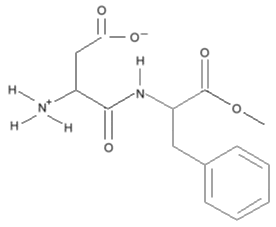
http://sci-toys.com/ingredients/aspartame.gif

does anyone have any insight as to a guide how to read these or can you explain ? I don't get how structural formula is read...

Ygggdrasil
Jan17-12, 11:57 AM
In your previous thread, I posted a link to the following tutorial: http://www.chemguide.co.uk/basicorg/conventions/draw.html

Did you read it and do you have questions about it? What sort of information do you want to learn from reading the structural formulas of the molecules?

xilc
Jan17-12, 12:17 PM
In your previous thread, I posted a link to the following tutorial: http://www.chemguide.co.uk/basicorg/conventions/draw.html

Did you read it and do you have questions about it? What sort of information do you want to learn from reading the structural formulas of the molecules?

Yes, I read it, but I'm still confused... I'm just not grasping the concept of writing out structural molecules, or reading them... and I want to learn what the point of having the structural formulas is...

I'll give you a brief example of what I can't understand.

the structural form of the molecule C2H5Cl.
http://www.chemguide.co.uk/basicorg/conventions/c2h5cldispl.GIF

I don't get how to read that at all.. I get that the lines mean that there is a bond, that is provided... But how exactly do you read something like that? Are the lines meant to say that they're sharing electrons? and the original picture I've included is in like skeletal form to which I get even further confusion... It just seems very hard to understand how to read it..

and I need to learn how to read it for chem, and eventually organic chemistry in college.

Jorriss
Jan17-12, 12:42 PM
the structural form of the molecule C2H5Cl.
http://www.chemguide.co.uk/basicorg/conventions/c2h5cldispl.GIF

I think you may be trying to over complicate these. Lewis structures are a very basic bonding theory. It means just what you said.

H-H means we have two hydrogen atoms sharing two electrons in a bond. In the case of something like ethyl chloride, it's the same concept.

aroc91
Jan17-12, 02:32 PM
The point is to know what the molecule looks like, because that has a direct effect on how it reacts, etc.

xilc
Jan17-12, 03:24 PM
I think you may be trying to over complicate these. Lewis structures are a very basic bonding theory. It means just what you said.

H-H means we have two hydrogen atoms sharing two electrons in a bond. In the case of something like ethyl chloride, it's the same concept.
But is it correct then that the bond lines are implying that (in a covalent bond) EVERY atom connected completes it's valence shell ?

but Sorry, lol... The thing I meant to say I'm not getting is how to read them. Essentially were to be given something like H2SO4 (sulfuric acid) and supposed to draw a structural diagram of the thing, and I don't get how to from scratch... I don't get how they place them, and arrange them, etc.

aroc91
Jan17-12, 04:18 PM
But is it correct then that the bond lines are implying that (in a covalent bond) EVERY atom connected completes it's valence shell ?

Yeah, that's the idea.

but Sorry, lol... The thing I meant to say I'm not getting is how to read them. Essentially were to be given something like H2SO4 (sulfuric acid) and supposed to draw a structural diagram of the thing, and I don't get how to from scratch... I don't get how they place them, and arrange them, etc.

First, you have to know how many bonds each atom needs to form to complete its valence. Hydrogen makes one bond, oxygen makes 2 bonds (or a double bond) and sulfur can make 6. You have to reason your way through with that information. Logically, sulfur is the central atom with all 4 oxygen atoms attached to it, 2 with double bonds and 2 with single bonds. The oxygen atoms with the single bonds will then have the hydrogens on them.

Initially, it's trial and error until you have enough experience to look at something and sort of guesstimate how it looks based on its constituent atoms.

Mike H
Jan17-12, 04:38 PM
You may want to check out this tutorial page on covalent bonding and structural formulas:

http://www.grandinetti.org/Teaching/Chem121/Lectures/CovalentBonds

There are other notes for an entire year's worth of introductory general chemistry on that site that you may find useful. I would recommend starting in on the notes where things stop making sense to you presently so you can learn things in a coherent and organized manner, rather than just trying to pick up ideas piecemeal, which can be very disorienting.

Jorriss
Jan17-12, 07:02 PM
But is it correct then that the bond lines are implying that (in a covalent bond) EVERY atom connected completes it's valence shell ?
.
No, a single line means a single bond. If, for example, a carbon has four bonds, or 3 bonds and a lone pair, or any combination of bonds and lone pairs that add up to 8 electrons THEN it has a complete shell.

There's a few rules to know about writing out lewis structures.

1) Formal charges
2) Octet rule + hydrogen
3) Expanded octets

Are any of those unfamiliar to you?

Can you write the lewis structure for, say, BH3? H2S?