Can Intuition Replace Physics in Solving Structural Analysis Problems?

  • Thread starter Thread starter tmer
  • Start date Start date
Click For Summary

Discussion Overview

The discussion revolves around solving a structural analysis problem involving a statically indeterminate beam. Participants are exploring various methods to approach the problem, including the use of equilibrium equations, shear and moment diagrams, and intuitive reasoning. The scope includes technical explanations and mathematical reasoning related to structural mechanics.

Discussion Character

  • Technical explanation
  • Mathematical reasoning
  • Debate/contested
  • Homework-related

Main Points Raised

  • Some participants assert that the beam is statically indeterminate, requiring more than just equilibrium equations to solve it.
  • There is a claim that the shear and moment diagrams presented are conceptually incorrect due to the omission of the reaction force at point B.
  • A participant questions how to deduce the need for more than equilibrium equations and discusses the implications for the shear force diagram.
  • Another participant agrees with the need for additional methods to address the indeterminacy and suggests that different approaches may be necessary.
  • One participant provides links to images illustrating different cases related to the problem, offering to assist further if equations are needed.
  • A participant inquires about specific numerical values provided in a previous post, seeking clarification on their derivation.
  • There is mention of using the Force Method and the superposition principle to address the problem, with references to Hooke's Law and the concept of deflection at point B being zero.
  • Another participant expresses confusion about specific terms used in the discussion, such as "wISchemeB" and "wIISchemeB," and seeks clarification on the bending moment representation.
  • One participant suggests that an intuitive approach could suffice for part of the question, arguing that understanding the relationship between support types, loading, and deflected shapes might yield a valid answer without extensive physics analysis.
  • There is a mention of points of contraflexure that could help unlock the indeterminacy and facilitate the drawing of moment and shear diagrams.

Areas of Agreement / Disagreement

Participants generally agree on the need for more than equilibrium equations to solve the problem, but there are competing views on the methods to approach the solution and the role of intuition versus formal analysis. The discussion remains unresolved regarding the best approach to take.

Contextual Notes

Some assumptions about the definitions of terms and the specific conditions of the beam are not fully clarified. The discussion includes various interpretations of the problem statement, which may affect the approaches suggested.
tmer
Messages
6
Reaction score
0
Hi,

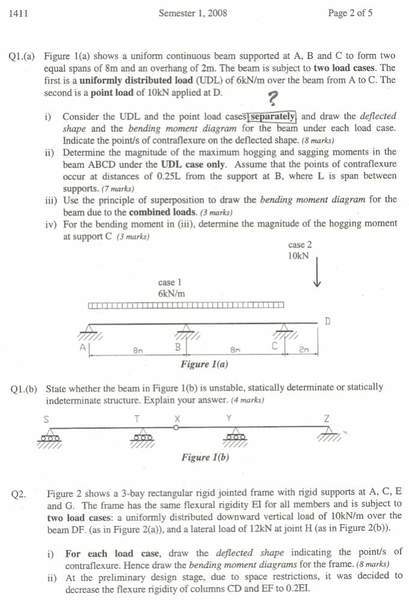
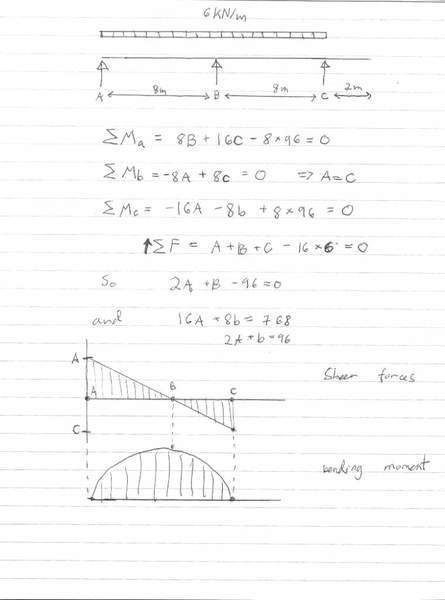
Ive attached my attempt at solutions please help me resolve question 1a

thank you,

exam questions.jpg


exam answers1.jpg
 
Physics news on Phys.org
The beam is statically indeterminate, so you need more than just the equilibrium equations to solve it. Using just the equilibrium equations won't cut it. Your shear and moment diagrams are conceptually incorrect; you have ignored the reaction force at B.
 
PhanthomJay said:
The beam is statically indeterminate, so you need more than just the equilibrium equations to solve it.

How do you deduce that?

PhanthomJay said:
Using just the equilibrium equations won't cut it. Your shear and moment diagrams are conceptually incorrect; you have ignored the reaction force at B.

so there should be a jump at point B in the sheer force diagram. What would the bending moment diagram look like?
 
PhanthomJay said:
The beam is statically indeterminate, so you need more than just the equilibrium equations to solve it. Using just the equilibrium equations won't cut it. Your shear and moment diagrams are conceptually incorrect; you have ignored the reaction force at B.

I agree absolutely.
What way it requires to fix undetermination? Different approaches are possible. I can try to solve but it is not so fast.
Try to find here in the meantime http://www.orlovsoft.com/mmsamples/mmpage01.html
 
The first Case:
http://img705.imageshack.us/img705/9721/tophysicsforum03.png
The second Case:
http://img29.imageshack.us/img29/1944/tophysicsforum04.png
Both together:
http://img824.imageshack.us/img824/9440/tophysicsforum05.png
I hope it helps. But if you need equations post here, I will try.
 
Last edited by a moderator:
thank you SolidElast, but how did you get the numbers 18000,60000 for first case?
 
For example, by Force Method. Be patient, it is simple but not is so obviously. You need only in physics process understanding. Your first task in general kind looks like this.
http://img823.imageshack.us/img823/2784/tophysicsforum06.png
According to Hook Rule (liner deformations) we can apply superposition principle.
So, detected task is presented by two separate tasks superposition.
http://img513.imageshack.us/img513/6137/tophysicsforum07.png
And
http://img38.imageshack.us/img38/7364/tophysicsforum08.png
Now we can remember that total deflection in B point is zero:

[itex]{\it wIScheme}_{{B}}+{\it wIIScheme}_{{B}}=0[/itex]
From last equation we determine unknown [itex]R_{{B}}[/itex]
 
Last edited by a moderator:
I don't understand, what is wISchemeB, wIISchemeB ?

Is the pink line the bending moment of the beam?
 
Deflections. The solution's main idea is fact that deflection of B point (for example B) is zero because there is fixing. The way is to combine equation of such fact.
 
  • #10
Although previous helpers are correct, there is another interpretation of the badly worded question part a i). If it had said "draw the approximate deflected shape and the approximate bending moment diagram", you could have done that without any physics. Maybe just an intuitive answer is possible, and worth 8 marks if you understand the relationship between types of support, loading, deflected shape and M diagram. Then, in part (ii) the points of contraflexure are given. This unlocks the indeterminacy and enables you to draw the moment and shear diagrams without indeterminate analysis. Symmetry also helps understanding in this question.
 

Similar threads

  • · Replies 1 ·
Replies
1
Views
3K
  • · Replies 8 ·
Replies
8
Views
2K
  • · Replies 13 ·
Replies
13
Views
2K
  • · Replies 12 ·
Replies
12
Views
3K
  • · Replies 5 ·
Replies
5
Views
2K
  • · Replies 10 ·
Replies
10
Views
3K
Replies
11
Views
4K
  • · Replies 9 ·
Replies
9
Views
4K
  • · Replies 9 ·
Replies
9
Views
3K
  • · Replies 6 ·
Replies
6
Views
2K