How Do You Calculate the Final Speeds of Pucks After a Collision?

Click For Summary
SUMMARY

The discussion focuses on calculating the final speeds of two pucks after a collision on an air-hockey table. Puck A, with a mass of 0.020 kg and an initial velocity of +5.5 m/s, collides with puck B, which has a mass of 0.040 kg and is initially at rest. The conservation of momentum is applied using vector equations for both the x-axis and y-axis to determine the final speeds of the pucks post-collision. The user ultimately resolves the problem after correcting a calculation error.

PREREQUISITES
  • Understanding of conservation of momentum principles
  • Knowledge of vector decomposition in physics
  • Familiarity with angular momentum concepts
  • Basic algebra for solving equations
NEXT STEPS
  • Study the conservation of momentum in two-dimensional collisions
  • Learn about vector decomposition in physics
  • Explore angular momentum calculations in collisions
  • Practice solving collision problems with varying masses and velocities
USEFUL FOR

Physics students, educators, and anyone interested in understanding collision dynamics and momentum conservation principles.

atlbraves49
Messages
80
Reaction score
0
I can NOT figure this question out, it's the only one I haven't gotten, can someone help?

The drawing shows a collision between two pucks on an air-hockey table. Puck A has a mass of 0.020 kg and is moving along the x-axis with a velocity of +5.5 m/s. It makes a collision with puck B, which has a mass of 0.040 kg and is initially at rest. The collision is not head-on. After the collision, the two pucks fly apart with the angles shown in the drawing.
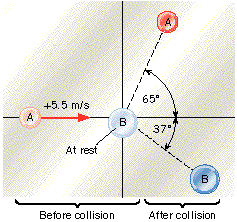
07_32.gif


(a) Find the final speed of puck A.
______ m/s
(b) Find the final speed of puck B.
______ m/s
 
Physics news on Phys.org
Hi atlbraves,

usually you must propose a solution or give some hints ...but today I'll make an exception for you:

You must write the the conservation law for angular momentum:

[tex]\vec{p_{A0}}=\vec{p_A}+\vec{p_B}[/tex]

Then you have to write the above vectorial equation on Ox (the direction of the initial velocity of A) and Oy (perpendicular on it):

Ox: [tex]p_{A0}=p_A \cdot cos(\alpha_A)+p_B \cdot cos(\alpha_B)[/tex]
Oy: [tex]p_A \cdot sin(\alpha_A)-p_B \cdot sin(\alpha_B)=0[/tex]
 
clive said:
Hi atlbraves,

usually you must propose a solution or give some hints ...but today I'll make an exception for you:

You must write the the conservation law for angular momentum:

[tex]\vec{p_{A0}}=\vec{p_A}+\vec{p_B}[/tex]

Then you have to write the above vectorial equation on Ox (the direction of the initial velocity of A) and Oy (perpendicular on it):

Ox: [tex]p_{A0}=p_A \cdot cos(\alpha_A)+p_B \cdot cos(\alpha_B)[/tex]
Oy: [tex]p_A \cdot sin(\alpha_A)-p_B \cdot sin(\alpha_B)=0[/tex]

thanks, i figured it out, i actually ended up knowing how to do it, the reason i wasnt getting the answer correct is i messed up a calculation, thanks for the help anyways
 

Similar threads

Replies
5
Views
3K
Replies
4
Views
2K
Replies
4
Views
4K
  • · Replies 35 ·
2
Replies
35
Views
6K
Replies
7
Views
2K
  • · Replies 2 ·
Replies
2
Views
4K
Replies
3
Views
2K
  • · Replies 14 ·
Replies
14
Views
2K
  • · Replies 1 ·
Replies
1
Views
2K
  • · Replies 4 ·
Replies
4
Views
3K