What Happens When a Sliding Block Collides with Another on a Flat Surface?

  • Thread starter Thread starter lando45
  • Start date Start date
  • Tags Tags
    Collision
Click For Summary
SUMMARY

The discussion centers on a physics problem involving two blocks, where a block of mass m = 2.80 kg slides down a 30.0° incline and collides elastically with a stationary block of mass M = 6.80 kg. The user, Rory, successfully calculated the distance traveled down the incline as 7.2 m but is unsure how to proceed with determining the speeds of both blocks post-collision. The recommended approach is to apply the principle of energy conservation to find the speed of the sliding block before the collision.

PREREQUISITES
  • Understanding of basic physics concepts such as energy conservation
  • Knowledge of elastic collision principles
  • Familiarity with trigonometry for calculating distances on inclines
  • Ability to apply Newton's laws of motion
NEXT STEPS
  • Study the conservation of mechanical energy in the context of inclined planes
  • Learn about elastic collision equations and their applications
  • Explore the use of momentum conservation in collision problems
  • Review trigonometric functions related to angles and distances in physics
USEFUL FOR

Students studying physics, particularly those focusing on mechanics and collision problems, as well as educators seeking to clarify concepts related to energy conservation and elastic collisions.

lando45
Messages
84
Reaction score
1
Hey,

I got this question, and I don't really know how to solve it, I'm stuck:

A block of mass m = 2.80 kg slides down a 30.0° incline which is 3.60 m high. At the bottom, it strikes a block of mass M = 6.80 kg which is at rest on a horizontal surface, Fig. 7-41. (Assume a smooth transition at the bottom of the incline, an elastic collision, and ignore friction.)
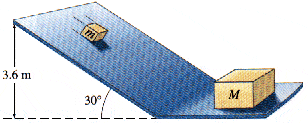
7_41.gif


Determine the speeds of the two blocks after the collision.

I worked out the length traveled down the slope using basic trigonometry and got a value of 7.2m, but now I am completely lost and don't know what the next step is...any help?

Thanks a lot,

Rory
 
Physics news on Phys.org
Start by finding the speed of the small block using energy conservation and go from there. :)
 

Similar threads

Replies
12
Views
2K
  • · Replies 4 ·
Replies
4
Views
2K
Replies
4
Views
4K
  • · Replies 2 ·
Replies
2
Views
3K
  • · Replies 4 ·
Replies
4
Views
3K
  • · Replies 4 ·
Replies
4
Views
5K
  • · Replies 18 ·
Replies
18
Views
2K
  • · Replies 5 ·
Replies
5
Views
2K
  • · Replies 9 ·
Replies
9
Views
4K
  • · Replies 3 ·
Replies
3
Views
13K