image
Physics Forums Logo
image
image
* Register * Upgrade Blogs Library Staff Rules Mark Forums Read
image
image   image
image

Go Back   Physics Forums > Engineering > Electrical Engineering


Reply

image Another RC circuit question Share It Thread Tools Search this Thread image
Old Apr2-09, 09:53 PM                  #1
bill.connelly

bill.connelly is Offline:
Posts: 16
Another RC circuit question

Hi,

I'm just a humble biologist (writting up a PhD Thesis in Neuroscience) and I'm trying to get a feel for how my equipment works. The circuit for monitoring the current that flows across a cells membrane (in response to an imposed voltage step) can essentially be seen as a resistor, connected to a resistor and capacitor in parallel (Rs, Rm and Cm)
(the full circuit, ignore the op-amps and such if you can)
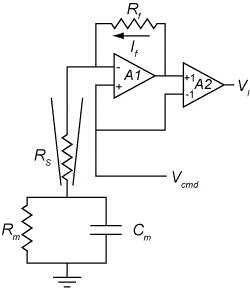

I understand that for a resistor and capacitor in parallel, the current that flows in response to a voltage can be explained by
LaTeX Code: <BR>i(t)=\\frac{v(t)}{R}+C\\frac{dv(t)}{dt}<BR>
However this means that in response to a step change in voltage, I = infinity (which is of course what you expect). With a resistor in series to that parallel circuit, I also appriciate that at after a step of voltage V,
LaTeX Code: \\Delta I=V.R_{s}
and then I recays exponentially to
LaTeX Code: \\Delta I=V.(R_{s}+R_{m})
However, I want to be able to calculate I and any time, in response to an arbitrary voltage. Can anyone explain, or even just give me the equation to calculate that.
Attached Images
File Type: gif Circuit.gif (3.6 KB, 50 views)
  Reply With Quote
Old Apr2-09, 11:33 PM       Last edited by The Electrician; Apr2-09 at 11:33 PM.. Reason: Add another reference            #2
The Electrician

The Electrician is Online:
Posts: 250
Re: Another RC circuit question

You just convolve the impulse response of your circuit with the arbitrary input.

See:

http://www.swarthmore.edu/NatSci/ech...nvolution.html

Also:

http://en.wikipedia.org/wiki/Convolution
  Reply With Quote
Old Apr3-09, 12:08 AM                  #3
bill.connelly

bill.connelly is Offline:
Posts: 16
Re: Another RC circuit question

Thanks The Electrician,

I'm sorry, but someone is going to have to dumb it down for me.
  Reply With Quote
Old Apr3-09, 02:07 AM                  #4
The Electrician

The Electrician is Online:
Posts: 250
Re: Another RC circuit question

Do I understand correctly that you will be applying some sort of stimulus function (you mentioned a step function) to the CMD input of your circuit, and you want to be able to calculate the response current?

If your input is truly arbitrary, meaning it can't be described as some simple mathematical function such a sine wave, or a step function, then how would you describe it for the purpose of making mathematical computations? Some sort of a time series, an array of values for small increments of time?
  Reply With Quote
Old Apr4-09, 12:52 AM                  #5
bill.connelly

bill.connelly is Offline:
Posts: 16
Re: Another RC circuit question

What I'm ACTUALLY trying to do is show that for and given Vcmd, VI is = If*Rf. I was able to do that if I ignore Rs and Cm (ignoring Rs is okay because Rs is a finy fraction of Rm). So essentially I was working in the steady state case, where the capacitance didn't mater.

What I'm looking for is an equation that relates the voltage output of op amp A1, to the current that flows, If. Previously I was just using Ohms law, so If = V1/(Rf+Rm). But I assume there is an equation that will take into account that capacitor and Rs.
  Reply With Quote
Old Apr4-09, 01:15 AM                  #6
The Electrician

The Electrician is Online:
Posts: 250
Re: Another RC circuit question

If the steady state condition is that a steady DC voltage is applied to Vcmd, then capacitors don't matter. In that case it is possible to derive an expression for what you want that doesn't include capacitors. Of course, the value of the various components will determine the settling time; how long you must wait until the currents and voltages are stable.

The way you have drawn Rs makes it look like there is a distributed capacitance associated with. If you have a time varying voltage applied to Vcmd, that distributed capacitance would make for a more complicated expression for the impulse response. But if all you care about is the steady state response to a DC stimulus, then the various capacitances don't matter.

So, is the circuit response to a steady DC stimulus what you want?
  Reply With Quote
Old Apr4-09, 02:11 AM                  #7
bill.connelly

bill.connelly is Offline:
Posts: 16
Re: Another RC circuit question

If the steady state condition is that a steady DC voltage is applied to Vcmd
Indeed, and I have written up equations to explain the behaviour of the circuit in the steady state case.

What I want is an equation, given an applied voltage V, not a step or steady response, but just any arbitrary V, what is equation that explains the current that is drawn by Rm, Cm and Rs.

Exactly in the same manner that if I had an arbitrary current I, applied to a similar circuit, I could explain the voltage as dV/dt = I/C

or how if it weren't for the resistor Rs, I could explain the current by
LaTeX Code: <BR>i(t)=\\frac{v(t)}{R}+C\\frac{dv(t)}{dt}<BR>

But how do I modify that equation to account for Rs.
  Reply With Quote
Old Apr4-09, 03:05 AM                  #8
Phrak

Phrak is Offline:
Posts: 2,786
Recognitions:
PF Contributor PF Contributor
Re: Another RC circuit question

I'm completely confused. The circuitry that [i]monitors[i/] the voltage consists of the op amps. Somewhere in this monitoring circuit are two points that connect across the cell membrane. Where are they?
  Reply With Quote
Old Apr4-09, 05:28 AM       Last edited by bill.connelly; Apr4-09 at 05:36 AM..            #9
bill.connelly

bill.connelly is Offline:
Posts: 16
Re: Another RC circuit question

Hi Phrak,

The voltage Vi is measured relative to earth; does that answer your question? But all that part of the circuit is not neccesary...

Lets just consider this circuit

A variable voltage Vcmd is supplied, and causes Itot to flow. What is the equation that relates Vcmd, Rs, Rm and Cm to Itot.
I know that As DVcmd/Dt approaches infinity, Itot = Vcmd/Rs, and when DVcmd/Dt = 0, Itot tends towards Vcmd/(Rs+Rm) and decays towards that value with the time constant of Cm*Rs.
BUT what I want is the single equation that explains how Itot varies over time, in response to voltage? It is presumbly some way proportional to dVcmd/dt, but I can't figure out the exact details.
  Reply With Quote
Old Apr4-09, 06:00 AM                  #10
The Electrician

The Electrician is Online:
Posts: 250
Re: Another RC circuit question

There isn't any expression for i(t) as simple as:
LaTeX Code: <BR>i(t)=\\frac{v(t)}{R}+C\\frac{dv(t)}{dt}<BR>

You can't escape using convolution if the applied voltage is arbitrary.

See the attachment.
Attached Images
File Type: png Convolve.png (254.4 KB, 12 views)
  Reply With Quote
Old Apr4-09, 05:47 PM                  #11
bill.connelly

bill.connelly is Offline:
Posts: 16
Re: Another RC circuit question

*sigh* that's a shame. Thanks anyway.
  Reply With Quote
Old Apr4-09, 07:19 PM                  #12
The Electrician

The Electrician is Online:
Posts: 250
Re: Another RC circuit question

It's really not a big deal. If you have your arbitrary stimulus in the form of a data file, a sampled waveform in other words, you can use the built-in convolution function that most modern mathematical software such as Matlab include.

The impulse response of your circuit is easy to derive as I showed. Then just convolve it with your stimulus and you have the current i(t).
  Reply With Quote
Old Apr5-09, 04:56 AM                  #13
bill.connelly

bill.connelly is Offline:
Posts: 16
Re: Another RC circuit question

It can't be explained by
I=Vm/Rm + C dVm/dt,
Where Vm (the voltage over the capacitor)
Vm=Vcmd - Rs * Vm/Rm+C dVm/dt

There is a bit of a debate going over here
http://groups.google.com/group/bione...8ba433c2e50ff9
  Reply With Quote
Old Apr5-09, 06:27 AM       Last edited by uart; Apr5-09 at 06:33 AM..            #14
uart

uart is Offline:
Posts: 1,261
Re: Another RC circuit question

Originally Posted by bill.connelly View Post
It can't be explained by
I=Vm/Rm + C dVm/dt,
Where Vm (the voltage over the capacitor)
Vm=Vcmd - Rs * Vm/Rm+C dVm/dt

There is a bit of a debate going over here
http://groups.google.com/group/bione...8ba433c2e50ff9
It can but that will give you a DE instead of a closed form solution. The DE you obtain is :

LaTeX Code:  (R_1+R_2) \\, i + R_1\\, R_2\\, C \\, di/dt = v + R_2\\, C\\, dv/dt

In general you'd need to specify the input voltage as a time function, v(t), and solve the above DE.


If however you just want to consider a simple case like a "step" input then it's fairly easy.

For a step input voltage of amplitude "V" you will get :

LaTeX Code: i(t) = I_f + (I_0-I_f) e^{-t/T}

Where,

LaTeX Code:  T = \\frac{R_1 R_2 C} {R_1+R_2}

LaTeX Code: I_0 = \\frac{V}{R_1} {assuming zero initial capacitor voltage}

LaTeX Code: I_f = \\frac{V}{R_1+R_2}

PS. R1 is the series resistor and R2 the parallel reisitor in the above.
  Reply With Quote
Old Apr5-09, 09:04 PM       Last edited by bill.connelly; Apr5-09 at 09:18 PM..            #15
bill.connelly

bill.connelly is Offline:
Posts: 16
Re: Another RC circuit question

And in a more general sense, looking at the op amps above, does that mean the output of summing amp A2 (VI)...
Vi=I*Rf-Rs(Vm/Rm+C*dVm/dt)?
Or more simply
Vi=I*Rf-Rs*If

(Again, where Vm is the voltage over the capacitor Cm)
  Reply With Quote
Old Apr6-09, 07:14 AM       Last edited by uart; Apr6-09 at 08:07 AM..            #16
uart

uart is Offline:
Posts: 1,261
Re: Another RC circuit question

The relationship between the current in the resistor-capacitor network, which I've called i(t) above, and the output of the first op-amp is :

LaTeX Code: v_1(t) = v + R_f \\,\\, i(t)

Therefore the output of the second amplifier (the differential amplifier) is :

LaTeX Code: v_2(t) = v_1(t) - v = R_f \\, \\, i(t)

Here (and above) I've used "v" for the voltage marked "v_cmd" on your diagram.
  Reply With Quote
image image
Reply
Thread Tools


Similar Threads for: Another RC circuit question
Thread Thread Starter Forum Replies Last Post
Experts please: DC CIRCUIT (PARALLEL-SERIES CIRCUIT) QUESTION suey Introductory Physics 3 May8-09 12:52 PM
LED Circuit Question cissey Engineering, Comp Sci, & Technology 1 Feb20-09 03:50 AM
Short Circuit, and open circuit question th3plan Engineering, Comp Sci, & Technology 1 Oct29-08 06:42 AM
circuit question darkcrystal Electrical Engineering 0 Jun6-04 06:48 AM
circuit question david90 Electrical Engineering 1 Jan19-04 06:24 AM

Powered by vBulletin Copyright ©2000 - 2010, Jelsoft Enterprises Ltd. © 2009 Physics Forums
Sciam | physorgPhysorg.com Science News Partner
image
image   image