New Reply

"Graphical" Vector Problem (What are they asking for?)

 
Share Thread
Nov14-10, 04:14 PM   #1
 
Recognitions:
Gold Membership Gold Member

"Graphical" Vector Problem (What are they asking for?)


1. The problem statement, all variables and given/known data
Here is the problem statement. I honestly don't understand what it is they are asking for? Do they want actual numbers? Am I supposed to measure the lengths with a ruler or something? I know it's easy once I interpret the question correctly
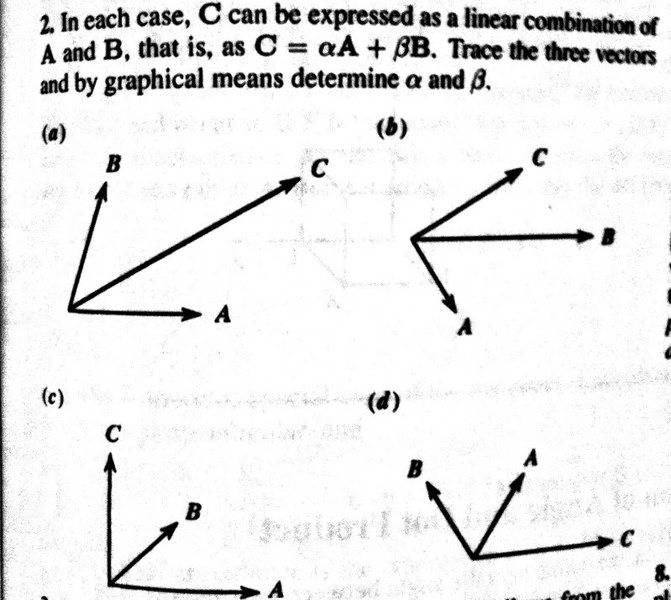


How would you interpret this one?
PhysOrg.com science news on PhysOrg.com

>> New language discovery reveals linguistic insights
>> US official: Solar plane to help ground energy use (Update)
>> Four microphones, computer algorithm enough to produce 3-D model of simple, convex room
Nov14-10, 05:25 PM   #2
 
Recognitions:
Gold Membership Gold Member
Homework Helper Homework Help
Hey, that vector A in part (c) is bent. Must have a non-zero curl

Yup, that's what I would do. Draw them carefully, construct the corresponding parallelograms and figure out the alpha and beta by measuring to scale things. "Trace" them certainly suggests that.
Nov14-10, 09:35 PM   #3
 
Recognitions:
Gold Membership Gold Member
Quote by LCKurtz View Post
Hey, that vector A in part (c) is bent. Must have a non-zero curl

Yup, that's what I would do. Draw them carefully, construct the corresponding parallelograms and figure out the alpha and beta by measuring to scale things. "Trace" them certainly suggests that.
Haha! Thanks LCKurtz! Don't quit your day job (assuming you have one!)!
Nov14-10, 09:50 PM   #4
 
Mentor

"Graphical" Vector Problem (What are they asking for?)


By "graphical means" they mean for you to extend the vectors A and B so that the lengthened vectors form two sides of a parallelogram whose diagonal is C. You'll need to find the lengths of A and B with a ruler so that you can determine the values of [itex]\alpha[/itex] and [itex]\beta[/itex] so that [itex]\alpha[/itex]A + [itex]\beta[/itex]B = C.

For example, if you have to double the lengths of A and B to form the parallelogram, then [itex]\alpha[/itex] = [itex]\beta[/itex] = 2.

Your mileage may vary...
Nov15-10, 11:55 PM   #5
 
Recognitions:
Gold Membership Gold Member
I must be an idiot. I cannot see a way to extend or shorten A and B such that C becomes the diagonal of the parallelogram. My brain keeps making B the diagonal since it is more intuitive to me.
Nov16-10, 11:20 AM   #6
 
Recognitions:
Gold Membership Gold Member
Homework Helper Homework Help
Don't forget that your coefficients of A and/or B may be negative so you also have to consider the opposite of A or B when making your parallelogram.
New Reply

Similar Threads for: "Graphical" Vector Problem (What are they asking for?)
Thread Forum Replies
Difference between "Identical", "Equal", "Equivalent" Calculus & Beyond Homework 9
A "problem" like Fermat's Last "Theorem" Linear & Abstract Algebra 15
The Problem of "Individualism" vs. "Collectivism" General Discussion 1
"simple" vector problem Introductory Physics Homework 1