New Reply

Question about our place in the milky way and what we can see in the sky at night

 
Share Thread Thread Tools
Mar19-11, 05:26 PM   #1
 

Question about our place in the milky way and what we can see in the sky at night


Hi,

I'm slightly confused about how we see other galaxies in the night sky ...


Looking at this image of the milky way and our position
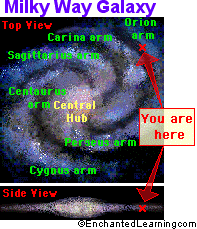


Why does the milky way look like a streak across the night sky like this

http://en.wikipedia.org/wiki/File:Milkyway_pan1.jpg


If we are at the edge of a spiral then why do we not see the entire sky filled with with stars in the milky way ? Instead of the streak we see.


Also how can we see other galaxies outside of our own when we look out would we not just see a mass of stars around us ?


Thanks
PhysOrg.com
PhysOrg
astronomy news on PhysOrg.com

>> NASA builds unusual testbed for analyzing X-ray navigation technologies
>> Subaru Telescope observations and CoRoT mission unveil future of the Sun
>> Galaxy's Ring of Fire
Mar20-11, 04:31 AM   #2
 
Recognitions:
Science Advisor Science Advisor
Because the Milky Way galaxy is thin.
Mar21-11, 12:05 PM   #3
 
The space around us is littered with class M stars. At a certain distance they thin and eventually stop altogether. The galaxy is still filled with class M stars, it's just they are too dim to be seen past a certain distance.

We don't see a mass of stars because they are so distant from us they are too dim to be seen by the time the light reaches us. But, becuase there are so many stars between us and the core of the galaxy, their combined energy is strong enough to reach us at this distance and we see them as a "streak."
Mar28-11, 09:05 PM   #4
 
Recognitions:
Gold Membership Gold Member

Question about our place in the milky way and what we can see in the sky at night


Out of all the stars you can see in the sky with the naked eye, about 3,000, over 90% of them are bigger and brighter than the sun. However, out of all the stars in the galaxy, over 90% of them are smaller and dimmer than the sun. (Both of these from an astronomy book I have. Not at home or i'd go look up the title real quick)

So almost all the stars we can see are bigger and brighter than the sun, yet they only compose a very small fraction of the stars in our galaxy. The other stars are too dim for the light to be seen with the naked eye. If you could visibly see single photons, the entire sky would be full and blinding, but since it takes many many more for us to see anything, the dimmer stars simply don't put out enough light for us to make them out without telescopes. (Also the atmosphere and gas and dust in space absorbs some too)

Also, the distances between stars in space are vast. Our closest companion is the Alpha Centauri system, over 4 light years away. It takes light OVER FOUR YEARS to reach us JUST from our closest neighbor. The vast distances between most objects in space means that, in general, you can look almost anywhere and see "between the stars". IE you can see things behind and beyond them because stars are so small in comparison to the distances between them. Stars only look bigger or smaller in the sky due to their luminosity. The same way a very bright light looks larger than it actually is when you look at it.

Our closest major galaxy is the Andromeda Galaxy. I live in Shreveport/Bossier City, where the light pollution isnt terrible, but is still enough to make it nearly impossible to see andromeda. I have a 6 in telescope and i can BARELY make out a smudge that is its core. The whole galaxy takes up an area in the sky several times greater than the full moon does. We simply can't see this usually because again, there isn't enough light emitted.
Mar28-11, 10:16 PM   #5
 
Recognitions:
Gold Membership Gold Member
You have some wonderful responses already. I'd like to add that if you are in the northern hemisphere, you can see some pretty impressive stuff in the winter, and your tilt toward the south in the summer can let you look at stuff that you might not plan on seeing.
Mar30-11, 02:37 AM   #6
 
Recognitions:
Gold Membership Gold Member
Science Advisor Science Advisor
The image posted is a view top down view to portray the position of the sun relative to the galactic core. It is not even a good representation of the milky way - which is a barred spiral.
New Reply

Tags
galaxies, milky way
Thread Tools


Similar Threads for: Question about our place in the milky way and what we can see in the sky at night
Thread Forum Replies
Question about Milky Way ? General Astronomy 6
Theoretical Question about Milky Way General Astronomy 1
Question about our solar systems orbital path through the milky way General Astronomy 13
need help with this 1 question that has been bugging me all night Precalculus Mathematics Homework 9