New Reply

How much did Earth's gravity alter the course of 2005 YU55?

 
Share Thread Thread Tools
Nov11-11, 05:13 PM   #1
 

How much did Earth's gravity alter the course of 2005 YU55?


Just like the title says - with the meteor passing close by the Earth, gravity should alter the meteor's course. So how much was it?
 
PhysOrg.com
PhysOrg
astronomy news on PhysOrg.com

>> South Africa's new radio telescope reveals giant outbursts from binary star system
>> Researchers find winds on Uranus and Neptune confined to thin atmosphere layer
>> Kepler spacecraft's planet-hunting days may be numbered (Update)
Nov11-11, 05:38 PM   #2
 
Earth: 5x10^24kg
Aircraft carrier: 7x10^7kg
Separation:300,000,000m

http://www.wsanford.com/~wsanford/ca...alculator.html
 
Nov11-11, 06:04 PM   #3
 
Quote by DaveC426913 View Post
Earth: 5x10^24kg
Aircraft carrier: 7x10^7kg
Separation:300,000,000m

http://www.wsanford.com/~wsanford/ca...alculator.html
That wasn't my question. As the meteor passed by Earth there was a varible force that acted on the meteor. This force would alter the trajectory of the meteor. Was it a degree, an arcminute, an arcsecond?
 
Nov11-11, 06:11 PM   #4
 
Mentor

How much did Earth's gravity alter the course of 2005 YU55?


Quote by 2milehi View Post
That wasn't my question. As the meteor passed by Earth there was a varible force that acted on the meteor. This force would alter the trajectory of the meteor. Was it a degree, an arcminute, an arcsecond?
Dave was giving you a way to calculate the sideways force on the object. Do you know how long the object was within the orbit of the moon? You could get a pretty good approximation for how much the trajectory was altered by applying the average gravitational attraction of the Earth on the object in a perpendicular direction for the duration of the time inside the Moon's orbit.
 
Nov12-11, 12:11 PM   #5
 
Recognitions:
Gold Membership Gold Member
Science Advisor Science Advisor
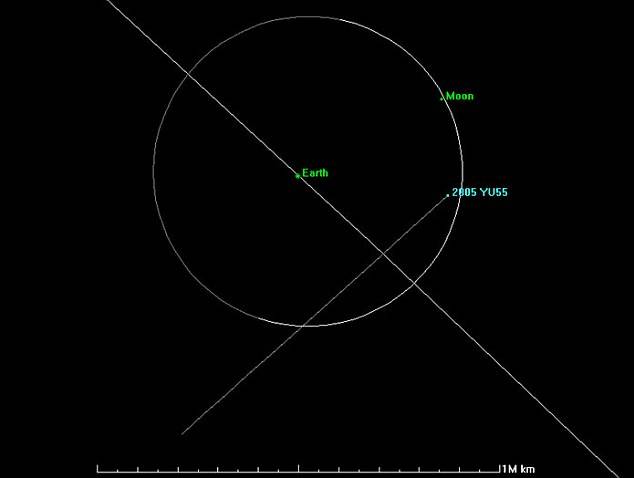
Earth boosted 2005YU55's semimajor axis by about 2 million km. It reduced its inclination from about a half a degree to about a third of a degree.

In this image, the green orbit is 2005 YU55. The interior one is before, the exterior one is after.
 
Nov12-11, 05:03 PM   #6
 
Thank you for answering my question. :-)
 
Nov12-11, 05:47 PM   #7
 
Actually, the question is quite a bit misguided.

The trajectory remain the same as it ever was - all gravitational perturbations included.

Look at it as an object travelling in a perfectly straight line tnrough some very uneven surface (gravity wells of Earth, Sun, Moon...). The object still rolls/flies in a straght line... But the line is warped.
 
Nov12-11, 05:53 PM   #8
 
To continue: Even if you fall back on the classical/Newtonian physics the question still doesn't make sense. "changed" compared to what? To what it would be in the Earth's absence? But... hold on a sec, in Earth's absence that asteroid wouldn't even arrive here in the first place - Earth's gravitational pull is part of the reason that asteroid got where it was anyway.
 
Nov12-11, 07:03 PM   #9
 
Tony understood my question. Griz you are not adding anything to my question. I will expand to clear any confusion - what was the change in the orbital characteristics of 2005 YU55 when it recently passed by Earth.

This gif makes a lot more sense when comparing it to
Tony's pic
 
Nov12-11, 07:40 PM   #10
 
Well, perhaps I misunderstood your question. (I'm actually inclined to think so).

But the basic fact remains that the question "how much did the Earth gravity changed the course of that asteroid" is pretty much meaningless. It didn't. In any shape, size or form UNLESS you mean how it shaped the course from the start, to begin with. But then... the question about "change" is once again a bit odd.
 
Nov12-11, 09:45 PM   #11
 
Quote by Grizzled View Post
Well, perhaps I misunderstood your question. (I'm actually inclined to think so).

But the basic fact remains that the question "how much did the Earth gravity changed the course of that asteroid" is pretty much meaningless. It didn't. In any shape, size or form UNLESS you mean how it shaped the course from the start, to begin with. But then... the question about "change" is once again a bit odd.
Change - like before and after. Tell me that you don't see it with the following image.


The meteor was "sling-shot" when passing by Earth. Space probes use Jupiter to "sling-shot" to add speed and change direction.
 
Nov12-11, 09:55 PM   #12
 
What -I- don't see is how this pretty picture indicates a changed orbit.

What -you- don't see is the fact that orbits are never the same perfect ellipses. Doesn't happen.

So, what your picture shows is just a normsl, pretty ordinary orbit.

Perhaps you should make distinction between the words course/trajectory/orbit?
 
Nov12-11, 10:10 PM   #13
 
Quote by tony873004 View Post
Earth boosted 2005YU55's semimajor axis by about 2 million km. It reduced its inclination from about a half a degree to about a third of a degree.

In this image, the green orbit is 2005 YU55. The interior one is before, the exterior one is after.
Griz maybe you missed this post. The inside green circle represents the orbital characteristics of the meteor before it was "sling-shot" by Earth. The outer green circle represents the new orbital characteristics of the meteor. The Earth change the direction and the speed of the meteor via gravitational attraction.

It seems you are going out of your way NOT to understand what I am asking/saying.
 
Nov12-11, 10:55 PM   #14
 
Recognitions:
Gold Membership Gold Member
Grizzled, I'm sure your technically correct, but I think you're simply confusing some people. Suffice it to say I think the OP's question was answered by the picture.
 
Nov16-11, 01:25 AM   #15
 
Drakkith,

I can't help it if some people are so easily confused. Perhaps they should study a bit?

I also can't help it if all they want are some pretty pictures which they (for some mysterious reason) insist on posting over and over again.

At least you agree that I am "technically" correct.

Thanks.
 
Nov16-11, 05:07 AM   #16
 
Recognitions:
Gold Membership Gold Member
Quote by Grizzled View Post
Drakkith,

I can't help it if some people are so easily confused. Perhaps they should study a bit?
Why do you think they are here at PF if not to study and learn? EVERYONE is easily confused when they know very little about something. Just because you know more about the subject does not give you a reason to be rude. Instead it might help if you explained what the different terms mean for this particular scenario.

I also can't help it if all they want are some pretty pictures which they (for some mysterious reason) insist on posting over and over again.
There is nothing wrong with pictures and diagrams. They help people to visualize a concept, which is very important for most people when attempting to learn something new.
 
Nov16-11, 07:12 AM   #17
 
Quote by Grizzled View Post
Drakkith,

I can't help it if some people are so easily confused.
You can. You can address the question asked.

Quote by Grizzled View Post
I also can't help it if all they want are some pretty pictures which they (for some mysterious reason) insist on posting over and over again.
If pretty pictures answer the question asked then pretty pictures are the thing.

Quote by Grizzled View Post
At least you agree that I am "technically" correct.
I am "technically" correct when I mention that Mercury precesses. The issue, of course, is whether that answers the question being asked.


The OP's is a legitimate question. He wants to know how much YU 55 was deflected by Earth's passage. consider: if you were stationary wrt the asteroid and looked in the direction of its travel, you'd see a point it's heading toward. If Earth had not crossed its path that point would move steadily as the asteroid proceeded in its orbit. After Earth fly-by the point would be completely different.

Does that make it clearer to you what the OP is asking?
 
New Reply
Thread Tools


Similar Threads for: How much did Earth's gravity alter the course of 2005 YU55?
Thread Forum Replies
spotting 2005 YU55 General Astronomy 42
Earth's Gravity if the Earth rotated the opposite direction Introductory Physics Homework 1
Earth transits the Sun as viewed from Mars in 2005? General Astronomy 5
gravity on mass on earth's surface vs sun-earth gravity Introductory Physics Homework 2
Will Solar Eclipses Occur on 8 April 2005 and 3 November 2005? General Physics 8