kmarinas86
- 974
- 1
A.T. said:Yes. The intersection point of the blade surface with the path of the particle is moving slower than the particle.
Settled!

The discussion centers around the principles and mechanics of vehicles that can travel directly downwind faster than the wind (DDWFTTW). Participants explore the underlying physics, including the role of propellers, friction, and wind dynamics, as well as the implications of these principles in both theoretical and practical contexts.
Participants express a range of views on the mechanics of DDWFTTW vehicles, with no consensus reached on certain aspects, particularly regarding the behavior of the propeller at different speeds and the implications of wind dynamics on power generation.
Participants highlight the need for clarity in terminology, such as distinguishing between different types of wind and reference frames, which may affect the understanding of the principles involved. There are also references to specific cases and experimental setups that may not be universally applicable.
This discussion may be of interest to those studying physics, engineering, or anyone curious about the mechanics of propulsion and energy transfer in wind-driven vehicles.
A.T. said:Yes. The intersection point of the blade surface with the path of the particle is moving slower than the particle.
kmarinas86 said:Settled!
jduffy77 said:Hey do you think that would work for Humber? Just kidding.
Seriously, what do you think about the sail to prop animation now marinas. I think you probably see it differently, I am just asking because I always thought it was a great visualization of what you just discovered.
Cool, huh?kmarinas86 said:It's all good to me now.
A.T. said:This animation shows how the "ball" (air particle) hits the back of the propeller blade:
https://www.youtube.com/watch?v=FqJOVHHf6mQ
A.T. said:The intersection point of the blade surface with the path of the particle is moving slower than the particle. Even if the cart is moving faster than the particle.
kmarinas86 said:Now I'm no longer disputing the calculation of input and output energy. I'm also not disputing the forces and their orientation in the video. I think the video sufficiently shows that... but:
Concerning frame of reference of the intersection point (seen as the corner made by the blue line in the video), the air does not change speed, just the direction.
In other words, something possessed by the particles of the air, the momentum per air mass, the norm of which gives us the air speed (scalar), does not appear to change here. How then does this cause the kinetic energy of the combined mass of the cart and the ground to increase relative to the intersection point? Maybe it does not!
kmarinas86 said:At 0:52 and 0:53 we see the vectors "force on air" and "force on airfoil", which are both diagonal. The air bounces off the surface of the airfoil at the intersection point. I imagine that the combined mass of the cart and the ground reacts to this air in an equal but opposite manner, as shown by the blue and maroon arrows that I added to the diagram, which are oriented CCW and CW respectively.
So it does not even seem to me that the kinetic energy of the wind even needs to be extracted by the cart in order for this to work. All there needs to be is a deflection of existing energy.
kmarinas86 said:After all, if we discount the hypothesis that potential energy is somehow relevant in this system, while at the same time we assume the conservation of energy, then it would stand to reason that "kinetic energy+heat" is conserved both before and after the force interactions.
kmarinas86 said:If the air does not lose kinetic energy in the reference frame of the intersection, then neither could the rest of system gain it.
jduffy77 said:But it does change. I would suggest you research propeller thrust in order to understand what is happening.
jduffy77 said:Could you elaborate on what you mean by this? It does not make sense to me.
This does not "stand to reason" for me in the sense that it constitutes an argument for the cart using the "deflection of existing energy".
jduffy77 said:But it does lose energy.
kmarinas86 said:The change of speed does depend on the frame of reference. In one reference frame the velocity of a particle can flip 90 degrees, 180 degrees, or whatever degrees without changing speed. An example of this is light bouncing off a mirror. The velocity flips across an axis normal to a mirror's surface. The speed of light did not change.
In any other frame than that in which the lines of the air flow in the video were traces, the speed will undoubtedly change. This includes the ground frame, the cart frame, and the wind frame.
kmarinas86 said:I don't know how this could be clearer. Do I need to show how two balls can bounce off each other from an angle without either gaining more kinetic energy from the other than the other is gaining from it?
kmarinas86 said:That depends on the frame of reference!
I'm just saying that there is a way to look at it (a particular frame of reference) where it does not involve the transfer of net energy.
jduffy77 said:You are confusing yourself again. None of this has any relevance to the cart. In the ground frame the prop is slowing down the air. It does not need energy to do this. The air is doing the work.
jduffy77 said:A. No. B. This is nothing to do with the cart.
jduffy77 said:This does not "stand to reason" for me in the sense that it constitutes an argument for the cart using the "deflection of existing energy".
jduffy77 said:The air loses kinetic energy with respect to the ground. If by net energy you mean that COE is not violated you are correct but I don't expect that's what you are getting at.
kmarinas86 said:The air is doing the work with respect to the ground frame and other frames. Not in all inertial frames. That is relativity, you know, the theory invented by Albert Einstein?
kmarinas86 said:It has something to do with the statement I was responding to:
Saying this means you deny that the cart involves the deflection of existing energy. That's like saying that no matter can be changing direction in this system. That has everything to do with blue and maroon arrows in the diagram below:
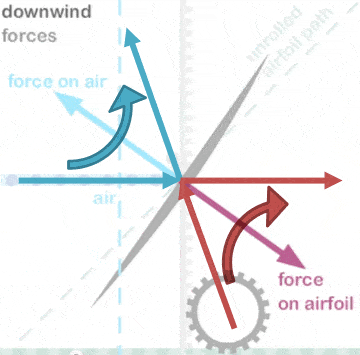
https://www.physicsforums.com/attachment.php?attachmentid=42518&stc=1&d=1325884076
kmarinas86 said:The air is doing the work with respect to the ground frame and other frames. Not in all inertial frames. That is relativity, you know, the theory invented by Albert Einstein?
It has something to do with the statement I was responding to:
Saying this means you deny that the cart involves the deflection of existing energy. That's like saying that no matter can be changing direction in this system. That has everything to do with blue and maroon arrows in the diagram below:
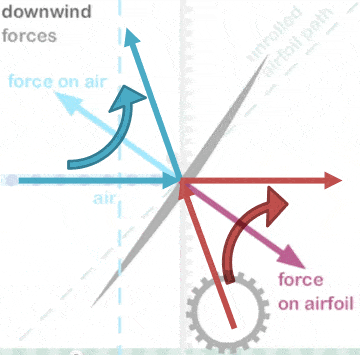
https://www.physicsforums.com/attachment.php?attachmentid=42518&stc=1&d=1325884076
Edit: You added:
By net energy, I mean there is a reference frame in which the net transfer of energy across the intersection between the depicted air stream and the propeller is zero.
kmarinas86 said:Edit: You added:
By net energy, I mean there is a reference frame in which the net transfer of energy across the intersection between the depicted air stream and the propeller is zero.
jduffy77 said:I do indeed. You seem to be having some problems with it at the moment though. You have made a correct statement here which should lead to an enhanced understanding of the cart mechanism, but instead it is leading you to incorrect conclusions.
Your diagram is incorrect. That is what I am trying to help you with. I think talking "deflection of existing energy" in the context of the cart is nonsensical.
A.T. said:The best way to avoid confusion is to be precise:
- Make clear which reference frame you are analyzing (power/kinetic energy are frame dependent quantities)
- Distinguish between "air" with "wind" (movement of air relative to something)
- Distinguish between true wind (relative to ground) with relative wind (relative to cart)
- Distinguish between work done by the cart chassis on the air, with work done by the propeller on the air.
Being precise in formulating the questions, often makes the answer obvious.That is not necessarily true. Depending on the propeller pitch the acceleration can be not maximal at WS but rather above it. So the increase in KE (seen from the ground frame) is maximal there. But the power transmitted though the vehicle always increases with speed. Here I posted some simulated values:
https://www.physicsforums.com/showthread.php?p=3352297From the ground frame: Some of the air is doing negative work on the cart chassis. But there is more positive work done on the propeller blades by the air.
The propeller always slows down air relative to the ground. The faster you go, the more volume of air you encounter, that you can draw KE from. But that increase is linear, while chassis drag and transmission inefficiency increase non linearly with speed.Have a look at the table below that shows different settings for a variable blade pitch propeller, coupled to the ground via wheels. What you describe above is starting out in CASE A (that gives you maximal initial acceleration) and then at some point below 1WS switching to CASE C that allows you to go faster than wind.
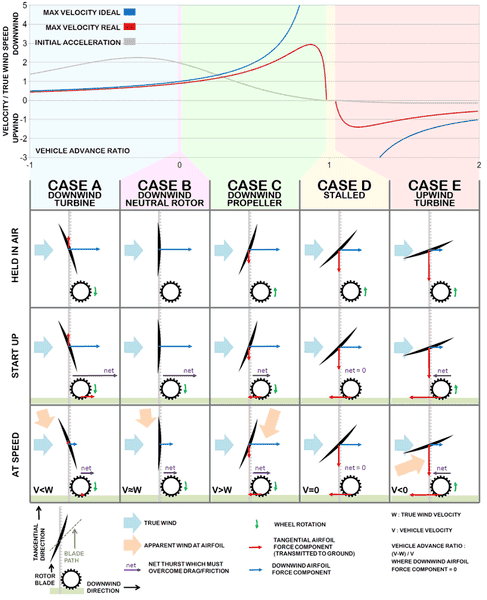
Note that the Blackbird didn't have that ability (even when it had variable pitch later). They didn't want the ability to turn the wheels with the prop, to avoid confusion about using stored energy. They used CASE C only.
But Andrew Bauer was using his propeller as a turbine below windspeed. Here is video where you can see him starting in "windmill mode" and change the blade pitch later.
http://www.fasterthanthewind.org/2010/09/sad-news-in-world-of-ddwfttw.html
See also the graphs on page 15 in Bauer's paper.
http://projects.m-qp-m.us/donkeypus...aster-Than-The-Wind-The-Ancient-Interface.pdf
kmarinas86 said:Saying this means you deny that the cart involves the deflection of existing energy. That's like saying that no matter can be changing direction in this system.
kmarinas86 said:Doesn't the angle of deflection of existing energy matter?
jduffy77 said:The energy for the ddwfttw cart comes from slowing down the wind with respect to the ground. Is that the "deflection of existing energy" that you are talking about?
kmarinas86 said:By deflection I mean an angular change of the direction with respect to some surface. If by deflection I meant the actual thing deflected, then I should really call this "deflected matter". So what you are taking about is "deflected matter" as seen from the ground point of view.
kmarinas86 said:So it does not even seem to me that the kinetic energy of the wind even needs to be extracted by the cart in order for this to work. All there needs to be is a deflection of existing energy. After all, if we discount the hypothesis that potential energy is somehow relevant in this system, while at the same time we assume the conservation of energy, then it would stand to reason that "kinetic energy+heat" is conserved both before and after the force interactions. If the air does not lose kinetic energy in the reference frame of the intersection, then neither could the rest of system gain it.
Finally, I would also like to point out that at from 1:07 to 1:22 in the video, the amount that the energy in and the amount of energy out is calculated to be different, even though the friction was not modeled! Clearly the video is not taking into to account the work done tangentially. It turns out that the video as a whole takes into account the work done along the path of the wind and the cart (horizontally that is), but not the tangential work. For example, consider how much faster the prop moves cuts up through the air than the air itself does. If they took into account the work done by the propeller onto the air tangentially to the wind, it turns out that net work that the wind does on the rest of the system, and vice versa, combining both horizontal and tangential components, is zero from the frame of reference of the intersection between the air propeller.
In the frame where the air's KE doesn't change, the carts KE increases while the grounds KE decreases.kmarinas86 said:How then does this cause the kinetic energy of the combined mass of the cart and the ground to increase relative to the intersection point?
Keep in mind that this is strongly simplified picture. The real airflow is quite different, but the result in terms of force on the blade is the same.kmarinas86 said:The air bounces off the surface of the airfoil at the intersection point.
See first comment.kmarinas86 said:If the air does not lose kinetic energy in the reference frame of the intersection, then neither could the rest of system gain it.
Work is done only along the direction of movement, at the rate P = F dot v (the dot product cancels the tangential force component). It is an idealized model that assumes just a short interaction with the blade. The inefficiencies of a real world propeller (like swirling the air tangentially) constitute the losses.kmarinas86 said:Clearly the video is not taking into to account the work done tangentially.
A.T. said:If the frame where the air's KE doesn't change, the carts KE increases while the grounds KE decreases.
Keep in mind that this is strongly simplified picture. The real airflow is quite different, but the result in terms of force on the blade is the same.
See first comment.
Work is done only along the direction of movement, at the rate P = F dot v (the dot product cancels the tangential force component). It is an idealized model that assumes just a short interaction with the blade. The inefficiencies of a real world propeller (like swirling the air tangentially) constitute the losses.
kerosene said:People follow their intuition and think that the dw component (for some reason) cannot exceed wind speed.
kmarinas86 said:Thinking about tacking wasn't helping that much. As evident on this thread, I and many others wasted a lot of time on that issue. I suggest that next time someone doubts that this is possible, one can skip the whole discussion about tacking and go directly towards talking about the effective velocity between the air mass and the rotating, pitched blade in the sense of vectors (velocities), not scalars (speeds). It's the only thing that should really matter here.
spork said:We have found that there is no single explanation that works for everyone. Whenever someone finally "gets it" they usually ask why we wasted their time with all the other useless or even wrong explanations. But the fact is, we have a whole bunch of different explanations. They're all accurate, and each person seems to respond to a different one - and think the rest are nonsense.
kmarinas86 said:Saying this means you deny that the cart involves the deflection of existing energy. That's like saying that no matter can be changing direction in this system. That has everything to do with blue and maroon arrows in the diagram below:
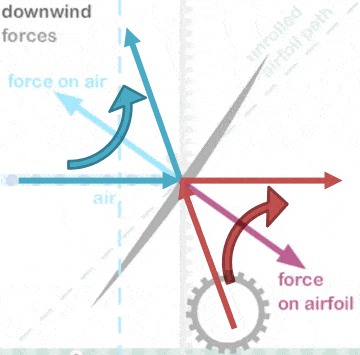
https://www.physicsforums.com/attachment.php?attachmentid=42518&stc=1&d=1325884076
Focus: Getting an Extra Bounce said:Focus: Getting an Extra Bounce
Published October 4, 2004 | Phys. Rev. Focus 14, 14 (2004) | DOI: 10.1103/PhysRevFocus.14.14
Computer simulations and experiments show that a ball can rebound from a surface with more vertical speed than it had initially.
Anomalous Behavior of the Coefficient of Normal Restitution in Oblique Impact
Hiroto Kuninaka and Hisao Hayakawa
Phys. Rev. Lett. 93, 154301 (2004)
Published October 5, 2004
Figure 1
NASA-JPL
http://physics.aps.org/assets/1e41c2ebe02d4468
Quick sand. Computer simulations agree with experiments suggesting that a disk can hit a surface and rebound with a surprisingly vertical trajectory. Research on such impacts can help improve models of the flow of granular materials–such as these Martian sand dunes (shown in false color).
Figure 2
M. Louge/Cornell Univ.
http://physics.aps.org/assets/389adf7d129904e2
Pop-up. In previous experiments [2] the trajectory of a ceramic ball hitting an elastic surface made a larger angle with the surface after impact than before. (See computer simulation video below.)
Animation courtesy of H. Kuninaka, Kyoto University.
http://physics.aps.org/assets/0d26d47f89100be8/video-v1.ogg
High ball. This two-dimensional simulation shows how a ball can deform an elastic surface when it bounces. The surface becomes in effect a ski jump, which redirects the ball’s velocity skyward.
Like a gymnast who runs toward a vaulting horse and then hurls herself skyward, a ball can, under certain conditions, rebound from a glancing impact with a surprisingly vertical trajectory. It’s a phenomenon that’s been observed but never fully explained–and at times even doubted. But now researchers report in the 8 October PRL that they have developed a theory that explains the phenomenon and have tested it with computer simulations. Their explanation–which hinges on the ball’s impact deforming the surface it hits–could help refine models of the flow of granular materials such as sand dunes, cement, and soil.
The coefficient of normal restitution compares the vertical component of the velocity of an object before and after it has bounced. Conventional wisdom says it’s less than one–that is, a ball can’t leave the ground moving faster than when it arrived, because that would require extra energy (in the case of the gymnast, her body creates energy). But since the early 1990s several research groups have reported experiments with oblique impacts in which they found what seemed to be absurd results: A hockey-puck-like disk glanced against a wall and then appeared to pop away with an increased perpendicular velocity [1] and a ceramic sphere rebounded off a softer surface with a noticeably more vertical trajectory [2].
“They first thought I was crazy!” says Michel Louge of Cornell University, who performed the sphere-bouncing experiment with student Michael Adams. But after carefully ruling out experimental error, he concluded that the ball must deform the surface in such a way that it changes the trajectory of the ball. In that way, he thought, some of the horizontal component of the velocity could be transferred to the vertical component[/color]. He wasn’t sure exactly how this would happen, although it was clear that the effect was limited to special situations. “My conjecture in the [experimental] paper was just that–a conjecture,” he says.
Now Hiroto Kuninaka and Hisao Hayakawa of Kyoto University in Japan report that they have simulated the small-scale interactions between a disk and an elastic surface that can lead to a greater-than-one coefficient of normal restitution. Their computer simulation calculates a coefficient of 1.3 when the disk strikes the surface at an angle of about 11 degrees; at that angle, their simulated ball rebounds at about 15 degrees. The simulation results resemble Louge’s experimental data, according to the authors.
The simulation allowed the team to see the virtual disk denting the surface when it hit at oblique angles. Bill Stronge of Cambridge University in England describes the indentation as a kind of ski jump, which redirects the sphere’s velocity skyward. Because of this phenomenon, the coefficient of normal restitution can be greater than one without breaking the laws of physics. “The point is that the target material is softer than the ball,” says Kuninaka.
But Stronge doubts that the impact could make as vertical a ski jump as the researchers’ model suggests. It may have some effect, he says, “but I think that it’s certainly not nearly as dramatic as they have portrayed.” Computer models of granular materials such as cement and soil must account accurately for the collisions between grains, which can be treated like collisions with walls. So the work could contribute to practical advances in industries that manage and transport these materials, says Louge–and add to the understanding of the physics of ball sports.
–Chelsea Wald
References
J. Calsamiglia, S. W. Kennedy, A. Chatterjee, A. Ruina, and J. T. Jenkins, “Anomalous Frictional Behavior in Collisions of Thin Disks,” J. Appl. Mech.66, 146 (1999).
Michel Y. Louge and Michael E. Adams, “Anomalous behavior of normal kinematic restitution in the oblique impacts of a hard sphere on an elastoplastic plate,” Phys. Rev. E 65, 021303 (2002).
kmarinas86 said:From this, we can see that "DDWFTTW" phenomenon isn't limited to sails or propellers
spork said:The very fact that these are "anomalous" tells us that they're not all that similar to DDWFTTW.
Focus: Getting an Extra Bounce said:Bill Stronge of Cambridge University in England describes the indentation as a kind of ski jump, which redirects the sphere’s velocity skyward.
kmarinas86 said:From this, we can see that "DDWFTTW" phenomenon isn't limited to sails or propellers:
Anomalous behavior of normal kinematic restitution in the oblique impacts of a hard sphere on an elastoplastic plate
jduffy77 said:kmarinas86 said:From this, we can see that "DDWFTTW" phenomenon isn't limited to sails or propellers:
Anomalous behavior of normal kinematic restitution in the oblique impacts of a hard sphere on an elastoplastic plate
http://masters.donntu.edu.ua/2010/fimm/kutnyashenko/library/nem_1/nem_1.pdf
This article has absolutely nothing to do with ddwfttw whatsoever. Your apparent desire to over complicate the simple lever which is the ddwfttw cart is fascinating to me. I believe your confusion stems from the fact that you still wish to see the cart as being pushed along by the wind. You need to think about the cart's prop exactly as you would the prop in a powered airplane. In this case the cart is powered by the wheels but it is generating thrust in exactly the same manner as the airplane.
kmarinas86 said:"Powered by the wheels" makes no sense. They're not the source of energy.
kmarinas86 said:The relative motion of the wind with respect to the ground is also not necessary, otherwise, dynamic soaring would not work.
kmarinas86 said:And do you think that DD"W"FTT"W" can only happen with sails and propellers? I think just about any two interfaces will do. One of them doesn't have to be "wind". That's my point. I'm saying that DD"W"FTT"W" could done with anything, even with two "solids" if the angles are just right. DD"W"FTT"W" could also happen inside a fluid, where particles in the fluid can be likened to "ships" or "wind".
