Discussion Overview
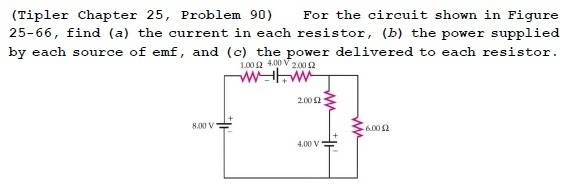
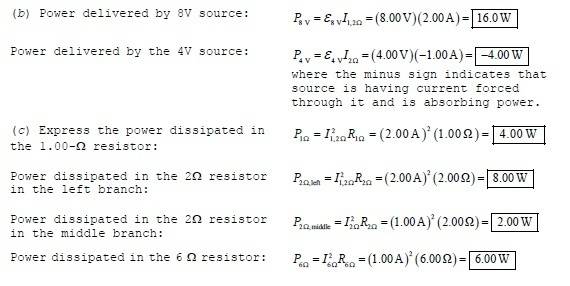
The discussion revolves around the relationship between power supply and power dissipation in an electrical circuit, specifically examining a scenario involving multiple voltage sources and resistors. Participants explore concepts related to Thévenin's theorem and conservation of energy, while addressing a specific problem that raises questions about power calculations.
Discussion Character
- Technical explanation
- Mathematical reasoning
- Debate/contested
Main Points Raised
- One participant questions whether the power supply can be smaller than the power dissipated, citing a specific problem involving three cells.
- Another participant asserts that power supplied cannot be smaller than power dissipated due to conservation of energy, suggesting a reevaluation of the problem without a specific resistor.
- A different participant introduces a Thévenin equivalent circuit, proposing that it would yield a specific voltage and resistance, leading to a balanced power dissipation calculation.
- Further contributions suggest alternative approaches to calculating the Thévenin equivalent and the implications of voltage drops across resistors in the circuit.
- One participant expresses confusion about their calculations and acknowledges a mistake in their approach to determining the Thévenin equivalent voltage.
- Another participant describes a method involving Kirchhoff's laws to find the potential and currents in the circuit, challenging the assumption that power from the two 4V sources cancels out.
- A final participant indicates that they have gained clarity on the topic after engaging in the discussion.
Areas of Agreement / Disagreement
Participants express differing views on the calculations and interpretations of power supply and dissipation, with no consensus reached on the initial question regarding whether power supply can be less than power dissipated. Multiple competing models and approaches are presented throughout the discussion.
Contextual Notes
Participants reference specific circuit configurations and calculations that depend on assumptions about voltage sources and resistances, with some unresolved mathematical steps and interpretations of Thévenin's theorem. The discussion highlights the complexity of power calculations in circuits with multiple sources.