| Thread Closed |
10^80 particles in observable v unobservable universe |
Share Thread | Thread Tools |
| Jun20-12, 04:07 AM | #1 |
|
|
10^80 particles in observable v unobservable universe
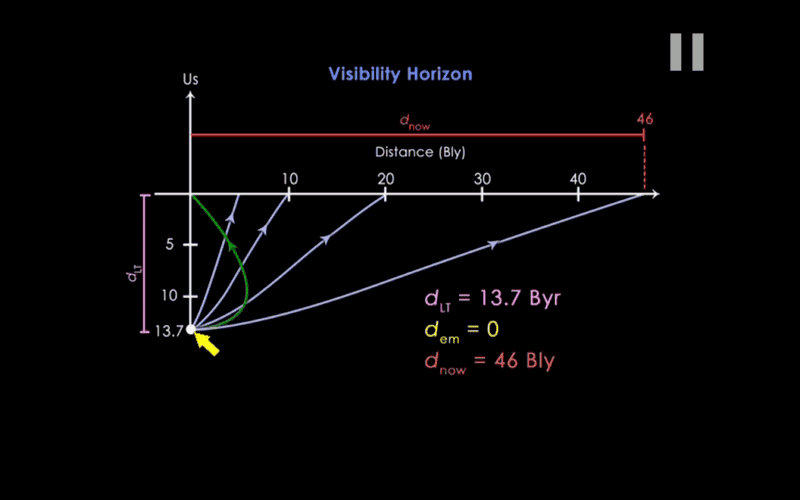
Here is a chart showing the unobservable universe
![]() The green lines indicates the part we can see. My question is that figure that gets thrown around, there are 10^80 particles in the universe, is that for observable or the unobservable universe. |
| Jun20-12, 04:16 AM | #2 |
|
Recognitions:
|
10^80 is for the observable universe, as the unobservable universe is probably [maybe?] infinite.
|
| Jun20-12, 05:47 AM | #3 |
|
|
that the unobservable universe is not infinite is something i feel very strongly about. it's quite simple: the universe began at a definite time in the past and it is bounded by the present, so there is a boundary on the past and the present, hence finite. Second argument: in an infinite universe there is an infinite amount of matter which would overwhelm the cosmological constant thus causing the universe to implode into a big crunch. third, you can't do any measurements in an infinite universe because all quantities are infinite, thus there is no way to determine if space is flat. fourth, although this is an argument from authority, take a look at the graph, it clearly shows the unobservable universe to be not infinite but finite at roughly 46 billion light years. fifth, you can't calculate probabilities in an infinite universe, the odds of all events happening are infinite. sixth, as olbert demonstrated in the 1830's in an infinite universe the sky would be filled with light from every angle.
|
| Jun20-12, 06:20 AM | #4 |
|
Recognitions:
|
10^80 particles in observable v unobservable universe |
| Jun20-12, 05:35 PM | #5 |
|
|
D = RT, distance equals rate times time. You're arguing the D is infinite. How do you get D to be infinite? Either R or T has to be infinite. What's the R of the universe? It's the Hubble constant, 75 km/s/MPc. What's the T of the universe. It's 13.75 by. Hence D is finite. |
| Jun20-12, 06:23 PM | #6 |
|
|
While it is probably true that, in an infinite universe, all things that can happen will happen, so what? our cause and effect is still limited to our own light cone. Show me one example where something that happens 1030 light years away has any effect on our calculations or physical universe here. |
| Jun20-12, 07:08 PM | #7 |
|
|
Your inability, or unwillingness, to accept that the universe might have STARTED OUT infinite (weird as that does seem), is your limitation, not the universe's. Just because it was a lot smaller 14+ billion years ago does NOT imply that it was finite. |
| Jun20-12, 07:53 PM | #8 |
|
|
Take the following equation: D = RT, distance equals rate times time. You're arguing the D is infinite. How do you get D to be infinite? Either R or T has to be infinite. What's the R of the universe? It's the Hubble constant, 75 km/s/MPc. What's the T of the universe. It's 13.75 by. Hence D is finite. I would like an answer to the above. |
| Jun20-12, 07:57 PM | #9 |
|
|
For you as well, phinds, I would like an answer to this: D = RT, distance equals rate times time. You're arguing the D is infinite. How do you get D to be infinite? Either R or T has to be infinite. What's the R of the universe? It's the Hubble constant, 75 km/s/MPc. What's the T of the universe. It's 13.75 by. Hence D is finite. |
| Jun20-12, 10:12 PM | #10 |
|
|
|
| Jun20-12, 10:15 PM | #11 |
|
|
More correctly, we think it's probably finite. |
| Jun20-12, 10:50 PM | #12 |
|
|
|
| Jun20-12, 11:06 PM | #13 |
|
|
|
| Jun20-12, 11:25 PM | #14 |
|
|
Also an infinite universe conflicts with standard inflationary cosmology. Here's a quote from Lisa Randall I also want to get back to the density parameter. You can't calculate the density of an infinite universe. Such statements as the universe is 4% ordinary matter, and 24% dark matter are meaningless because in an infinite universe there is an infinite amount of matter. |
| Jun20-12, 11:31 PM | #15 |
|
|
|
| Jun20-12, 11:39 PM | #16 |
|
|
|
| Jun20-12, 11:40 PM | #17 |
|
|
Hey OP, imagine a (infinite) plane. Next, imagine the plane stretching evenly. If you drew two points on it, they would recede from eachother. So would any two arbitrary points. Did the size of the plane increase? Next, imagine two distant points and a light signal emanating from the first one towards the second one. If the points are sufficiently far apart, the distance between them would increase by more than the distance traverseed by the light. In this fashion, we arrive at an observable region around each point. Does this region increase?
|
| Thread Closed |
| Thread Tools | |
Similar Threads for: 10^80 particles in observable v unobservable universe
|
||||
| Thread | Forum | Replies | ||
| the flatness of the observable and unobservable univ | Cosmology | 24 | ||
| Is the unobservable universe free from quantum indeterminism? | Beyond the Standard Model | 3 | ||
| If the observable universe were the entire universe, would the mass make it expand? | Cosmology | 7 | ||
| Is the whole Universe expanding, or just the Observable Universe? | Cosmology | 4 | ||
| Randall-Sundrum; Observable particles at LHC? | Beyond the Standard Model | 10 | ||