MetalManuel
- 38
- 0
I'm a second year college student right now and I have decided to major in physics, it is the only subject I have taken so far that has provided me with a challenge (this semester).
I am currently taking Physics 2 right now and I have got to say this class is really challenging, well not the class, but the professor. I thought I was really good at Physics last semester, until I got to this guy. My Physics 1 professor gave us basic problems of blocks sliding down ramps with a certain friction, etc etc and were relatively easy; which i think is the way most professors are. My current professor seems to love physics and the way he teaches it to us is just using variables (not the hard part, actually makes it simpler). The hard part is he gives us situations and wants us to describe them with mathematical formulas.
That's the hard part, coming up with the proper formulas to describe that certain situation. We have done this so much I don't even know the numerical value for some things, like epsilon 0, only the units.
Like this for example(took me hours to solve by myself with no help):
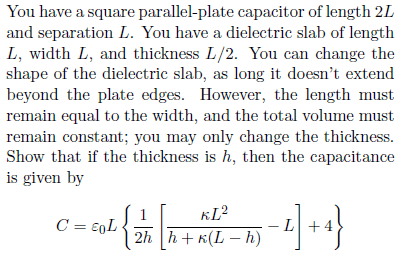
Since taking this professor I have gotten all his homework from his Physics 1 class and decided to try to start solving it, but like this semester's homework, it's really difficult and it's like relearning the class again.
What I was wondering is if I were to present a problem like this to the average physicist, would he be able to solve it? What I mean is, is having a really strong understanding of all of the basic Physics classes (mechanics, electricity, magnetism, optics, thermodynamics, waves/acoustics, and modern physics) a must?
I feel like I got jipped last semester by taking that professor's class.
I am currently taking Physics 2 right now and I have got to say this class is really challenging, well not the class, but the professor. I thought I was really good at Physics last semester, until I got to this guy. My Physics 1 professor gave us basic problems of blocks sliding down ramps with a certain friction, etc etc and were relatively easy; which i think is the way most professors are. My current professor seems to love physics and the way he teaches it to us is just using variables (not the hard part, actually makes it simpler). The hard part is he gives us situations and wants us to describe them with mathematical formulas.
That's the hard part, coming up with the proper formulas to describe that certain situation. We have done this so much I don't even know the numerical value for some things, like epsilon 0, only the units.
Like this for example(took me hours to solve by myself with no help):
Since taking this professor I have gotten all his homework from his Physics 1 class and decided to try to start solving it, but like this semester's homework, it's really difficult and it's like relearning the class again.
What I was wondering is if I were to present a problem like this to the average physicist, would he be able to solve it? What I mean is, is having a really strong understanding of all of the basic Physics classes (mechanics, electricity, magnetism, optics, thermodynamics, waves/acoustics, and modern physics) a must?
I feel like I got jipped last semester by taking that professor's class.
Last edited:

