| New Reply |
Passive RC Filter Loading? |
Share Thread | Thread Tools |
| Nov15-12, 12:15 AM | #1 |
|
|
Passive RC Filter Loading?
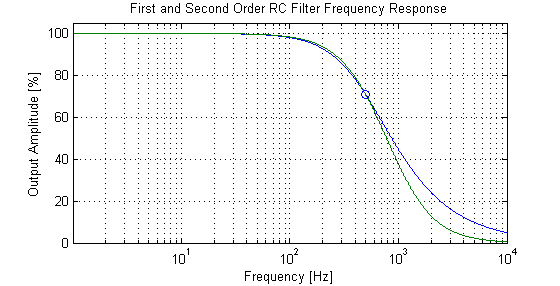
I'm trying to use a second order passive RC filter to attenuate noise in a thermocouple signal. I've heard that using two passive RC filters in series can generate "loading" effects. I'm not sure exactly what this means, except for the output response is different from the theoretical response.
Here is my theoretical response for a 500Hz cutoff frequency: ![]() What effects does loading have on the output response and how can I combat them? |
| Nov15-12, 12:38 AM | #2 |
|
Mentor
|
|
| Nov15-12, 01:03 AM | #3 |
|
|
Yes, like Berkeman said, if you don't have a buffer to isolate the two stages, they interact with each other and have a different response. I notice your frequency is quite low, My suggestion is looking into active low pass filter. Here are two articles:
http://en.wikipedia.org/wiki/Sallen%...93Key_topology http://www.ti.com/lit/ml/sloa088/sloa088.pdf They are very simple to implement, just calculate RC like your passive filter, then adjust the d. |
| Nov15-12, 05:24 AM | #4 |
|
Recognitions:
|
Passive RC Filter Loading?e.g., if the first low pass stage comprises R kΩ + C μF, make the second stage 100·R kΩ + 0.01·C μF. Other considerations, however, generally make this simple method impracticable, and you have to implement buffering. |
| Nov15-12, 11:52 PM | #5 |
|
|
Can anyone clarify the means that cause the response change? Also, how does the response change? Does filtering become more aggressive, less aggressive, or just different? |
| Nov16-12, 12:13 AM | #6 |
|
Recognitions:
|
Have you got simulation software? You'll get a much better feel for what is going on if you simulate a couple of filter circuits with different components and see the responses. In particular, what I said earlier.
|
| Nov16-12, 12:45 AM | #7 |
|
|
|
| Nov16-12, 12:55 AM | #8 |
|
|
so where are you now in your EE curriculum? |
| Nov16-12, 11:57 AM | #9 |
|
|
|
| Nov16-12, 12:24 PM | #10 |
|
|
To help you further, you need to provide info on what are you going to use the output of the filter to drive. Your question ended at the output of the filter which is really an open ended question. The important question is the drive capability requirement. If you need to drive a low impedance load, then that will change the filter response if it is a simple RC, RLC filter.
That's the reason I suggested the active filter as you are working with lower frequency range where active filter behave very ideal. And also the output impedance is low so it can drive the next stage easily without affecting the response. Also, if you are a mechanical engineer and don't get into the details of the filter design, there are cook books that you can just follow how to design the Sallen-Key filter. Once you know how to set the d, the RC=1/(2πf) so you can implement it very easy. If you use totally passive components, it might look simpler, but with relative low frequency, the value of the components tend to increase and the output loading start to become a big part of the filter and you end up having to put an op-amp buffer and you end up with a bigger circuit. With two stage passive circuit, calculation tends to be more complicated also. |
| Nov16-12, 12:31 PM | #11 |
|
|
then you have freedom to set two of those four parameters to something sorta arbitrary. pick a decent typical values for C1 and C2. they can even be equal. then, given C1 and C2, and the two real pole values (they might be equal if you want them to be), and solve for R1 and R2. they won't be equal. but if R2 >> R1 which means that C2 << C1, you can see that the effect of "loading" (which, for me, is just an issue of circuit generality) gets smaller and smaller. maybe to the point you can ignore it. but you don't have to ignore it or do this. just get on top of the math and what knobs you can twist. |
| Nov16-12, 12:41 PM | #12 |
|
|
to pick up on yungman, i would also suggest getting down to the basics and telling us what you wanna do.
so you have the output of a thermocouple and it's a little noisy and you want a LPF to reduce some of the noise, is that it? it appears that you're sorta fussy about how the LPF should appear in the frequency response. because even with this extra "loading", you still have a Low-Pass Filter. what are the specific needs you have of your LPF? because this is electrical, and possibly without active parts (transistors or op-amps), then the output resistance of your thermocouple is important, and the input resistance of whatever you're connecting your output (of the LPF) to is also important. do you know these values? one thing, if you're going to get real anal about this, if you have a passive LPF, besides the attenuation you expect to get at high frequencies, you will also have attenuation at DC because of these input and output resistances. |
| Nov16-12, 01:33 PM | #13 |
|
|
My goal is to put together a small PCB that takes in the thermocouple input on one end, and outputs an amplified and filtered response on the other. My current design (on paper) uses an Analog AD8497 for a type-K thermocouple with a 320Hz input stage, common mode filter (500Ohm, 0.1uF and 1uF differential RC filter) for attenuating RFI and other high frequency noise. I was planning to put an output stage filter on the output line of the AD8497 for filtering power-line (50/60Hz) noise and further attenuating any higher frequency noise (25Hz cutoff?). |
| Nov16-12, 02:49 PM | #14 |
|
|
Post the schematic on the circuit you have first. Then people can help you better.
|
| Nov17-12, 03:46 PM | #15 |
|
you dont need fancy computer simulation. Simple ohm's law will do.
First, figure transfer function of simple RC low pass , 1/(rsc+1) now add a second stage and observe your transfer function sprouts a lot more terms - because second RC is in parallel with first C. Derive that function and at corner frequency, tabulate attenuation for various ratios of R1::R2... observe that if second R >> first 1/sc at corner freq, you're not too far off a properly buffered response. Rule of thumb in analog days was keep it a decade away. Somebody said that earlier. ... I hope you go thru the exercise in algebra for it'll plant the concept firmly in your mind. |
| Nov17-12, 04:09 PM | #16 |
|
Recognitions:
|
I think a proper active filter is the go. |
| Nov17-12, 05:00 PM | #17 |
|
|
Regardless, I did go back and rederive the transfer function using KCL. Kirchoff's current law adds the additional loading term into the equation. Based on my limited understanding, it seems as if the "loading" term is caused by two things: the phase shift of the circuit and the extra current being pulled through the first stage resistor by the second stage filter. Does that sound right? Here's a plot of my model and my experimental data (I did build the circuits on a breadboard): ![]() For whatever reason, the bode analyzer I used generated some funky numbers on the second order filter with no buffering and the decade separation. The dashed teal line shows this (discontinuities). The buffered response was rather disappointing. I used a 741 Op-Amp Voltage Follower to separate the two and it did get marginally better response, but only below the cutoff frequency. The corner didn't appear to get any sharper (in contrast with the theoretical model). |
| New Reply |
| Thread Tools | |
Similar Threads for: Passive RC Filter Loading?
|
||||
| Thread | Forum | Replies | ||
| A question on passive low-pass filter | Engineering, Comp Sci, & Technology Homework | 3 | ||
| Passive butterworth filter design | Engineering Systems & Design | 1 | ||
| Specifications for Passive filter? | Engineering, Comp Sci, & Technology Homework | 0 | ||
| Question about passive filter | Introductory Physics Homework | 4 | ||
| passive band pass filter | Introductory Physics Homework | 10 | ||