| New Reply |
Multiple calculus questions |
Share Thread |
| Dec4-12, 08:54 AM | #1 |
|
|
Multiple calculus questions
1) [tex]f(x)=\frac { { x }^{ 2 } }{ \sqrt { x+1 } } \\ f'(x)=\frac { 2x\sqrt { x+1 } -\frac { \sqrt { x+1 } }{ 2 } }{ x+1 } \\ f'(x)=\frac { x(3x+4) }{ 2{ (x+1) }^{ \frac { 3 }{ 2 } } } [/tex]
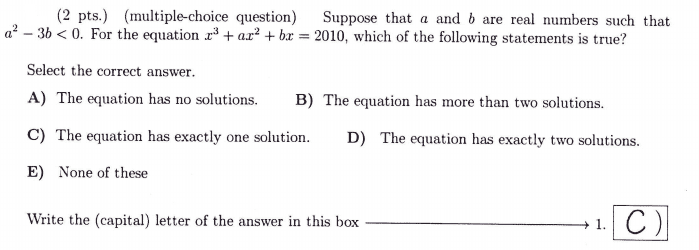
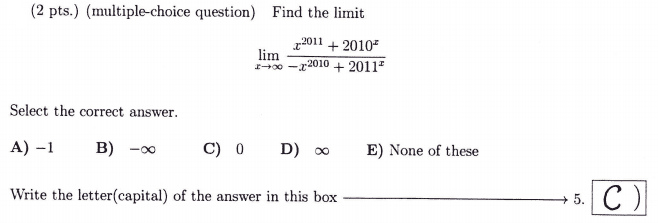
Can somebody show how you can get from the second step to the third step? I tried factoring x+1 from the numerator but it just made it even messier. 2) ![]() Can somebody tell me what method/technique or what theorem I need to use in order to do this question? 3) ![]() Can somebody tell me what method/technique or what theorem I need to use in order to do this question? |
| Dec4-12, 10:37 AM | #2 |
|
Recognitions:
|
|
| Dec4-12, 11:17 AM | #3 |
|
Mentor
|
|
| Dec4-12, 01:04 PM | #4 |
|
|
Multiple calculus questions
One more question:
4) [tex]{ (\frac { 1 }{ 3 } x+\frac { 1 }{ 3 } { x }^{ -1 }+{ x }^{ -2 }) }^{ -1 }\\ =\frac { 1 }{ 3 } { x }^{ -1 }+\frac { 1 }{ 3 } { x }+{ x }^{ 2 }[/tex] That's correct, right? But if it were -2 instead of -1, you wouldn't be able to distribute the exponent right? You'd still be able to distribute the negative though, correct? I'll upload my work in a sec |
| Dec4-12, 01:41 PM | #5 |
|
|
I solved question 1. The key was to use the product rule - not the quotient rule for derivatives and then use common denominators to add the fractions.
For question 2, I tried to use the discriminant for cubic functions to make some sort of resemblance to the inequality, but no luck. See: http://en.wikipedia.org/wiki/Discriminant#Formula_2 Here is my attempt for question 3: [tex]\underset { x\rightarrow \infty }{ lim } \frac { { x }^{ 2011 }+{ 2010 }^{ x } }{ -{ x }^{ 2010 }+{ 2011 }^{ x } } \\ =\underset { x\rightarrow \infty }{ lim } \frac { { { x }^{ 2010 }(x }+{ 2010 }^{ x }{ x }^{ -2010 }) }{ { x }^{ 2010 }(-1+{ 2011 }^{ x }{ x }^{ -2010 }) } \\ =\underset { x\rightarrow \infty }{ lim } \frac { { x }+{ 2010 }^{ x }{ x }^{ -2010 } }{ -1+{ 2011 }^{ x }{ x }^{ -2010 } } [/tex] Just to add, I have a calculus exam in 4 hours and 15 minutes from the time of this post, so sorry about not showing my work the first time. |
| Dec4-12, 01:47 PM | #6 |
|
Mentor
|
|
| Dec4-12, 01:59 PM | #7 |
|
Mentor
|
|
| Dec4-12, 02:10 PM | #8 |
|
|
I'm currently on my tablet, so I won't be able to post latex.
Thanks for answering question 4. So if instead of a negative exponent for the brackets, the contents of the brackets was just in the denominator of a fraction, then you still wouldn't be able to move each term to the numerator by changing the signs of the exponents right? Anyone know how to solve question 2? |
| Dec4-12, 02:13 PM | #9 |
|
Mentor
|
[itex]\displaystyle f'(x)=\frac{2\sqrt { x+1 }}{2\sqrt { x+1 }}\left(\frac { 2x\sqrt { x+1 } -\frac {x^2 }{ 2\sqrt { x+1} } }{ x+1 }\right) [/itex] [itex]\displaystyle |
| Dec5-12, 01:59 AM | #10 |
|
|
The solution to #2 was to take the derivative of the equation. Then calculate the discriminant for the the derivative.
The solution to #3 was to apply L'Hôpital's rule 2011 times (or when you noticed the pattern and skipped right to the end). |
| New Reply |
Similar discussions for: Multiple calculus questions
|
||||
| Thread | Forum | Replies | ||
| Calculus Readiness Multiple Choice Test Answer Key Wrong? | Precalculus Mathematics Homework | 12 | ||
| Multiple choice questions | Introductory Physics Homework | 1 | ||
| multiple choice questions about SHM | Introductory Physics Homework | 4 | ||
| Multiple Circuit Questions | Introductory Physics Homework | 1 | ||
| Multiple Choice Questions ( NEED HELP!! ) | Introductory Physics Homework | 3 | ||