Ryoko
- 149
- 10
I have a problem which got me thinking, but I'm unable to solve to my satisfaction. The problem involves a gyro attached to a platform which in turn is attached to a flywheel. (See image below)
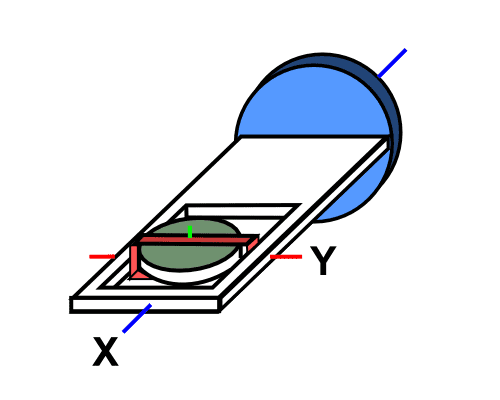
The constraints are as follow: The platform & flywheel are solidly attached to each other and can only rotate about the global X-axis. The gyro gimbal has one axis of freedom about the local Y-axis. There is no friction.
The system has the following properties: The gyro has an angular moment of inertia of 0.25 slug-ft^2 and is spinning at 1000 rad/sec (angular momentum of 250 lbf-ft-sec). The platform/flywheel has an angular moment of inertia of 80 slug-ft^2.
The initial conditions are that the gyro is spun up with its gimbal is locked in place. The platform is then spun about the x-axis to an angular velocity of 1 rad/sec. The gyro's gimbal is released when the gyro's spin axis is exactly vertical (aligned with the z-axis). What happens to the system?
I know that the gyro will immediately precess. But I'm having trouble with conserving both angular momentum and total energy. As I understand it, if the gyro precesses, it will take angular momentum away from the flywheel so that the total angular momentum along the x-axis is conserved. However, if any momentum is taken from the flywheel, it's energy drops. Where does this energy go? I seem to remember that precession doesn't change the angular momentum of the gyro, which means the gyro didn't gain the energy lost from the flywheel when it's momentum changed. What am I overlooking? How do I conserve both angular momentum and energy?
The constraints are as follow: The platform & flywheel are solidly attached to each other and can only rotate about the global X-axis. The gyro gimbal has one axis of freedom about the local Y-axis. There is no friction.
The system has the following properties: The gyro has an angular moment of inertia of 0.25 slug-ft^2 and is spinning at 1000 rad/sec (angular momentum of 250 lbf-ft-sec). The platform/flywheel has an angular moment of inertia of 80 slug-ft^2.
The initial conditions are that the gyro is spun up with its gimbal is locked in place. The platform is then spun about the x-axis to an angular velocity of 1 rad/sec. The gyro's gimbal is released when the gyro's spin axis is exactly vertical (aligned with the z-axis). What happens to the system?
I know that the gyro will immediately precess. But I'm having trouble with conserving both angular momentum and total energy. As I understand it, if the gyro precesses, it will take angular momentum away from the flywheel so that the total angular momentum along the x-axis is conserved. However, if any momentum is taken from the flywheel, it's energy drops. Where does this energy go? I seem to remember that precession doesn't change the angular momentum of the gyro, which means the gyro didn't gain the energy lost from the flywheel when it's momentum changed. What am I overlooking? How do I conserve both angular momentum and energy?