SUMMARY
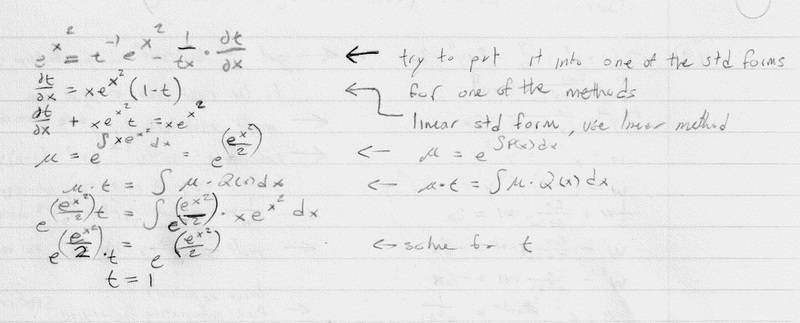
The discussion focuses on indicating transient terms in equations where the dependent variable y equals 1. The key point is the introduction of the constant of integration, represented as 'c', which is necessary for accurately expressing solutions. The equation t = 1 + c or t = 1 + c/μ is established as a valid representation, highlighting the importance of including the constant in the solution process. Additionally, the function e^((e^x^2)/2) should be divided by 'c' when solving for t to maintain mathematical integrity.
PREREQUISITES
- Understanding of differential equations
- Familiarity with the concept of transient terms
- Knowledge of constants of integration
- Basic proficiency in mathematical functions and their properties
NEXT STEPS
- Study the role of constants of integration in differential equations
- Learn about transient terms in mathematical modeling
- Explore the implications of dividing functions by constants in calculus
- Investigate advanced topics in differential equations, such as stability analysis
USEFUL FOR
Mathematicians, engineering students, and anyone involved in solving differential equations or studying transient behavior in mathematical models.