| New Reply |
Spacetime diagram - Twin paradox |
Share Thread | Thread Tools |
| Feb12-13, 05:53 PM | #1 |
|
|
Spacetime diagram - Twin paradox
I was studying the twin paradox (of Einstein special relativity) and everything was working well until I get to the traveler's spacetime diagram.
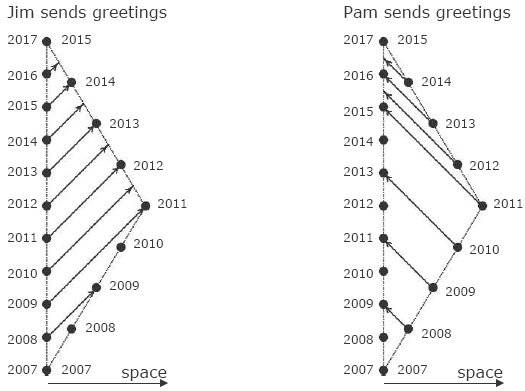
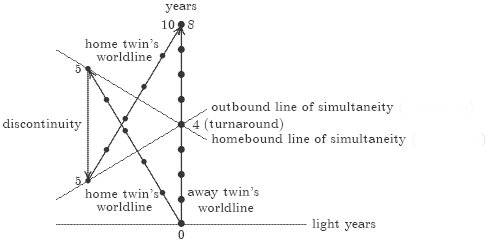
First let me introduce the paradox for you to understand the diagram. Pam is the twin sister of Joe. Pam goes out Earth in 2007 in a spaceship with v = 0.6c (velocity that Jim measures) for a 3 light-years round trip (again, distance that Jim measures). Every year that passes in Pam calendar, she sends a message to Jim ( the message travels with light-speed). So do Jim. At the end, they find out Pam is 2 years younger than Jim. The spacetime diagram in the Jim's frame of reference is: ![]() But when we try to put this in the Pam's frame of reference it goes like this: ![]() Or, if we draw the message lines too (red lines) ![]() I'm confused about the following: 1) What is this discontinuity in the diagram? What does it means? 2) In 2009 (Pam's calendar) Pam sends a New Year message to his brother, and we can see the message intersects the diagram 2 times (in 2011 and 2014, Jim's calendar ). What does it mean? Will Jim receives 2 times the same message sent by Pam? 3) In the discontinuity line, 2 messages sent by Pam arrives. What does it mean? Seen that the turnaround occurs in a very short period of time, will Pam receive this 2 messages at the turnaround, and simultaneously? |
| Feb12-13, 06:36 PM | #2 |
|
|
The real question is, why do you feel it necessary to do this to study the twin paradox? You can do everything in the single inertial frame in which the stay-at-home twin is at rest. What's missing? |
| Feb12-13, 07:24 PM | #3 |
|
|
Actually the images and the traveler's diagram are from this site
http://www.einsteins-theory-of-relat...paradox-2.html I just wanted to understand them |
| Feb12-13, 08:16 PM | #4 |
|
|
Spacetime diagram - Twin paradoxThey give, as their main point, that you are much better off sticking to one of the inertial frames. While I agree with their overall point, their implication that any attempt to represent the experience of the traveling twin in one set of coordinates will be absurd, is, itself absurd. |
| Feb12-13, 08:22 PM | #5 |
|
|
|
| Feb12-13, 09:06 PM | #6 |
|
|
http://math.ucr.edu/home/baez/physic...x/twin_gr.html This is an article by Einstein on this subject http://en.wikisource.org/wiki/Dialog..._of_Relativity This analysis is not necessary because working out the proper lengths can be done more easily in an inertial frame. But if one insists that there is a valid frame in which the travelling twin remains stationary, this seems to be the only way to get it. |
| Feb12-13, 09:37 PM | #7 |
|
|
|
| Feb12-13, 09:49 PM | #8 |
|
|
- the traveling twin a straight vertical line. - The home twin would proceed to the left from starting point at less the 45° to vertical until near midway point. Then it would shoot far to the left nearly horizontally, sharply turnaround back, nearly horizontally (with no intersection, loop, or discontinuity); then proceed the rest of the way back in a straight line less the 45° to the vertical. The wild path for the home twin would still be a geodesic in these coordinates, while the vertical traveling twin path would not be a geodesic. Light rays would have complex paths in these coordinates. If you marked proper time of the home twin along its path in these coordinates, most of the tick marks would occur on the 'shoot left and back' portion of the trajectory. |
| Feb12-13, 10:02 PM | #9 |
|
|
http://www.einsteins-theory-of-relat...s-gravity.html |
| Feb13-13, 12:27 AM | #10 |
|
Recognitions:
|
This discontinuity can be eliminated if we smooth Pam's journey out by rounding off the corner. The simplest way is to replace the sharp corner by a segment of a hyperbola (which represents constant proper acceleration in the Minkowski diagram). When an observer undergoes acceleration, it is possible that objects in the "spatial future" (that is, outside the lightcone, but ahead of the line of simultaneity) end up in the "spatial past" (outside the lightcone, and behind the line of simultaneity), or vice versa. During the short moments when Pam turns around, large swaths of Jim's worldline quickly migrate from Pam's "spatial future" to her "spatial past", effectively causing Pam to "skip" many of Jim's years. The skipped years are the ones that appear in your triangular loop. I would not attempt to use your distorted diagram to find out how signals travel between Pam and Jim, because you have essentially torn a rift in spacetime and glued it back together in order to make that diagram. The paths actually taken by light are not going to be the obvious ones as you might try to draw in that picture. |
| Feb13-13, 12:36 AM | #11 |
|
|
As I've pointed out in another thread, for a more complex twin trajectory, you couldn't construct valid coordinates using simultaneity based on spacelike geodesics 4-orthogonal to the traveling world line. However, for any 'twin' situation at all, you could still construct coordinates based on radar simulteneity. |
| Feb13-13, 11:54 AM | #12 |
|
|
|
| Feb13-13, 12:31 PM | #13 |
|
|
If you are looking for a verbal description, or a computation for a specific case, I am not willing to do it. Radar coordinates are simple in concept but lead to very messy metrics. |
| Feb14-13, 02:23 AM | #14 |
|
|
You can visualize Pam's non-moving point of view as follows.
On the first part of the journey, Jim is travelling away from Pam. Then suddenly someone in the opposite direction to Jim switches on a powerful gravitational field. Pam is suspended motionless in this field, but she feels her feet pressing against the floor, which is away from Jim who is now above her head. She sees Jim slow down in this field, until he starts to fall towards her. Then the field switches off and Jim continues to aproach her at constant speed. While this linear gravitational field is switched on, Jim is at a much higher potential in the field than Pam, and as per GR, his clock will advance faster than Pam's. Where she did see it delayed relative to hers, she now sees it advance rapidly until it is well ahead of hers. Then the field switches off and his clock ticks slowly again, but when he gets back she finds his clock is still ahead of hers. So there we have a description from the point of view of a "stationary" Pam. All we need is a way to switch gravity on and off. Mike Just waiting for PAllen and Peter Donis to pull me to pieces! Edit: OK, so I've ignored the time light takes to travel for Pam to "see" Jim's clock. So lets say she calculates what his clock would be reading in her coordinate system. I know the situation is much more complicated than I have described. |
| Feb14-13, 11:31 AM | #15 |
|
|
|
| Feb14-13, 12:25 PM | #16 |
|
|
|
| Feb14-13, 02:24 PM | #17 |
|
|
Why doesn't Pam conclude to age more from her perspective? Answering this question with: Who cares about Pam's perspective? is not very convincing to the inquiring layman. |
| New Reply |
| Thread Tools | |
Similar Threads for: Spacetime diagram - Twin paradox
|
||||
| Thread | Forum | Replies | ||
| Ehrenfest Paradox + Twin Paradox | Special & General Relativity | 16 | ||
| twin paradox | Special & General Relativity | 2 | ||
| twin paradox - which twin is older? | Special & General Relativity | 12 | ||
| twin paradox | Special & General Relativity | 14 | ||
| Is the Loedel Diagram a Special Case of the Minkowski Spacetime Diagram? | Special & General Relativity | 11 | ||