| New Reply |
Spacetime diagram - Twin paradox |
Share Thread | Thread Tools |
| Feb14-13, 02:34 PM | #18 |
|
|
Spacetime diagram - Twin paradox |
| Feb14-13, 02:58 PM | #19 |
|
|
|
| Feb14-13, 03:24 PM | #20 |
|
|
(You can construct any number of coordinate systems in which Pam has constant spatial coordinate position, but none of these constitute a global frame for Pam in the sense that there are global inertial frames). |
| Feb14-13, 04:08 PM | #21 |
|
|
![]() It looks like I need to get busy on the Twin Paradox FAQ that I have been meaning to draft for this forum. |
| Feb14-13, 05:03 PM | #22 |
|
|
Personally I like to use space-propertime diagrams to visualize the twins, because you see the age difference directly. In this interactive version there is both types of diagrams, and the three inertial frames of the quick-turnaround version:
http://www.adamtoons.de/physics/twins.swf As has been mentioned: If you want to have just one rest frame of non-inertial twin, you have to smooth the acceleration to avoid discontinuities. In the simplest case the acceleration is constant, and you have a constant gravity in the rest-frame of the non-inertial twin. In space-propertime diagrams gravity looks something like this: ![]() From: http://www.physics.ucla.edu/demoweb/...spacetime.html So the twin frames would look something like this: Keep in mind that both worldlines are supposed to have the same length in each diagram, because everything advances at the same rate in space-propertime. Also note that this is equivalent with throwing up an object (red) from the surface of the Earth (green). |
| Feb14-13, 05:16 PM | #23 |
|
|
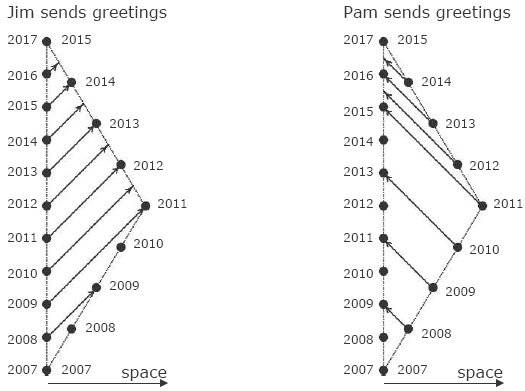
- Jim's worldline is straight - Pam's worldline is curved |
| Feb14-13, 05:20 PM | #24 |
|
|
A.T.,
We've been over how this is not a valid coordinate chart of Minkowski space because one event in Minkowski space appears in two places on this chart. It could conceivably be treated as a chart of a completely different manifold. In terms of utility, how do you draw light paths on this? It seems all light paths are on top of each other along the bottom of the diagram. Not very instructive. Also not instructive is intersections of paths on this chart do not represent coincident events in the real world. I think this highly non-standard tool will only serve to confuse. |
| Feb14-13, 05:22 PM | #25 |
|
|
Edit: I should have noted, as PAllen did, that your diagram is not a coordinate chart; the coordinate transformation I was talking about would be done from a standard inertial chart to a non-inertial chart in which Pam's worldline was the "time" axis. |
| Feb14-13, 05:28 PM | #26 |
|
|
Let me remind to look at my post #8, where I describe carefully how the diagram looks for Pam at rest in a typical coordinate chart. This description is based on Fermi-Normal coordinates for Pam.
|
| Feb14-13, 05:44 PM | #27 |
|
|
http://www.adamtoons.de/physics/twins.swf |
| Feb14-13, 06:00 PM | #28 |
|
|
Can you give a simple answer to how they appear? It seems they can only be as I supposed because they have no proper time. [Edit: Ok, I see you have to press the animate button. But that just adds more confusion: you draw light paths as horizontal lines from where they originate, so based on proper time of whatever world line emitted them. It's clear as mud where they end; they don't end on the line for the other twin (in general). I don't see the logic of where they end. (Oh, I figured that out). Additional point: such diagrams are completely un-interpretable except in the presence of the Minkowski diagram, because a twin situation or a situation where two rockets never meet at all could be indistinguishable. ] |
| Feb14-13, 06:21 PM | #29 |
|
|
I don't think light signals are useful or needed in the space-propertime diagram of the twins. In the Minkowski diagram they are used as an indirect way to show the differential aging. But that is already shown directly in the space-propertime diagram.
|
| Feb14-13, 06:26 PM | #30 |
|
|
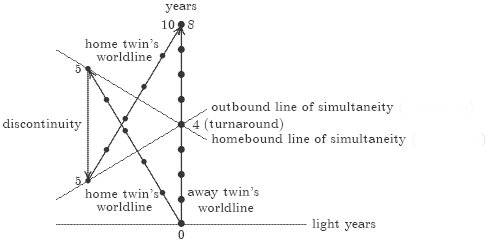
Also, when she switches on her gravity machine (her rocket motors) she will see Jims clock speed up due to the difference in gravitational potential. So a more correct diagram would be like this - ![]() In answer to Peter's question, his view is that of a mathematicuian. All the correct numbers can be obained from one static reference frame, and one doesn't have to look at the situation from any other point of view. But some of us want a bit more than numbers. We want to be able to visualize the situation from different points of view to enable us to understand it a bit more deeply. Of course, there are limits to what our imagining can achieve - I still like the Bohr atom with its circular and elliptical orbits, and electrons jumping from one orbit to the other! Mike NB. I didn't count the year dots on Jims turnaround line. NB2. The two lines of simultaneity shouldn't meet at 4 on Pams time line - than would assume that turnaround is accomplished in zero time. |
| Feb14-13, 07:23 PM | #31 |
|
|
|
| Feb14-13, 10:40 PM | #32 |
|
|
The direct metric method, or picking any inertial reference frame method, or doppler analysis all work fine for a W shaped trajectory, but these lines of simultaneity break down. It simply means there are limitations to that simultaneity convention for more complex non-inertial motion. You can pick a different simultaneity convention, getting a different type of diagram in which Pam is 'at rest', that does work for this case. One example is radar coordinates. |
| Feb14-13, 11:56 PM | #33 |
|
|
Thanks, PAllen, for mentioning the shoot out to the left. I hadn't realised that that happened, but its obvious when you consider Lorentz contraction and decreasing relative velocity.
|
| Feb15-13, 03:39 AM | #34 |
|
|
But I agree that they should be used together with Minkowski diagrams, because both have their weak points: - Space-propertime diagrams don't show meetings directly as intersections of world lines - Minkowski diagrams don't show poper-time directly as a length |
| New Reply |
| Thread Tools | |
Similar Threads for: Spacetime diagram - Twin paradox
|
||||
| Thread | Forum | Replies | ||
| Ehrenfest Paradox + Twin Paradox | Special & General Relativity | 16 | ||
| twin paradox | Special & General Relativity | 2 | ||
| twin paradox - which twin is older? | Special & General Relativity | 12 | ||
| twin paradox | Special & General Relativity | 14 | ||
| Is the Loedel Diagram a Special Case of the Minkowski Spacetime Diagram? | Special & General Relativity | 11 | ||