New Reply

Cosmo calculators with tabular output

 
Share Thread Thread Tools
Feb12-13, 05:08 AM   #35
 
Recognitions:
Gold Membership Gold Member

Cosmo calculators with tabular output


For anyone who missed the discussion in Marcus' "88 billion year" sticky above, here is the latest version of the "inhouse" tabular cosmo-calculator, as also shown in Marcus' signature (TabCosmo5.html).

The main changes since September last year are: an easy method to get a logarithmic spread of redshifts (actually stretch S = z+1) and that the latest (2013) WMAP9 (combined) maximum likelihood parameters are now used. Please read the info tool-tips of the calculator for clarification of usage.

Here is a sample plot of data generated by the calculator, as copied into a spreadsheet.


Of particular interest from the visuals are the following observations:
  1. The max value of D_then ~ 5.8, where D_then crosses T_Hub at S ~ 2.62. You will need 29 S-steps to spot this max precisely on a generated table.
  2. The correspondence of T_Hubble and D_hor when S < ~0.3, where the cosmological constant completely dominates.
  3. The 'straight' T-curve into the future (S < 1), with an equation [itex] T \approx 13 - 16.5 \ln(S) [/itex] Gy, with 13 roughly the y-intercept of the linear portion and 16.5 is Y_inf (Hubble time in far future).
Attached Thumbnails
Log-linear-plot2.jpg  
Feb13-13, 07:06 PM   #36
 
Recognitions:
Gold Membership Gold Member
Science Advisor Science Advisor
Part of what Jorrie was just talking about. I.e. stretch factor 2.63 and emission distance 5.8, has to do with the beautiful fact that past lightcones are TEAR-DROP SHAPE.

You can see that at the top level of the "figure 1" in my signature. That is what they look like when you measure in proper distance, the real distance that it actually was at the time, if you could have stopped the expansion process.

Other levels of the "figure 1" show conformal distance---what the distance to that same bit of matter would be today, not what it was back then. So the lightcone is not teardrop, it is some other shape.

the point of S=2.63 is that where the WIDEST bulge of the teardrop comes, in our past light cone. The largest girth. Farther back in time from then, the light cone PULLS IN. Of course that's because distances were smaller back then---and it is what gives it the teardrop or pear shape.

A rather beautiful thing happened around S=2.63 namely when galaxies emitted light then, that was destined to get here today for us to receive with telescopes, that light stayed at the same distance from us for a long time. Making barely if any progress. It stayed at distance 5.8, or more precisely according to the calculator, 5.798. Because its forward motion thru the surrounding space exactly canceled the rate at which the distance 5.798 was growing! So no net headway!

And then after a long time that distance 5.798 had slowed slightly and was not growing at the speed of light and the photons began to make headway towards us. The calculator will give an idea how long they took, all told, to get here. I think it was very nearly 10 billion years.

So you see in the preceding post Jorrie suggests putting 29 into the STEPS box, and also be sure to check the "exactly S=1" box so you get the exact present in your table. Then you will get, among much else, the S=2.62 line in the table, and that 5.8, and the time, what year it was etc.

The widest girth is at a crossing point in the figure which basically says the distance was growing at exactly c. You can see where the two curves cross. Blue and green. Blue for the emission distance, green for the Hubble distance (that distance which is growing at speed c.)

If you click on figure 1 in my signature you will also see a crossing of curves that marks this widest point on the teardrop lightcone. (In the top layer, the version drawn using proper distance. Other layers distort shape.)
Feb15-13, 03:29 PM   #37
 
Recognitions:
Gold Membership Gold Member
Quote by marcus View Post
... stretch factor 2.63 and emission distance 5.8, has to do with the beautiful fact that past lightcones are TEAR-DROP SHAPE.

You can see that at the top level of the "figure 1" in my signature. That is what they look like when you measure in proper distance, the real distance that it actually was at the time, if you could have stopped the expansion process.
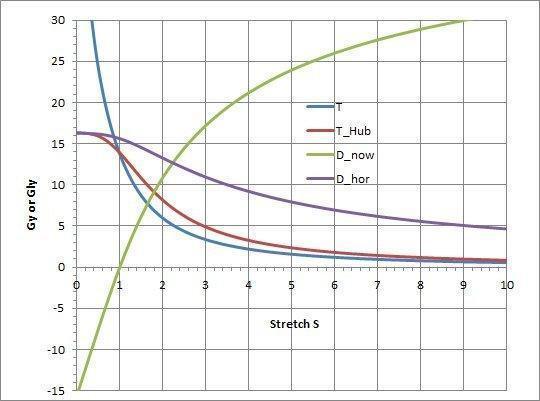
I have massaged a spreadsheet of the tabular data a little in order to plot a graph that looks somewhat like the top level Davis plot in your sig. In the process I became interested in the relationship between the event horizon and the particle horizon and subsequently have added a column for the particle horizon to TabCosmo5 (saved as TabCosmo6). Graphically it looks like this:


It corresponds (partially) to the Davis diagram turned on its side, with the 'teardrop' the two opposite side D_then distances, crossing and diverging in the future.

Interestingly, there are two other intersections happening simultaneously at another cosmic time, T~4 Gy: (i) the Hubble sphere crossing the past light cone and (ii) the event horizon crossing the particle horizon.

Crossing (i) is as you explained in your prior post, but I'm not sure why crossing (ii) happens at the same time (or at least very closely so, as far as I can tell). The correspondence seems to be independent of the choice of input parameters (Ynow and Yinf).

If I have it right, the cosmic event horizon is the largest proper distance (at time of emission) between an emitter and receiver that light can ever bridge, while the particle horizon is the proper radius of the observable universe at the time of the emission of the signal that is observed at stretch S.

Is it because observed redshift at the event horizon will tend to infinity?
Attached Thumbnails
DavisDiagramCosmoTab6small.jpg  
Feb15-13, 03:48 PM   #38
 
Recognitions:
Gold Membership Gold Member
Science Advisor Science Advisor
Nice!
The present moment is shown in an elegant graphic way as the point joining the past and future lightcones. I'll think about your question shortly, just wanted to respond immediately to the figure
Feb15-13, 05:24 PM   #39
 
Recognitions:
Gold Membership Gold Member
Science Advisor Science Advisor
Sorry, I got dragged off to lunch and had to prune trees in the garden. I see that simultaneous intersection clearly! I can't explain it. I'll keep thinking about it and may have some luck later.
Feb15-13, 05:33 PM   #40
 
Recognitions:
Gold Membership Gold Member
Science Advisor Science Advisor
That is my understanding too, Jorrie. The redshift approaches infinity by the time photons currently emited at the CEH reach us. Of course, the time it takes those photons to reach us also approaches infinity. If you think in terms of scale factor, it all seems to make sense.
Feb15-13, 10:03 PM   #41
 
Recognitions:
Gold Membership Gold Member
Science Advisor Science Advisor
One thing that occurs to me is that Lineweaver is a talented explainer who devoted his lifetime to cosmology and his figure 1 has THREE bands. Probably you can't get the whole thing into one picture and if you try to, the first picture will start getting complicated and won't communicate as well.

The THIRD band of figure 1 uses comoving distance (each bit of matter is given an unchanging label) and the timescale is adjusted to match that. Then particle horizon is a straight 45 degree line that intersects event horizon which is also a straight 45 degree line and is effectively "the past lightcone at infinity".

The story you can tell about that intersection (P horizon with E horizon) is of a RADAR ECHO. We send out a PING at the start of expansion, and we ask what is the most distant matter that can echo back or send a reply message to us, that we would eventually receive if we could wait arbitrarily long. If we could wait "till infinity" to hear the reply or the echo, then what is the most distant matter we could contact that way. With the whole history of the universal expansion to do it in, to make contact.

And I think your tabular calculator gives the answer to that, and it says WHEN the radar signal bounces, if I recall it is around year 4 billion, which is when the lines intersect. I have to check this.

Yes, I'm just using version 5. It says that the proper distance to that farthest ever ping-able matter is 11.8 Gly, that is at the moment it gets our message (we sent at the start of expansion) and echos it back. And that is at S=2.63. So to find the distance NOW I have to multiply 11.8*2.63 = 31 Gly
And distance now of some particular bit of matter is what they call its "comoving" distance. So that 31 Gly should agree with Lineweaver figure 1.

Actually I don't think this has to do with infinitely redshifting light. It is not what you can practically get a radar ping from it is what you can do IN PRINCIPLE. using arbitrarily large antennas and arbitrarily sensitive receivers etc etc. Let me check and see if Lineweaver puts that intersection at 31 Gly.

Yes, bingo! right on 31 Gly! So I think the analysis is all right.

Now there is still the puzzle Jorrie posed which is why that farthest matter echo event happens right at S = 2.63.
Why should it coincide with....??? Have to think some more about that. If somebody else doesn't come up with an explanation I'll think about it tomorrow morning when I'm fresh. We're only just getting started on that one, I think. Intriguing coincidence!
Feb15-13, 10:54 PM   #42
 
Recognitions:
Gold Membership Gold Member
Science Advisor Science Advisor
This is strange. Using the new calculator version6, I don't actually get a coincidence.
I'm putting in Step=0 so I just get a one-line table, for S=2.632
That is what I am used to using to get the intersection of Hubbleradius and D_then. Or even better: S=2.6321

But that does not give a match between D_hor and particle horizon D_par! It looked on the figure as if they were at the same level so I thought there was an exact coincidence (but couldn't figure out why there would be) and now the table does not give a coincidence.

11.804 ≠ 11.934

Am I missing something? being really dense? Sorry for a possible bungling lapse of competence. Can someone explain this almost but not quite coincidence?

To get D_hor to equal D_par, you have to go to S=2.662
11.736 ≈ 11.735

well, let's still find the comoving (now) distance to the farthest pingable matter: 2.662*11.735 = 31.2 Gly. Yes! that's still good.

I suppose that twice that, namely 62.4 Gly is the distance now of the farthest matter we will ever hear from regardless how long we wait.
Feb15-13, 11:21 PM   #43
 
Recognitions:
Gold Membership Gold Member
Quote by marcus View Post
But that does not give a match between D_hor and particle horizon D_par! It looked on the figure as if they were at the same level so I thought there was an exact coincidence (but couldn't figure out why there would be) and now the table does not give a coincidence.

11.804 ≠ 11.934

Am I missing something? being really dense? Sorry for a possible bungling lapse of competence. Can someone explain this almost but not quite coincidence?

To get D_hor to equal D_par, you have to go to S=2.662
11.736 ≈ 11.735
I have also noticed this, but my first reaction was that it is caused by small errors in the numerical integration loops of the various curves. Remember that to get all the values perfect, it requires integration for time (or S) from zero to infinity with an 'infinite number of steps', which is not feasible. Especially D_hor is very susceptible to cut-off errors.

What is intriguing is that the rough correspondence remains when Ynow and Yinf are changed. I'm busy looking at it analytically (not easy) and will report what I find.
Feb15-13, 11:50 PM   #44
 
Recognitions:
Gold Membership Gold Member
Science Advisor Science Advisor
Because you are doing hard analytical work I should probably be quiet and not distract from that. I had something else I wanted to say, though. It seems to me that the distance 11.735 Gly is somehow UNIVERSAL. It does not know about us, that we are in year 13.7 Gy or so. It depends on sending out a radar ping at the start of the expansion, from wherever you are, and then being able to wait to year infinity to hear back.

The farthest distance, as a proper distance from your matter when the bounceback happens, should be the same for anyone in the universe at any stage in its history.

Is the distance 5.8 comparably universal? It seems strange that it should be roughly HALF of 11.735

But that could be a spurious coincidence. I dimly suspect that the distance 5.8 depends on WHEN in the history of the universe you are. It is the maximum proper distance at emission-time of any light we can detect now. I may be missing something, but that seems to depend on when in the history of the universe we are.
Feb16-13, 12:48 AM   #45
 
Recognitions:
Gold Membership Gold Member
Quote by Chronos View Post
The redshift approaches infinity by the time photons currently emited at the CEH reach us. Of course, the time it takes those photons to reach us also approaches infinity. If you think in terms of scale factor, it all seems to make sense.
Yes, it is a bit clearer in terms of scale a = 1/S and comoving distances. Working on that.
From Davis http://arxiv.org/abs/astro-ph/0402278 (2004), Eqs. A.19 and A.20, pp. 117, with c=1:

[tex]\chi_{par}= \int_{0}^{t}{ \frac{dt}{a}} = \int_{0}^{a}{ \frac{da}{a^2 H}}[/tex]
[tex] \chi_{hor} = \int_{t}^{\infty}{ \frac{dt}{a}} = \int_a^\infty { \frac{da}{a^2 H}}[/tex]

where [itex]H = H_0 \sqrt{\Omega_\Lambda + \Omega_m S^3 (1+S/S_{eq})}[/itex] and S = 1/a = 1+z (post #34 above). Further from #34, written in comoving form:

[tex]\chi_{Hub}= \frac{1}{a H}[/tex]
[tex] \chi_{then} = \int_{1}^{S}{ \frac{dS}{H}} = \int_a^1 { \frac{da}{a^2 H}}[/tex]

This looks deceptively easy, but since H is a function of a, I have no idea how to analytically solve for a for either of the two crossings. Maybe Maple software can help? (I do not have it).

Anyone with ideas?
Feb16-13, 12:08 PM   #46
 
Recognitions:
Gold Membership Gold Member
Science Advisor Science Advisor
Quote by Jorrie View Post
...Anyone with ideas?
This is not the type of idea you specifically asked for, but let's explore the idea that the apparent coincidence may be spurious. If that's wrong, and it is a mathematical equality some reader will show up, I trust, and explain. Meanwhile I make the tentative assertion that the maximum girth of the teardrop lightcone (and the time that occurs) depends strongly on where we are in the history of the universe. If we were later the teardrop would be bigger and the bulge would come later. We wouldn't be seeing that time figure of 4 Gy and that maximum emission distance figure of 5.8 Gly. If we were earlier/later in the expansion process those numbers would each be smaller/larger.

So if you want to destroy the spurious coincidence (I assert tentatively) then you don't change the parameters of the universe, you should figure out what numbers we will see later on, or would have seen earlier. Construct our perspective for some time in future.

Because I think the maximum proper distance of a radar bounce is a universal INVARIANT, and so is the year that bounce occurs. It is going to be the same as long as the basic cosmic parameters are the same, whether from the perspective of some one earlier than us or someone far in the future. the reason is that the present expansion age does not enter in to the definition.

The greatest proper distance of a radar bounce is always going to be 11.735 Gly and the time that bounce occurs is always going to be year 4 billion. Or 3.97...something billion, to be finicky.

The definition is you imagine sending out a signal right at the start of expansion. And every time it hits something part of the signal bounces back. And at first all those return echos are destined to get back to us eventually. If we wait long enough we will hear the ping.

But there comes a time (year 3.97... billion ) when the signal is at a proper distance of 11.735 Gly, and it makes its LAST BOUNCE that is ever destined to get back to us. Because it has reached a "point of no return", which is the event horizon.

When the particle horizon curve meets the event horizon curve there is no more pingback return from then on. The signal makes the last bounce we can expect to hear.

I'll think about this some more, but it seems obviously independent of when in the expansion history we happen to be at the present time. (which I expect the other numbers aren't independent of, so the coincidence has to be fortuitous even though bizarrely close.)
Feb16-13, 01:01 PM   #47
 
Recognitions:
Gold Membership Gold Member
Science Advisor Science Advisor
I checked. The coincidence does see merely accidental. I used version 6 and put in S_lower = 1 and Steps=50 (to get nice resolution).

Then I put in Y_now = 12.0 instead of 14.0. That corresponds to an earlier time in the same universe. The age is now only around 10 Gy instead of 13.7 Gy.

Then I looked down to where the TIME was about 3.99 Gy which is when we expect the farthest radar bounce to occur and in fact it did! Both Dhor and Dpar were around 11.7 and roughly equal.

But at that moment in time the other two numbers were NOT roughly equal. Dthen was nowhere near Thub. So people living in Milkyway back in year 10.14 billion would NOT see the coincidence we are talking about.

their maximum teardrop bulge would have occurred around year 2.9 billion and their max pingback bounce would have occurred (as it always does in our universe) at year 4 billion or so.

I didn't bother to adjust the 3250 number for the different perspective because I don't think it would have made any great difference.

I must say I like version 6! Will have to change link in signature.
Feb16-13, 01:25 PM   #48
 
Mentor
Quote by marcus View Post
I checked. The coincidence does see merely accidental.
Here's another way (or the same way from a slightly different perspective) to see this.

The particle and event horizons do not depend on a "now" event, so their intersection does not depend on a "now" event. The Hubble sphere does not depend on "now", but the past lightcone does depend on "now", so their intersection does depend on "now". This is particularly evident in Figure 1 from Davis Lineweaver. As the "now" line shifts up and down, the intersection of the past lightcone and the Hubble sphere changes (for me, especially clear in the bottom panel), but the intersection of the particle and event horizons remains the same.
Feb16-13, 01:42 PM   #49
 
Recognitions:
Gold Membership Gold Member
Science Advisor Science Advisor
Quote by George Jones View Post
Here's another way (or the same way from a slightly different perspective) to see this.

The particle and event horizons do not depend on a "now" event, so their intersection does not depend on a "now" event. The Hubble sphere does not depend on "now", but the past lightcone does depend on "now", so their intersection does depend on "now". This is particularly evident in Figure 1 from Davis Lineweaver. As the "now" line shifts up and down, the intersection of the past lightcone and the Hubble sphere changes (for me, especially clear in the bottom panel), but the intersection of the particle and event horizons remains the same.
Good! Clear concise way to explain it. Thanks, George.
Feb16-13, 01:43 PM   #50
 
Recognitions:
Gold Membership Gold Member
Quote by George Jones View Post
This is particularly evident in Figure 1 from Davis Lineweaver. As the "now" line shifts up and down, the intersection of the past lightcone and the Hubble sphere changes (for me, especially clear in the bottom panel), but the intersection of the particle and event horizons remains the same.
Thanks, this gives a clear picture. Like Marcus, I could not find any further empirical or analytical evidence anyway.
Feb16-13, 03:17 PM   #51
 
Recognitions:
Gold Membership Gold Member
Quote by marcus View Post
I checked. The coincidence does seem merely accidental. I used version 6 and put in S_lower = 1 and Steps=50 (to get nice resolution).

Then I put in Y_now = 12.0 instead of 14.0. That corresponds to an earlier time in the same universe. The age is now only around 10 Gy instead of 13.7 Gy.
My first reaction was that only the Ynow change would not give valid calculation for an earlier epoch, but to my surprise it works as you have done it. Leaving all the other stuff the same, the calculator calculates the new earlier energy balance and in effect just shrinks the past light cone, while the other outputs remain the same. It essentially just shifts the now-line up and down on the Davis Figure 1. Its a new usage of the tool that you have discovered. :-)

It's bed time in my valley, so I will look at it again some time tomorrow.
New Reply
Thread Tools


Similar Threads for: Cosmo calculators with tabular output
Thread Forum Replies
LaTeX: Tabular Environment? Forum Feedback & Announcements 4
By Parts (Tabular) Calculus & Beyond Homework 2
Tabular and Recursive IBP don't agree Calculus 8
LaTex tabular environment Math & Science Software 3