Thread Closed

Fluid Flows - Complex potential function and general equation of a streamline

 
Share Thread Thread Tools
Sep6-07, 03:20 AM   #1
 

Fluid Flows - Complex potential function and general equation of a streamline


Hi All

I'm having some problem with this question and was hoping that someone could help me with it. I think I have the first two bits but the rest I'm totally stuck
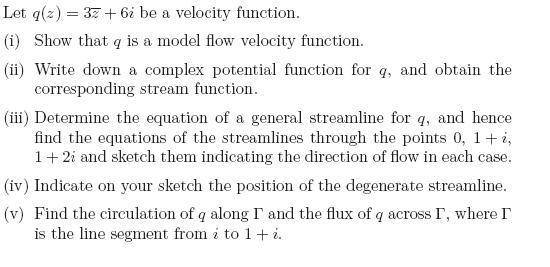
Click image for larger version

Name:	q2a.JPG
Views:	34
Size:	33.1 KB
ID:	10821

For part (ii) I have the complex potential function as (3x^2)/2 - (3y^2)/2 +6y and the stream function as x(3y-6). Is this correct and if so, how do I use these to calculate part (iii). In other words how can i determine the equation of a general streamline for q? Can someone please help me?


"Ignorance is always ready to admire itself. Procure yourself
critical friends."
Nicolas Boileau, 1674
PhysOrg.com
PhysOrg
science news on PhysOrg.com

>> King Richard III found in 'untidy lozenge-shaped grave'
>> Google Drive sports new view and scan enhancements
>> Researcher admits mistakes in stem cell study
Sep6-07, 06:24 AM   #2
 
Recognitions:
Gold Membership Gold Member
Science Advisor Science Advisor
Retired Staff Staff Emeritus
It's been a long time since I have done problems like that but here's how I would do it (perhaps awkwardly):
In the complex plane, writing z= x+ iy, the velocity function, [itex]q(z)= dx/dt+ i dy/dt= \overline{z}+ 6i= x- iy+ 6i= x+ (6-y)i[/itex] which gives the two differential equations dx/dt= 3x and dy/dt= 6- 3y. You can integrate those directly or divide one by the other to eliminate t and get dy/dx= (6-3y)/3x. I would be inclined to go ahead and cancel "3"s. dy/dx= (2-y)/x. That is a separable equation: dy/(2-y)= dx/x and integrating -ln(2-y)= ln(x)+ C or 1/(2-y)= C'x so x(2-y)= C', a family of hyperbolas. That is, except for a factor of 3 which is now incorporated in the constant, what you have for the stream lines. The "equi-potential" lines are always orthogonal to the stream lines so they are given by
dy/dx= -x/(2- y). (2-y)dy= -xdx so 2y- y2/2= -x2/2+ C That is the same as x2/2- y2/2+ 2y= C or x2- y2+ 4y= C' (C'= 2C), the family of hyperbolas orthogonal to the stream lines. That is also, except for the factor of 3, what you have.

To answer (c), determine C' in x(2-y)= C'. For example, the stream line through (0,0) has both x and y= 0 so 0(2-0)= C'. C'= 0 so x(2-y)= 0 which is only satisfied by (0,0) (that's your "degenerate" stream line). The stream line through 1+i= (1,1) has x=y= 1 so 1(2-1)= C'. C'= 1 and the stream line is the hyperbola x(2-y)= 1. From dx/dt= x, we see that, at x= 1> 0, x is increasing. The direction of flow is to the right.
Thread Closed
Thread Tools


Similar Threads for: Fluid Flows - Complex potential function and general equation of a streamline
Thread Forum Replies
Micro Flows Vs Normal Flows Mechanical Engineering 0
Equation of streamline Mechanical Engineering 0
Fluid Mechanics - Equations of motion circular flows Classical Physics 9
fluid mechanics-a gas flows into rigid container... Classical Physics 0